{"title":"免疫相关不良事件严重程度对一线免疫检查点抑制剂治疗老年非小细胞肺癌患者预后的影响","authors":"Ippei Miyamoto, Tetsuo Shimizu, Mizuki Hanamura, Yu Mizuno, Ryota Nakayama, Ryo Kusahana, Masayuki Nomoto, Yoshiko Nakagawa, Yasuhiro Gon","doi":"10.1111/1759-7714.70006","DOIUrl":null,"url":null,"abstract":"<p><strong>Background: </strong>Recently, the treatment needs of elderly lung cancer patients have become comparable with those of younger patients. This study evaluated the efficacy and safety of first-line immune checkpoint inhibitors (ICI) in elderly patients with nonsmall-cell lung cancer (NSCLC), stratified by immune-related adverse events (irAEs) severity, and identified key prognostic factors.</p><p><strong>Methods: </strong>This retrospective study targeted patients with advanced or recurrent NSCLC who received ICI therapy as first-line treatment between April 2017 and March 2023.</p><p><strong>Result: </strong>Of the 138 patients enrolled in this study, 81 and 57 patients were classified into the elderly (aged 70 and above) and nonelderly (under 70 years old) groups, respectively. Severe irAEs were significantly associated with shorter overall survival (OS) in the elderly group (severe irAEs vs. others, 9.9 vs. 24.7 months; p = 0.043) and favorable OS in nonelderly group (severe irAEs vs. others, NR [not reached] vs. 21.0 months, p = 0.026). The OS of patients with severe irAEs was significantly worse in the elderly group than in the nonelderly group (elderly group vs. nonelderly group, 9.9 vs. NR months, p = 0.001). In the multivariate analysis, mild irAEs were associated with a favorable prognosis in elderly patients (hazard ratio, 0.446; p = 0.032).</p><p><strong>Conclusion: </strong>Severe irAEs demonstrated different outcomes in elderly and nonelderly patients. Contrastingly, mild irAEs were associated with a favorable prognosis in elderly patients, emphasizing the need for appropriate patient selection, early intervention for irAEs and new tools to accurately predict irAE severity in elderly patients.</p>","PeriodicalId":23338,"journal":{"name":"Thoracic Cancer","volume":"16 3","pages":"e70006"},"PeriodicalIF":2.6000,"publicationDate":"2025-02-01","publicationTypes":"Journal Article","fieldsOfStudy":null,"isOpenAccess":false,"openAccessPdf":"https://www.ncbi.nlm.nih.gov/pmc/articles/PMC11790473/pdf/","citationCount":"0","resultStr":"{\"title\":\"The Impact of Immune-Related Adverse Event Severity on Prognosis in Elderly Patients With Nonsmall-Cell Lung Cancer in First-Line Immune Checkpoint Inhibitor Treatment.\",\"authors\":\"Ippei Miyamoto, Tetsuo Shimizu, Mizuki Hanamura, Yu Mizuno, Ryota Nakayama, Ryo Kusahana, Masayuki Nomoto, Yoshiko Nakagawa, Yasuhiro Gon\",\"doi\":\"10.1111/1759-7714.70006\",\"DOIUrl\":null,\"url\":null,\"abstract\":\"<p><strong>Background: </strong>Recently, the treatment needs of elderly lung cancer patients have become comparable with those of younger patients. This study evaluated the efficacy and safety of first-line immune checkpoint inhibitors (ICI) in elderly patients with nonsmall-cell lung cancer (NSCLC), stratified by immune-related adverse events (irAEs) severity, and identified key prognostic factors.</p><p><strong>Methods: </strong>This retrospective study targeted patients with advanced or recurrent NSCLC who received ICI therapy as first-line treatment between April 2017 and March 2023.</p><p><strong>Result: </strong>Of the 138 patients enrolled in this study, 81 and 57 patients were classified into the elderly (aged 70 and above) and nonelderly (under 70 years old) groups, respectively. Severe irAEs were significantly associated with shorter overall survival (OS) in the elderly group (severe irAEs vs. others, 9.9 vs. 24.7 months; p = 0.043) and favorable OS in nonelderly group (severe irAEs vs. others, NR [not reached] vs. 21.0 months, p = 0.026). The OS of patients with severe irAEs was significantly worse in the elderly group than in the nonelderly group (elderly group vs. nonelderly group, 9.9 vs. NR months, p = 0.001). In the multivariate analysis, mild irAEs were associated with a favorable prognosis in elderly patients (hazard ratio, 0.446; p = 0.032).</p><p><strong>Conclusion: </strong>Severe irAEs demonstrated different outcomes in elderly and nonelderly patients. Contrastingly, mild irAEs were associated with a favorable prognosis in elderly patients, emphasizing the need for appropriate patient selection, early intervention for irAEs and new tools to accurately predict irAE severity in elderly patients.</p>\",\"PeriodicalId\":23338,\"journal\":{\"name\":\"Thoracic Cancer\",\"volume\":\"16 3\",\"pages\":\"e70006\"},\"PeriodicalIF\":2.6000,\"publicationDate\":\"2025-02-01\",\"publicationTypes\":\"Journal Article\",\"fieldsOfStudy\":null,\"isOpenAccess\":false,\"openAccessPdf\":\"https://www.ncbi.nlm.nih.gov/pmc/articles/PMC11790473/pdf/\",\"citationCount\":\"0\",\"resultStr\":null,\"platform\":\"Semanticscholar\",\"paperid\":null,\"PeriodicalName\":\"Thoracic Cancer\",\"FirstCategoryId\":\"3\",\"ListUrlMain\":\"https://doi.org/10.1111/1759-7714.70006\",\"RegionNum\":3,\"RegionCategory\":\"医学\",\"ArticlePicture\":[],\"TitleCN\":null,\"AbstractTextCN\":null,\"PMCID\":null,\"EPubDate\":\"\",\"PubModel\":\"\",\"JCR\":\"Q3\",\"JCRName\":\"ONCOLOGY\",\"Score\":null,\"Total\":0}","platform":"Semanticscholar","paperid":null,"PeriodicalName":"Thoracic Cancer","FirstCategoryId":"3","ListUrlMain":"https://doi.org/10.1111/1759-7714.70006","RegionNum":3,"RegionCategory":"医学","ArticlePicture":[],"TitleCN":null,"AbstractTextCN":null,"PMCID":null,"EPubDate":"","PubModel":"","JCR":"Q3","JCRName":"ONCOLOGY","Score":null,"Total":0}
The Impact of Immune-Related Adverse Event Severity on Prognosis in Elderly Patients With Nonsmall-Cell Lung Cancer in First-Line Immune Checkpoint Inhibitor Treatment.
Background: Recently, the treatment needs of elderly lung cancer patients have become comparable with those of younger patients. This study evaluated the efficacy and safety of first-line immune checkpoint inhibitors (ICI) in elderly patients with nonsmall-cell lung cancer (NSCLC), stratified by immune-related adverse events (irAEs) severity, and identified key prognostic factors.
Methods: This retrospective study targeted patients with advanced or recurrent NSCLC who received ICI therapy as first-line treatment between April 2017 and March 2023.
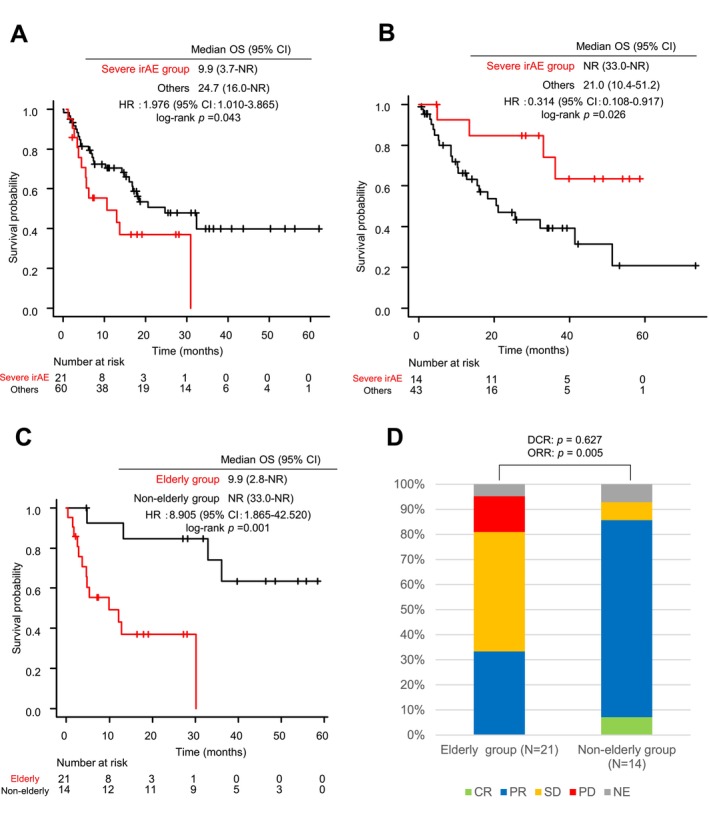
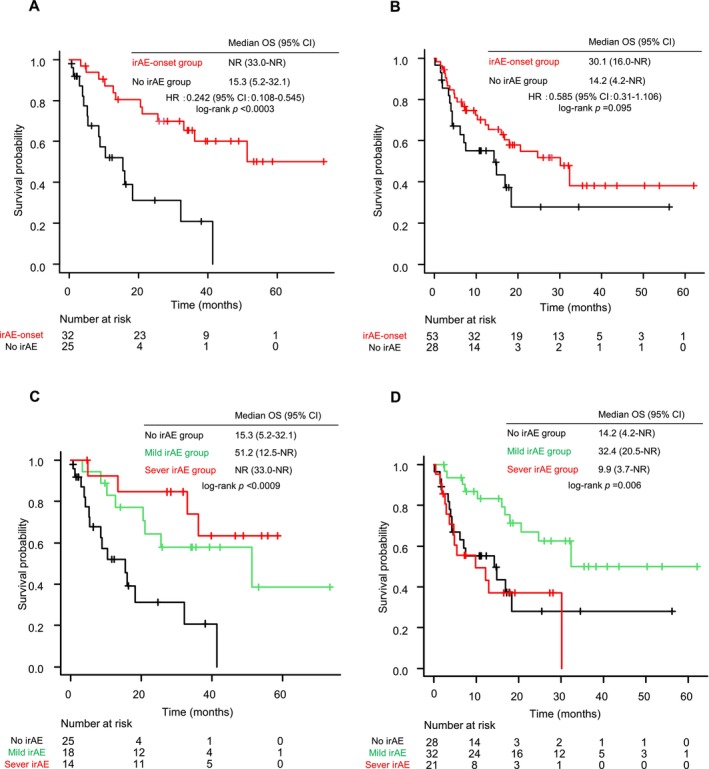
Result: Of the 138 patients enrolled in this study, 81 and 57 patients were classified into the elderly (aged 70 and above) and nonelderly (under 70 years old) groups, respectively. Severe irAEs were significantly associated with shorter overall survival (OS) in the elderly group (severe irAEs vs. others, 9.9 vs. 24.7 months; p = 0.043) and favorable OS in nonelderly group (severe irAEs vs. others, NR [not reached] vs. 21.0 months, p = 0.026). The OS of patients with severe irAEs was significantly worse in the elderly group than in the nonelderly group (elderly group vs. nonelderly group, 9.9 vs. NR months, p = 0.001). In the multivariate analysis, mild irAEs were associated with a favorable prognosis in elderly patients (hazard ratio, 0.446; p = 0.032).
Conclusion: Severe irAEs demonstrated different outcomes in elderly and nonelderly patients. Contrastingly, mild irAEs were associated with a favorable prognosis in elderly patients, emphasizing the need for appropriate patient selection, early intervention for irAEs and new tools to accurately predict irAE severity in elderly patients.
期刊介绍:
Thoracic Cancer aims to facilitate international collaboration and exchange of comprehensive and cutting-edge information on basic, translational, and applied clinical research in lung cancer, esophageal cancer, mediastinal cancer, breast cancer and other thoracic malignancies. Prevention, treatment and research relevant to Asia-Pacific is a focus area, but submissions from all regions are welcomed. The editors encourage contributions relevant to prevention, general thoracic surgery, medical oncology, radiology, radiation medicine, pathology, basic cancer research, as well as epidemiological and translational studies in thoracic cancer. Thoracic Cancer is the official publication of the Chinese Society of Lung Cancer, International Chinese Society of Thoracic Surgery and is endorsed by the Korean Association for the Study of Lung Cancer and the Hong Kong Cancer Therapy Society.
The Journal publishes a range of article types including: Editorials, Invited Reviews, Mini Reviews, Original Articles, Clinical Guidelines, Technological Notes, Imaging in thoracic cancer, Meeting Reports, Case Reports, Letters to the Editor, Commentaries, and Brief Reports.





 京公网安备 11010802042870号
京ICP备2023020795号-1
京公网安备 11010802042870号
京ICP备2023020795号-1

 分享
分享
 求助内容:
求助内容: 应助结果提醒方式:
 扫码关注我们
