Hyemin Jang, Daeun Shin, Heejin Yoo, Henrik Zetterberg, Kaj Blennow, Fernando Gonzalez-Ortiz, Nicholas J. Ashton, Theresa A. Day, Eun Hye Lee, Jihwan Yun, Duk L Na, Hee Jin Kim, Sung Hoon Kang, Ko Woon Kim, Si Eun Kim, Yeo Jin Kim, Yeshin Kim, Jaeho Kim, Chi-Hun Kim, Min Young Chun, Na Yeon Jung, Soo Hyun Cho, Jun Pyo Kim, Sang Won Seo, the K-ROAD study groups
{"title":"阿尔茨海默病血浆生物标志物在逐步生物标志物引导诊断中的差异作用","authors":"Hyemin Jang, Daeun Shin, Heejin Yoo, Henrik Zetterberg, Kaj Blennow, Fernando Gonzalez-Ortiz, Nicholas J. Ashton, Theresa A. Day, Eun Hye Lee, Jihwan Yun, Duk L Na, Hee Jin Kim, Sung Hoon Kang, Ko Woon Kim, Si Eun Kim, Yeo Jin Kim, Yeshin Kim, Jaeho Kim, Chi-Hun Kim, Min Young Chun, Na Yeon Jung, Soo Hyun Cho, Jun Pyo Kim, Sang Won Seo, the K-ROAD study groups","doi":"10.1002/alz.14526","DOIUrl":null,"url":null,"abstract":"<div>\n \n \n <section>\n \n <h3> INTRODUCTION</h3>\n \n <p>This study aimed to investigate the differential roles of various plasma biomarkers in a stepwise diagnostic strategy for Alzheimer's disease (AD).</p>\n </section>\n \n <section>\n \n <h3> METHODS</h3>\n \n <p>A total of 2984 participants, including 666 cognitively unimpaired (CU), 2032 with Alzheimer's clinical syndrome (ACS), and 286 non-ACS individuals, were recruited. Plasma amyloid beta (Aβ) 42/40, four phosphorylated tau (p-tau) epitopes, glial fibrillary acidic protein (GFAP), and neurofilament light chain (NfL) levels were measured using immunoassays.</p>\n </section>\n \n <section>\n \n <h3> RESULTS</h3>\n \n <p>NfL demonstrated fair to excellent accuracy in differentiating non-ACS from CU groups (area under the curve [AUC], 0.79 to 0.94). p-tau217 had the highest accuracy for identifying Aβ (AUC 0.94) and tau positron emission tomography status (AUC 0.91). In the ACS group, p-tau217 was the strongest predictor of cognitive decline (p < .001).</p>\n </section>\n \n <section>\n \n <h3> DISCUSSION</h3>\n \n <p>NfL may serve as a useful screening tool, while p-tau217 is particularly valuable for confirming AD pathology and prognosis.</p>\n </section>\n \n <section>\n \n <h3> Highlights</h3>\n \n <div>\n <ul>\n \n <li>Plasma NfL could screen for cognitive impairment.</li>\n \n <li>p-tau217 reliably detects AD pathology, regardless of diagnosis.</li>\n \n <li>p-tau217 and GFAP predict prognosis in ACS.</li>\n \n <li>Each plasma biomarker plays a distinct role in stepwise AD diagnostics.</li>\n </ul>\n </div>\n </section>\n </div>","PeriodicalId":7471,"journal":{"name":"Alzheimer's & Dementia","volume":"21 2","pages":""},"PeriodicalIF":11.1000,"publicationDate":"2025-02-05","publicationTypes":"Journal Article","fieldsOfStudy":null,"isOpenAccess":false,"openAccessPdf":"https://onlinelibrary.wiley.com/doi/epdf/10.1002/alz.14526","citationCount":"0","resultStr":"{\"title\":\"Differential roles of Alzheimer's disease plasma biomarkers in stepwise biomarker-guided diagnostics\",\"authors\":\"Hyemin Jang, Daeun Shin, Heejin Yoo, Henrik Zetterberg, Kaj Blennow, Fernando Gonzalez-Ortiz, Nicholas J. Ashton, Theresa A. Day, Eun Hye Lee, Jihwan Yun, Duk L Na, Hee Jin Kim, Sung Hoon Kang, Ko Woon Kim, Si Eun Kim, Yeo Jin Kim, Yeshin Kim, Jaeho Kim, Chi-Hun Kim, Min Young Chun, Na Yeon Jung, Soo Hyun Cho, Jun Pyo Kim, Sang Won Seo, the K-ROAD study groups\",\"doi\":\"10.1002/alz.14526\",\"DOIUrl\":null,\"url\":null,\"abstract\":\"<div>\\n \\n \\n <section>\\n \\n <h3> INTRODUCTION</h3>\\n \\n <p>This study aimed to investigate the differential roles of various plasma biomarkers in a stepwise diagnostic strategy for Alzheimer's disease (AD).</p>\\n </section>\\n \\n <section>\\n \\n <h3> METHODS</h3>\\n \\n <p>A total of 2984 participants, including 666 cognitively unimpaired (CU), 2032 with Alzheimer's clinical syndrome (ACS), and 286 non-ACS individuals, were recruited. Plasma amyloid beta (Aβ) 42/40, four phosphorylated tau (p-tau) epitopes, glial fibrillary acidic protein (GFAP), and neurofilament light chain (NfL) levels were measured using immunoassays.</p>\\n </section>\\n \\n <section>\\n \\n <h3> RESULTS</h3>\\n \\n <p>NfL demonstrated fair to excellent accuracy in differentiating non-ACS from CU groups (area under the curve [AUC], 0.79 to 0.94). p-tau217 had the highest accuracy for identifying Aβ (AUC 0.94) and tau positron emission tomography status (AUC 0.91). In the ACS group, p-tau217 was the strongest predictor of cognitive decline (p < .001).</p>\\n </section>\\n \\n <section>\\n \\n <h3> DISCUSSION</h3>\\n \\n <p>NfL may serve as a useful screening tool, while p-tau217 is particularly valuable for confirming AD pathology and prognosis.</p>\\n </section>\\n \\n <section>\\n \\n <h3> Highlights</h3>\\n \\n <div>\\n <ul>\\n \\n <li>Plasma NfL could screen for cognitive impairment.</li>\\n \\n <li>p-tau217 reliably detects AD pathology, regardless of diagnosis.</li>\\n \\n <li>p-tau217 and GFAP predict prognosis in ACS.</li>\\n \\n <li>Each plasma biomarker plays a distinct role in stepwise AD diagnostics.</li>\\n </ul>\\n </div>\\n </section>\\n </div>\",\"PeriodicalId\":7471,\"journal\":{\"name\":\"Alzheimer's & Dementia\",\"volume\":\"21 2\",\"pages\":\"\"},\"PeriodicalIF\":11.1000,\"publicationDate\":\"2025-02-05\",\"publicationTypes\":\"Journal Article\",\"fieldsOfStudy\":null,\"isOpenAccess\":false,\"openAccessPdf\":\"https://onlinelibrary.wiley.com/doi/epdf/10.1002/alz.14526\",\"citationCount\":\"0\",\"resultStr\":null,\"platform\":\"Semanticscholar\",\"paperid\":null,\"PeriodicalName\":\"Alzheimer's & Dementia\",\"FirstCategoryId\":\"3\",\"ListUrlMain\":\"https://alz-journals.onlinelibrary.wiley.com/doi/10.1002/alz.14526\",\"RegionNum\":1,\"RegionCategory\":\"医学\",\"ArticlePicture\":[],\"TitleCN\":null,\"AbstractTextCN\":null,\"PMCID\":null,\"EPubDate\":\"\",\"PubModel\":\"\",\"JCR\":\"Q1\",\"JCRName\":\"CLINICAL NEUROLOGY\",\"Score\":null,\"Total\":0}","platform":"Semanticscholar","paperid":null,"PeriodicalName":"Alzheimer's & Dementia","FirstCategoryId":"3","ListUrlMain":"https://alz-journals.onlinelibrary.wiley.com/doi/10.1002/alz.14526","RegionNum":1,"RegionCategory":"医学","ArticlePicture":[],"TitleCN":null,"AbstractTextCN":null,"PMCID":null,"EPubDate":"","PubModel":"","JCR":"Q1","JCRName":"CLINICAL NEUROLOGY","Score":null,"Total":0}
Differential roles of Alzheimer's disease plasma biomarkers in stepwise biomarker-guided diagnostics
INTRODUCTION
This study aimed to investigate the differential roles of various plasma biomarkers in a stepwise diagnostic strategy for Alzheimer's disease (AD).
METHODS
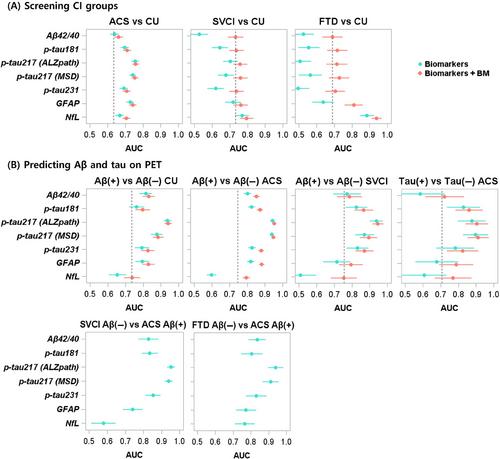
A total of 2984 participants, including 666 cognitively unimpaired (CU), 2032 with Alzheimer's clinical syndrome (ACS), and 286 non-ACS individuals, were recruited. Plasma amyloid beta (Aβ) 42/40, four phosphorylated tau (p-tau) epitopes, glial fibrillary acidic protein (GFAP), and neurofilament light chain (NfL) levels were measured using immunoassays.
RESULTS
NfL demonstrated fair to excellent accuracy in differentiating non-ACS from CU groups (area under the curve [AUC], 0.79 to 0.94). p-tau217 had the highest accuracy for identifying Aβ (AUC 0.94) and tau positron emission tomography status (AUC 0.91). In the ACS group, p-tau217 was the strongest predictor of cognitive decline (p < .001).
DISCUSSION
NfL may serve as a useful screening tool, while p-tau217 is particularly valuable for confirming AD pathology and prognosis.
Highlights
Plasma NfL could screen for cognitive impairment.
p-tau217 reliably detects AD pathology, regardless of diagnosis.
p-tau217 and GFAP predict prognosis in ACS.
Each plasma biomarker plays a distinct role in stepwise AD diagnostics.
期刊介绍:
Alzheimer's & Dementia is a peer-reviewed journal that aims to bridge knowledge gaps in dementia research by covering the entire spectrum, from basic science to clinical trials to social and behavioral investigations. It provides a platform for rapid communication of new findings and ideas, optimal translation of research into practical applications, increasing knowledge across diverse disciplines for early detection, diagnosis, and intervention, and identifying promising new research directions. In July 2008, Alzheimer's & Dementia was accepted for indexing by MEDLINE, recognizing its scientific merit and contribution to Alzheimer's research.






 京公网安备 11010802042870号
京ICP备2023020795号-1
京公网安备 11010802042870号
京ICP备2023020795号-1

 分享
分享
 求助内容:
求助内容: 应助结果提醒方式:
 扫码关注我们
