Manthan N. Patel, Sachchidanand Tiwari, Yufei Wang, Sarah O’Neill, Jichuan Wu, Serena Omo-Lamai, Carolann Espy, Liam S. Chase, Aparajeeta Majumder, Evan Hoffman, Anit Shah, András Sárközy, Jeremy Katzen, Norbert Pardi, Jacob S. Brenner
{"title":"使用装载内源性抗炎脂质的脂质纳米颗粒更安全的非病毒DNA递送","authors":"Manthan N. Patel, Sachchidanand Tiwari, Yufei Wang, Sarah O’Neill, Jichuan Wu, Serena Omo-Lamai, Carolann Espy, Liam S. Chase, Aparajeeta Majumder, Evan Hoffman, Anit Shah, András Sárközy, Jeremy Katzen, Norbert Pardi, Jacob S. Brenner","doi":"10.1038/s41587-025-02556-5","DOIUrl":null,"url":null,"abstract":"The value of lipid nanoparticles (LNPs) for delivery of messenger RNA (mRNA) was demonstrated by the coronavirus disease 2019 (COVID-19) mRNA vaccines, but the ability to use LNPs to deliver plasmid DNA (pDNA) would provide additional advantages, such as longer-term expression and availability of promoter sequences. However, pDNA-LNPs face substantial challenges, such as toxicity and low delivery efficiency. Here we show that pDNA-LNPs induce acute inflammation in naive mice that is primarily driven by the cGAS–STING pathway. Inspired by DNA viruses that inhibit this pathway for replication, we loaded endogenous lipids that inhibit STING into pDNA-LNPs. Loading nitro-oleic acid (NOA) into pDNA-LNPs (NOA-pDNA-LNPs) ameliorated serious inflammatory responses in vivo, enabling safer, prolonged transgene expression—11.5 times greater than that of mRNA-LNPs at day 32. Additionally, we performed a small LNP formulation screen to iteratively optimize transgene expression and increase expression 50-fold in vitro. pDNA-LNPs loaded with NOA and other bioactive molecules should advance genetic medicine by enabling longer-term and promoter-controlled transgene expression. Lipid nanoparticles carrying plasmid DNA and an inflammation inhibitor enable longer transgene expression than mRNA nanoparticles.","PeriodicalId":19084,"journal":{"name":"Nature biotechnology","volume":"44 1","pages":"79-89"},"PeriodicalIF":41.7000,"publicationDate":"2025-02-05","publicationTypes":"Journal Article","fieldsOfStudy":null,"isOpenAccess":false,"openAccessPdf":"","citationCount":"0","resultStr":"{\"title\":\"Safer non-viral DNA delivery using lipid nanoparticles loaded with endogenous anti-inflammatory lipids\",\"authors\":\"Manthan N. Patel, Sachchidanand Tiwari, Yufei Wang, Sarah O’Neill, Jichuan Wu, Serena Omo-Lamai, Carolann Espy, Liam S. Chase, Aparajeeta Majumder, Evan Hoffman, Anit Shah, András Sárközy, Jeremy Katzen, Norbert Pardi, Jacob S. Brenner\",\"doi\":\"10.1038/s41587-025-02556-5\",\"DOIUrl\":null,\"url\":null,\"abstract\":\"The value of lipid nanoparticles (LNPs) for delivery of messenger RNA (mRNA) was demonstrated by the coronavirus disease 2019 (COVID-19) mRNA vaccines, but the ability to use LNPs to deliver plasmid DNA (pDNA) would provide additional advantages, such as longer-term expression and availability of promoter sequences. However, pDNA-LNPs face substantial challenges, such as toxicity and low delivery efficiency. Here we show that pDNA-LNPs induce acute inflammation in naive mice that is primarily driven by the cGAS–STING pathway. Inspired by DNA viruses that inhibit this pathway for replication, we loaded endogenous lipids that inhibit STING into pDNA-LNPs. Loading nitro-oleic acid (NOA) into pDNA-LNPs (NOA-pDNA-LNPs) ameliorated serious inflammatory responses in vivo, enabling safer, prolonged transgene expression—11.5 times greater than that of mRNA-LNPs at day 32. Additionally, we performed a small LNP formulation screen to iteratively optimize transgene expression and increase expression 50-fold in vitro. pDNA-LNPs loaded with NOA and other bioactive molecules should advance genetic medicine by enabling longer-term and promoter-controlled transgene expression. Lipid nanoparticles carrying plasmid DNA and an inflammation inhibitor enable longer transgene expression than mRNA nanoparticles.\",\"PeriodicalId\":19084,\"journal\":{\"name\":\"Nature biotechnology\",\"volume\":\"44 1\",\"pages\":\"79-89\"},\"PeriodicalIF\":41.7000,\"publicationDate\":\"2025-02-05\",\"publicationTypes\":\"Journal Article\",\"fieldsOfStudy\":null,\"isOpenAccess\":false,\"openAccessPdf\":\"\",\"citationCount\":\"0\",\"resultStr\":null,\"platform\":\"Semanticscholar\",\"paperid\":null,\"PeriodicalName\":\"Nature biotechnology\",\"FirstCategoryId\":\"5\",\"ListUrlMain\":\"https://www.nature.com/articles/s41587-025-02556-5\",\"RegionNum\":1,\"RegionCategory\":\"生物学\",\"ArticlePicture\":[],\"TitleCN\":null,\"AbstractTextCN\":null,\"PMCID\":null,\"EPubDate\":\"\",\"PubModel\":\"\",\"JCR\":\"Q1\",\"JCRName\":\"BIOTECHNOLOGY & APPLIED MICROBIOLOGY\",\"Score\":null,\"Total\":0}","platform":"Semanticscholar","paperid":null,"PeriodicalName":"Nature biotechnology","FirstCategoryId":"5","ListUrlMain":"https://www.nature.com/articles/s41587-025-02556-5","RegionNum":1,"RegionCategory":"生物学","ArticlePicture":[],"TitleCN":null,"AbstractTextCN":null,"PMCID":null,"EPubDate":"","PubModel":"","JCR":"Q1","JCRName":"BIOTECHNOLOGY & APPLIED MICROBIOLOGY","Score":null,"Total":0}
Safer non-viral DNA delivery using lipid nanoparticles loaded with endogenous anti-inflammatory lipids
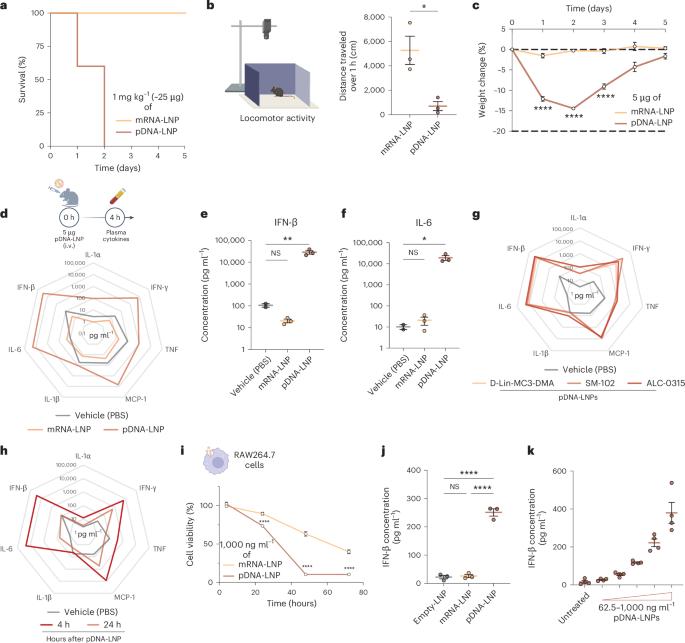
The value of lipid nanoparticles (LNPs) for delivery of messenger RNA (mRNA) was demonstrated by the coronavirus disease 2019 (COVID-19) mRNA vaccines, but the ability to use LNPs to deliver plasmid DNA (pDNA) would provide additional advantages, such as longer-term expression and availability of promoter sequences. However, pDNA-LNPs face substantial challenges, such as toxicity and low delivery efficiency. Here we show that pDNA-LNPs induce acute inflammation in naive mice that is primarily driven by the cGAS–STING pathway. Inspired by DNA viruses that inhibit this pathway for replication, we loaded endogenous lipids that inhibit STING into pDNA-LNPs. Loading nitro-oleic acid (NOA) into pDNA-LNPs (NOA-pDNA-LNPs) ameliorated serious inflammatory responses in vivo, enabling safer, prolonged transgene expression—11.5 times greater than that of mRNA-LNPs at day 32. Additionally, we performed a small LNP formulation screen to iteratively optimize transgene expression and increase expression 50-fold in vitro. pDNA-LNPs loaded with NOA and other bioactive molecules should advance genetic medicine by enabling longer-term and promoter-controlled transgene expression. Lipid nanoparticles carrying plasmid DNA and an inflammation inhibitor enable longer transgene expression than mRNA nanoparticles.
期刊介绍:
Nature Biotechnology is a monthly journal that focuses on the science and business of biotechnology. It covers a wide range of topics including technology/methodology advancements in the biological, biomedical, agricultural, and environmental sciences. The journal also explores the commercial, political, ethical, legal, and societal aspects of this research.
The journal serves researchers by providing peer-reviewed research papers in the field of biotechnology. It also serves the business community by delivering news about research developments. This approach ensures that both the scientific and business communities are well-informed and able to stay up-to-date on the latest advancements and opportunities in the field.
Some key areas of interest in which the journal actively seeks research papers include molecular engineering of nucleic acids and proteins, molecular therapy, large-scale biology, computational biology, regenerative medicine, imaging technology, analytical biotechnology, applied immunology, food and agricultural biotechnology, and environmental biotechnology.
In summary, Nature Biotechnology is a comprehensive journal that covers both the scientific and business aspects of biotechnology. It strives to provide researchers with valuable research papers and news while also delivering important scientific advancements to the business community.




 京公网安备 11010802042870号
京ICP备2023020795号-1
京公网安备 11010802042870号
京ICP备2023020795号-1

 分享
分享
 求助内容:
求助内容: 应助结果提醒方式:
 扫码关注我们
