Rui Liu;Yao Hu;Jibin Wu;Ka-Chun Wong;Zhi-An Huang;Yu-An Huang;Kay Chen Tan
{"title":"时空神经影像分析的动态图表示学习","authors":"Rui Liu;Yao Hu;Jibin Wu;Ka-Chun Wong;Zhi-An Huang;Yu-An Huang;Kay Chen Tan","doi":"10.1109/TCYB.2025.3531657","DOIUrl":null,"url":null,"abstract":"Neuroimaging analysis aims to reveal the information-processing mechanisms of the human brain in a noninvasive manner. In the past, graph neural networks (GNNs) have shown promise in capturing the non-Euclidean structure of brain networks. However, existing neuroimaging studies focused primarily on spatial functional connectivity, despite temporal dynamics in complex brain networks. To address this gap, we propose a spatio-temporal interactive graph representation framework (STIGR) for dynamic neuroimaging analysis that encompasses different aspects from classification and regression tasks to interpretation tasks. STIGR leverages a dynamic adaptive-neighbor graph convolution network to capture the interrelationships between spatial and temporal dynamics. To address the limited global scope in graph convolutions, a self-attention module based on Transformers is introduced to extract long-term dependencies. Contrastive learning is used to adaptively contrast similarities between adjacent scanning windows, modeling cross-temporal correlations in dynamic graphs. Extensive experiments on six public neuroimaging datasets demonstrate the competitive performance of STIGR across different platforms, achieving state-of-the-art results in classification and regression tasks. The proposed framework enables the detection of remarkable temporal association patterns between regions of interest based on sequential neuroimaging signals, offering medical professionals a versatile and interpretable tool for exploring task-specific neurological patterns. Our codes and models are available at <uri>https://github.com/77YQ77/STIGR/</uri>.","PeriodicalId":13112,"journal":{"name":"IEEE Transactions on Cybernetics","volume":"55 3","pages":"1121-1134"},"PeriodicalIF":10.5000,"publicationDate":"2025-02-04","publicationTypes":"Journal Article","fieldsOfStudy":null,"isOpenAccess":false,"openAccessPdf":"","citationCount":"0","resultStr":"{\"title\":\"Dynamic Graph Representation Learning for Spatio-Temporal Neuroimaging Analysis\",\"authors\":\"Rui Liu;Yao Hu;Jibin Wu;Ka-Chun Wong;Zhi-An Huang;Yu-An Huang;Kay Chen Tan\",\"doi\":\"10.1109/TCYB.2025.3531657\",\"DOIUrl\":null,\"url\":null,\"abstract\":\"Neuroimaging analysis aims to reveal the information-processing mechanisms of the human brain in a noninvasive manner. In the past, graph neural networks (GNNs) have shown promise in capturing the non-Euclidean structure of brain networks. However, existing neuroimaging studies focused primarily on spatial functional connectivity, despite temporal dynamics in complex brain networks. To address this gap, we propose a spatio-temporal interactive graph representation framework (STIGR) for dynamic neuroimaging analysis that encompasses different aspects from classification and regression tasks to interpretation tasks. STIGR leverages a dynamic adaptive-neighbor graph convolution network to capture the interrelationships between spatial and temporal dynamics. To address the limited global scope in graph convolutions, a self-attention module based on Transformers is introduced to extract long-term dependencies. Contrastive learning is used to adaptively contrast similarities between adjacent scanning windows, modeling cross-temporal correlations in dynamic graphs. Extensive experiments on six public neuroimaging datasets demonstrate the competitive performance of STIGR across different platforms, achieving state-of-the-art results in classification and regression tasks. The proposed framework enables the detection of remarkable temporal association patterns between regions of interest based on sequential neuroimaging signals, offering medical professionals a versatile and interpretable tool for exploring task-specific neurological patterns. Our codes and models are available at <uri>https://github.com/77YQ77/STIGR/</uri>.\",\"PeriodicalId\":13112,\"journal\":{\"name\":\"IEEE Transactions on Cybernetics\",\"volume\":\"55 3\",\"pages\":\"1121-1134\"},\"PeriodicalIF\":10.5000,\"publicationDate\":\"2025-02-04\",\"publicationTypes\":\"Journal Article\",\"fieldsOfStudy\":null,\"isOpenAccess\":false,\"openAccessPdf\":\"\",\"citationCount\":\"0\",\"resultStr\":null,\"platform\":\"Semanticscholar\",\"paperid\":null,\"PeriodicalName\":\"IEEE Transactions on Cybernetics\",\"FirstCategoryId\":\"94\",\"ListUrlMain\":\"https://ieeexplore.ieee.org/document/10870416/\",\"RegionNum\":1,\"RegionCategory\":\"计算机科学\",\"ArticlePicture\":[],\"TitleCN\":null,\"AbstractTextCN\":null,\"PMCID\":null,\"EPubDate\":\"\",\"PubModel\":\"\",\"JCR\":\"Q1\",\"JCRName\":\"AUTOMATION & CONTROL SYSTEMS\",\"Score\":null,\"Total\":0}","platform":"Semanticscholar","paperid":null,"PeriodicalName":"IEEE Transactions on Cybernetics","FirstCategoryId":"94","ListUrlMain":"https://ieeexplore.ieee.org/document/10870416/","RegionNum":1,"RegionCategory":"计算机科学","ArticlePicture":[],"TitleCN":null,"AbstractTextCN":null,"PMCID":null,"EPubDate":"","PubModel":"","JCR":"Q1","JCRName":"AUTOMATION & CONTROL SYSTEMS","Score":null,"Total":0}
Dynamic Graph Representation Learning for Spatio-Temporal Neuroimaging Analysis
Neuroimaging analysis aims to reveal the information-processing mechanisms of the human brain in a noninvasive manner. In the past, graph neural networks (GNNs) have shown promise in capturing the non-Euclidean structure of brain networks. However, existing neuroimaging studies focused primarily on spatial functional connectivity, despite temporal dynamics in complex brain networks. To address this gap, we propose a spatio-temporal interactive graph representation framework (STIGR) for dynamic neuroimaging analysis that encompasses different aspects from classification and regression tasks to interpretation tasks. STIGR leverages a dynamic adaptive-neighbor graph convolution network to capture the interrelationships between spatial and temporal dynamics. To address the limited global scope in graph convolutions, a self-attention module based on Transformers is introduced to extract long-term dependencies. Contrastive learning is used to adaptively contrast similarities between adjacent scanning windows, modeling cross-temporal correlations in dynamic graphs. Extensive experiments on six public neuroimaging datasets demonstrate the competitive performance of STIGR across different platforms, achieving state-of-the-art results in classification and regression tasks. The proposed framework enables the detection of remarkable temporal association patterns between regions of interest based on sequential neuroimaging signals, offering medical professionals a versatile and interpretable tool for exploring task-specific neurological patterns. Our codes and models are available at https://github.com/77YQ77/STIGR/.
期刊介绍:
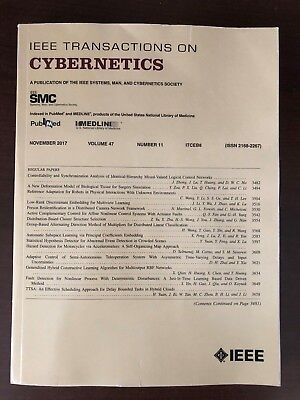
The scope of the IEEE Transactions on Cybernetics includes computational approaches to the field of cybernetics. Specifically, the transactions welcomes papers on communication and control across machines or machine, human, and organizations. The scope includes such areas as computational intelligence, computer vision, neural networks, genetic algorithms, machine learning, fuzzy systems, cognitive systems, decision making, and robotics, to the extent that they contribute to the theme of cybernetics or demonstrate an application of cybernetics principles.




 京公网安备 11010802042870号
京ICP备2023020795号-1
京公网安备 11010802042870号
京ICP备2023020795号-1

 分享
分享
 求助内容:
求助内容: 应助结果提醒方式:
 扫码关注我们
