{"title":"硫酸盐和磷酸盐四聚体定向的双螺旋链","authors":"Xianghua Lv, Xuemin Deng, Wei Zuo, Yue Wang, Chaochao Fan* and Chuandong Jia*, ","doi":"10.1021/acs.cgd.4c01486","DOIUrl":null,"url":null,"abstract":"<p >The assembly of helical structures with artificial molecules has been one of the focuses of supramolecular chemistry, while anion-based helical structures, especially infinite helical chains, have rarely been reported. Herein we present a strategy to assemble double-strand helical chains based on the anion coordination (hydrogen bonding in nature) of a <i>C</i><sub>2</sub>-symmetric bis-monourea ligand <b>L</b><sup>1</sup>, with a sulfate anion (<b>2</b>) or dihydrogen phosphate tetramers (<b>3</b>). Both of the assemblies were elucidated by single-crystal structures. Moreover, a control single-crystal structure, <b>1</b>, which was formed by one ligand <b>L</b><sup>1</sup> and two chloride ions, was also obtained for comparison, highlighting the necessity of the four coordination sites of the sulfate anion and dihydrogen phosphate tetramers for assembling the double-strand helical chains. The sulfate-based double-strand helix <b>2</b> was featured with absolute chirality as a result of the self-resolving crystallization. Within the chain-like structure of <b>2</b>, the V-shaped configuration of <b>L</b><sup>1</sup> led to the formation of cavities that are suitable for encapsulating TEA<sup>+</sup> cations through C–H···π interactions, thus making helix <b>2</b> appear as an infinite molecular train. Similarly, the anion-cluster dihydrogen phosphate tetramer, as an enlarged analogy of the sulfate anion, also providing four oxygen-based binding sites, induced another infinite molecular train <b>3</b> with the bigger TPA<sup>+</sup> cations loaded in the cavities. In contrast with the chiral structure of <b>2</b>, the structure of <b>3</b> is mesomeric, showing the sensitivity of the anionic helix toward the anion node.</p>","PeriodicalId":34,"journal":{"name":"Crystal Growth & Design","volume":"25 3","pages":"680–686 680–686"},"PeriodicalIF":3.4000,"publicationDate":"2025-01-27","publicationTypes":"Journal Article","fieldsOfStudy":null,"isOpenAccess":false,"openAccessPdf":"","citationCount":"0","resultStr":"{\"title\":\"Double-Helical Chain Directed by Sulfate and Phosphate Tetramers\",\"authors\":\"Xianghua Lv, Xuemin Deng, Wei Zuo, Yue Wang, Chaochao Fan* and Chuandong Jia*, \",\"doi\":\"10.1021/acs.cgd.4c01486\",\"DOIUrl\":null,\"url\":null,\"abstract\":\"<p >The assembly of helical structures with artificial molecules has been one of the focuses of supramolecular chemistry, while anion-based helical structures, especially infinite helical chains, have rarely been reported. Herein we present a strategy to assemble double-strand helical chains based on the anion coordination (hydrogen bonding in nature) of a <i>C</i><sub>2</sub>-symmetric bis-monourea ligand <b>L</b><sup>1</sup>, with a sulfate anion (<b>2</b>) or dihydrogen phosphate tetramers (<b>3</b>). Both of the assemblies were elucidated by single-crystal structures. Moreover, a control single-crystal structure, <b>1</b>, which was formed by one ligand <b>L</b><sup>1</sup> and two chloride ions, was also obtained for comparison, highlighting the necessity of the four coordination sites of the sulfate anion and dihydrogen phosphate tetramers for assembling the double-strand helical chains. The sulfate-based double-strand helix <b>2</b> was featured with absolute chirality as a result of the self-resolving crystallization. Within the chain-like structure of <b>2</b>, the V-shaped configuration of <b>L</b><sup>1</sup> led to the formation of cavities that are suitable for encapsulating TEA<sup>+</sup> cations through C–H···π interactions, thus making helix <b>2</b> appear as an infinite molecular train. Similarly, the anion-cluster dihydrogen phosphate tetramer, as an enlarged analogy of the sulfate anion, also providing four oxygen-based binding sites, induced another infinite molecular train <b>3</b> with the bigger TPA<sup>+</sup> cations loaded in the cavities. In contrast with the chiral structure of <b>2</b>, the structure of <b>3</b> is mesomeric, showing the sensitivity of the anionic helix toward the anion node.</p>\",\"PeriodicalId\":34,\"journal\":{\"name\":\"Crystal Growth & Design\",\"volume\":\"25 3\",\"pages\":\"680–686 680–686\"},\"PeriodicalIF\":3.4000,\"publicationDate\":\"2025-01-27\",\"publicationTypes\":\"Journal Article\",\"fieldsOfStudy\":null,\"isOpenAccess\":false,\"openAccessPdf\":\"\",\"citationCount\":\"0\",\"resultStr\":null,\"platform\":\"Semanticscholar\",\"paperid\":null,\"PeriodicalName\":\"Crystal Growth & Design\",\"FirstCategoryId\":\"92\",\"ListUrlMain\":\"https://pubs.acs.org/doi/10.1021/acs.cgd.4c01486\",\"RegionNum\":2,\"RegionCategory\":\"化学\",\"ArticlePicture\":[],\"TitleCN\":null,\"AbstractTextCN\":null,\"PMCID\":null,\"EPubDate\":\"\",\"PubModel\":\"\",\"JCR\":\"Q2\",\"JCRName\":\"CHEMISTRY, MULTIDISCIPLINARY\",\"Score\":null,\"Total\":0}","platform":"Semanticscholar","paperid":null,"PeriodicalName":"Crystal Growth & Design","FirstCategoryId":"92","ListUrlMain":"https://pubs.acs.org/doi/10.1021/acs.cgd.4c01486","RegionNum":2,"RegionCategory":"化学","ArticlePicture":[],"TitleCN":null,"AbstractTextCN":null,"PMCID":null,"EPubDate":"","PubModel":"","JCR":"Q2","JCRName":"CHEMISTRY, MULTIDISCIPLINARY","Score":null,"Total":0}
Double-Helical Chain Directed by Sulfate and Phosphate Tetramers
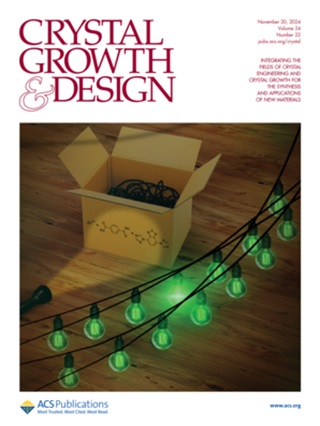
The assembly of helical structures with artificial molecules has been one of the focuses of supramolecular chemistry, while anion-based helical structures, especially infinite helical chains, have rarely been reported. Herein we present a strategy to assemble double-strand helical chains based on the anion coordination (hydrogen bonding in nature) of a C2-symmetric bis-monourea ligand L1, with a sulfate anion (2) or dihydrogen phosphate tetramers (3). Both of the assemblies were elucidated by single-crystal structures. Moreover, a control single-crystal structure, 1, which was formed by one ligand L1 and two chloride ions, was also obtained for comparison, highlighting the necessity of the four coordination sites of the sulfate anion and dihydrogen phosphate tetramers for assembling the double-strand helical chains. The sulfate-based double-strand helix 2 was featured with absolute chirality as a result of the self-resolving crystallization. Within the chain-like structure of 2, the V-shaped configuration of L1 led to the formation of cavities that are suitable for encapsulating TEA+ cations through C–H···π interactions, thus making helix 2 appear as an infinite molecular train. Similarly, the anion-cluster dihydrogen phosphate tetramer, as an enlarged analogy of the sulfate anion, also providing four oxygen-based binding sites, induced another infinite molecular train 3 with the bigger TPA+ cations loaded in the cavities. In contrast with the chiral structure of 2, the structure of 3 is mesomeric, showing the sensitivity of the anionic helix toward the anion node.
期刊介绍:
The aim of Crystal Growth & Design is to stimulate crossfertilization of knowledge among scientists and engineers working in the fields of crystal growth, crystal engineering, and the industrial application of crystalline materials.
Crystal Growth & Design publishes theoretical and experimental studies of the physical, chemical, and biological phenomena and processes related to the design, growth, and application of crystalline materials. Synergistic approaches originating from different disciplines and technologies and integrating the fields of crystal growth, crystal engineering, intermolecular interactions, and industrial application are encouraged.





 京公网安备 11010802042870号
京ICP备2023020795号-1
京公网安备 11010802042870号
京ICP备2023020795号-1

 分享
分享
 求助内容:
求助内容: 应助结果提醒方式:
 扫码关注我们
