Gautier Duroux, Matheus De Souza Lima Mendes, Iryna Makarchuk, Théo Lucante, Céline Kiefer, Sonia Buffière, François Weill, Walid Baaziz, Thierry Buffeteau, Sylvain Nlate, Reiko Oda, Patrick Rosa, Elizabeth A. Hillard*, Benoit P. Pichon* and Emilie Pouget*,
{"title":"氧化铁纳米颗粒手性诱导的挑战:在螺旋纳米平台上原位与非原位生长","authors":"Gautier Duroux, Matheus De Souza Lima Mendes, Iryna Makarchuk, Théo Lucante, Céline Kiefer, Sonia Buffière, François Weill, Walid Baaziz, Thierry Buffeteau, Sylvain Nlate, Reiko Oda, Patrick Rosa, Elizabeth A. Hillard*, Benoit P. Pichon* and Emilie Pouget*, ","doi":"10.1021/acs.cgd.4c01346","DOIUrl":null,"url":null,"abstract":"<p >The integration of chiral and magnetic properties has gained increasing interest due to its potential for enabling magneto-chiral phenomena. However, the development of nanoscale chiral systems that exhibit strong responsiveness to both light and magnetic fields remains largely underexplored. In this context, we investigate the use of silica nanohelices as a chiral platform for inducing circular dichroism (CD) in iron oxide nanoparticles (NPs). Two strategies are compared: an <i>ex situ</i> approach, where the NPs are synthesized independently and then grafted onto the helices, and an <i>in situ</i> approach, where the NPs are directly formed on the surface of the helices. This comparison enables us to evaluate the chirality induction arising from helicoidal assembly versus chiral shape, respectively. The efficiency of each strategy was assessed by electronic CD (ECD) and magnetic CD (MCD) spectroscopies. The results show that chirality induction on iron oxide nanocrystals is negligible with the <i>ex situ</i> method, whereas weak but unambiguous ECD signals are observed following the <i>in situ</i> approach. Furthermore, a comparative analysis of chirality induction in magnetite (Fe<sub>3</sub>O<sub>4</sub>) vs. maghemite (γ-Fe<sub>2</sub>O<sub>3</sub>) with both strategies is presented and discussed.</p>","PeriodicalId":34,"journal":{"name":"Crystal Growth & Design","volume":"25 3","pages":"603–611 603–611"},"PeriodicalIF":3.4000,"publicationDate":"2025-01-27","publicationTypes":"Journal Article","fieldsOfStudy":null,"isOpenAccess":false,"openAccessPdf":"","citationCount":"0","resultStr":"{\"title\":\"Challenges in Chirality Induction in Iron Oxide Nanoparticles: In Situ vs Ex Situ Growth on Helical Nanoplatforms\",\"authors\":\"Gautier Duroux, Matheus De Souza Lima Mendes, Iryna Makarchuk, Théo Lucante, Céline Kiefer, Sonia Buffière, François Weill, Walid Baaziz, Thierry Buffeteau, Sylvain Nlate, Reiko Oda, Patrick Rosa, Elizabeth A. Hillard*, Benoit P. Pichon* and Emilie Pouget*, \",\"doi\":\"10.1021/acs.cgd.4c01346\",\"DOIUrl\":null,\"url\":null,\"abstract\":\"<p >The integration of chiral and magnetic properties has gained increasing interest due to its potential for enabling magneto-chiral phenomena. However, the development of nanoscale chiral systems that exhibit strong responsiveness to both light and magnetic fields remains largely underexplored. In this context, we investigate the use of silica nanohelices as a chiral platform for inducing circular dichroism (CD) in iron oxide nanoparticles (NPs). Two strategies are compared: an <i>ex situ</i> approach, where the NPs are synthesized independently and then grafted onto the helices, and an <i>in situ</i> approach, where the NPs are directly formed on the surface of the helices. This comparison enables us to evaluate the chirality induction arising from helicoidal assembly versus chiral shape, respectively. The efficiency of each strategy was assessed by electronic CD (ECD) and magnetic CD (MCD) spectroscopies. The results show that chirality induction on iron oxide nanocrystals is negligible with the <i>ex situ</i> method, whereas weak but unambiguous ECD signals are observed following the <i>in situ</i> approach. Furthermore, a comparative analysis of chirality induction in magnetite (Fe<sub>3</sub>O<sub>4</sub>) vs. maghemite (γ-Fe<sub>2</sub>O<sub>3</sub>) with both strategies is presented and discussed.</p>\",\"PeriodicalId\":34,\"journal\":{\"name\":\"Crystal Growth & Design\",\"volume\":\"25 3\",\"pages\":\"603–611 603–611\"},\"PeriodicalIF\":3.4000,\"publicationDate\":\"2025-01-27\",\"publicationTypes\":\"Journal Article\",\"fieldsOfStudy\":null,\"isOpenAccess\":false,\"openAccessPdf\":\"\",\"citationCount\":\"0\",\"resultStr\":null,\"platform\":\"Semanticscholar\",\"paperid\":null,\"PeriodicalName\":\"Crystal Growth & Design\",\"FirstCategoryId\":\"92\",\"ListUrlMain\":\"https://pubs.acs.org/doi/10.1021/acs.cgd.4c01346\",\"RegionNum\":2,\"RegionCategory\":\"化学\",\"ArticlePicture\":[],\"TitleCN\":null,\"AbstractTextCN\":null,\"PMCID\":null,\"EPubDate\":\"\",\"PubModel\":\"\",\"JCR\":\"Q2\",\"JCRName\":\"CHEMISTRY, MULTIDISCIPLINARY\",\"Score\":null,\"Total\":0}","platform":"Semanticscholar","paperid":null,"PeriodicalName":"Crystal Growth & Design","FirstCategoryId":"92","ListUrlMain":"https://pubs.acs.org/doi/10.1021/acs.cgd.4c01346","RegionNum":2,"RegionCategory":"化学","ArticlePicture":[],"TitleCN":null,"AbstractTextCN":null,"PMCID":null,"EPubDate":"","PubModel":"","JCR":"Q2","JCRName":"CHEMISTRY, MULTIDISCIPLINARY","Score":null,"Total":0}
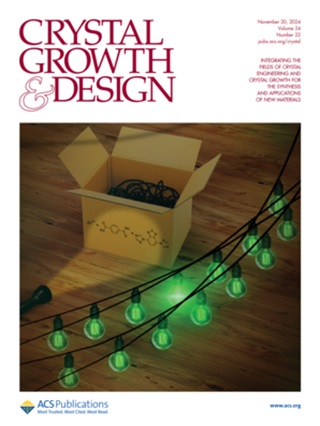
Challenges in Chirality Induction in Iron Oxide Nanoparticles: In Situ vs Ex Situ Growth on Helical Nanoplatforms
The integration of chiral and magnetic properties has gained increasing interest due to its potential for enabling magneto-chiral phenomena. However, the development of nanoscale chiral systems that exhibit strong responsiveness to both light and magnetic fields remains largely underexplored. In this context, we investigate the use of silica nanohelices as a chiral platform for inducing circular dichroism (CD) in iron oxide nanoparticles (NPs). Two strategies are compared: an ex situ approach, where the NPs are synthesized independently and then grafted onto the helices, and an in situ approach, where the NPs are directly formed on the surface of the helices. This comparison enables us to evaluate the chirality induction arising from helicoidal assembly versus chiral shape, respectively. The efficiency of each strategy was assessed by electronic CD (ECD) and magnetic CD (MCD) spectroscopies. The results show that chirality induction on iron oxide nanocrystals is negligible with the ex situ method, whereas weak but unambiguous ECD signals are observed following the in situ approach. Furthermore, a comparative analysis of chirality induction in magnetite (Fe3O4) vs. maghemite (γ-Fe2O3) with both strategies is presented and discussed.
期刊介绍:
The aim of Crystal Growth & Design is to stimulate crossfertilization of knowledge among scientists and engineers working in the fields of crystal growth, crystal engineering, and the industrial application of crystalline materials.
Crystal Growth & Design publishes theoretical and experimental studies of the physical, chemical, and biological phenomena and processes related to the design, growth, and application of crystalline materials. Synergistic approaches originating from different disciplines and technologies and integrating the fields of crystal growth, crystal engineering, intermolecular interactions, and industrial application are encouraged.





 京公网安备 11010802042870号
京ICP备2023020795号-1
京公网安备 11010802042870号
京ICP备2023020795号-1

 分享
分享
 求助内容:
求助内容: 应助结果提醒方式:
 扫码关注我们
