Imtej Singh Saggu, Mandeep Singh* and Sandeep Sharma*,
{"title":"WSe2对二甲基甲酰胺和苯胺的相依赖双分辨","authors":"Imtej Singh Saggu, Mandeep Singh* and Sandeep Sharma*, ","doi":"10.1021/acsaenm.4c00575","DOIUrl":null,"url":null,"abstract":"<p >Here, we report the room-temperature dual discrimination of <i>N</i>,<i>N</i>-dimethylformamide (DMF) and aniline using a 1T′/2H mixed phase tungsten diselenide (WSe<sub>2</sub>) chemiresistive gas sensor. Mixed phase WSe<sub>2</sub> microspheres were synthesized in a thermally controlled environment via a facile solvothermal method. Structural analysis using various characterization techniques confirmed the spherical flower-like morphology and presence of mixed phases. Further, a slight increase in the 1T′/2H ratio of WSe<sub>2</sub> showed a significant conductivity change, as confirmed using electrochemical impedance spectroscopy and two-terminal current voltage measurements. The sensing properties were investigated under varying relative humidity (40–90%) for two different devices made from WSe<sub>2</sub> synthesized at 200 and 220 °C, respectively. The sensing device created with WSe<sub>2</sub> synthesized at 200 °C exhibited response and recovery times of 157 and 68 s, respectively, for DMF (4 ppm). This device revealed a response of 2.77% toward 32 ppm DMF and a theoretically calculated limit of detection (LOD) of ∼114 ppb. The sensor created with WSe<sub>2</sub> synthesized at 220 °C displayed response and recovery times of 78 and 89 s, respectively, for aniline (3 ppm) under ambient conditions. This device exhibited a significant drop in response (0.04%) toward DMF in comparison to aniline and displayed a response of (1.07%) at room temperature with a calculated LOD of ∼250 ppb. The sensors showed higher resilience toward increased humidity levels. The absolutely clean, stable, and reproducible responses (2.35% and 1.61%) toward DMF and (0.9% and 0.66%) aniline vapors under relative humidities of 40% and 90%, respectively, confirm the durable behavior of the devices. The gas sensing mechanism was explained using appropriate energy level diagrams, as well as adequate surface reactions, which were then validated using the gas chromatography–mass spectroscopy (GC-MS) approach. The present work emphasizes a straightforward and facile approach to develop 1T′/2H mixed phase WSe<sub>2</sub> for the dual detection of DMF and aniline under ambient conditions.</p>","PeriodicalId":55639,"journal":{"name":"ACS Applied Engineering Materials","volume":"2 12","pages":"2885–2898 2885–2898"},"PeriodicalIF":3.5000,"publicationDate":"2024-11-15","publicationTypes":"Journal Article","fieldsOfStudy":null,"isOpenAccess":false,"openAccessPdf":"","citationCount":"0","resultStr":"{\"title\":\"Phase-Dependent Dual Discrimination of WSe2 toward Dimethylformamide and Aniline\",\"authors\":\"Imtej Singh Saggu, Mandeep Singh* and Sandeep Sharma*, \",\"doi\":\"10.1021/acsaenm.4c00575\",\"DOIUrl\":null,\"url\":null,\"abstract\":\"<p >Here, we report the room-temperature dual discrimination of <i>N</i>,<i>N</i>-dimethylformamide (DMF) and aniline using a 1T′/2H mixed phase tungsten diselenide (WSe<sub>2</sub>) chemiresistive gas sensor. Mixed phase WSe<sub>2</sub> microspheres were synthesized in a thermally controlled environment via a facile solvothermal method. Structural analysis using various characterization techniques confirmed the spherical flower-like morphology and presence of mixed phases. Further, a slight increase in the 1T′/2H ratio of WSe<sub>2</sub> showed a significant conductivity change, as confirmed using electrochemical impedance spectroscopy and two-terminal current voltage measurements. The sensing properties were investigated under varying relative humidity (40–90%) for two different devices made from WSe<sub>2</sub> synthesized at 200 and 220 °C, respectively. The sensing device created with WSe<sub>2</sub> synthesized at 200 °C exhibited response and recovery times of 157 and 68 s, respectively, for DMF (4 ppm). This device revealed a response of 2.77% toward 32 ppm DMF and a theoretically calculated limit of detection (LOD) of ∼114 ppb. The sensor created with WSe<sub>2</sub> synthesized at 220 °C displayed response and recovery times of 78 and 89 s, respectively, for aniline (3 ppm) under ambient conditions. This device exhibited a significant drop in response (0.04%) toward DMF in comparison to aniline and displayed a response of (1.07%) at room temperature with a calculated LOD of ∼250 ppb. The sensors showed higher resilience toward increased humidity levels. The absolutely clean, stable, and reproducible responses (2.35% and 1.61%) toward DMF and (0.9% and 0.66%) aniline vapors under relative humidities of 40% and 90%, respectively, confirm the durable behavior of the devices. The gas sensing mechanism was explained using appropriate energy level diagrams, as well as adequate surface reactions, which were then validated using the gas chromatography–mass spectroscopy (GC-MS) approach. The present work emphasizes a straightforward and facile approach to develop 1T′/2H mixed phase WSe<sub>2</sub> for the dual detection of DMF and aniline under ambient conditions.</p>\",\"PeriodicalId\":55639,\"journal\":{\"name\":\"ACS Applied Engineering Materials\",\"volume\":\"2 12\",\"pages\":\"2885–2898 2885–2898\"},\"PeriodicalIF\":3.5000,\"publicationDate\":\"2024-11-15\",\"publicationTypes\":\"Journal Article\",\"fieldsOfStudy\":null,\"isOpenAccess\":false,\"openAccessPdf\":\"\",\"citationCount\":\"0\",\"resultStr\":null,\"platform\":\"Semanticscholar\",\"paperid\":null,\"PeriodicalName\":\"ACS Applied Engineering Materials\",\"FirstCategoryId\":\"1085\",\"ListUrlMain\":\"https://pubs.acs.org/doi/10.1021/acsaenm.4c00575\",\"RegionNum\":0,\"RegionCategory\":null,\"ArticlePicture\":[],\"TitleCN\":null,\"AbstractTextCN\":null,\"PMCID\":null,\"EPubDate\":\"\",\"PubModel\":\"\",\"JCR\":\"\",\"JCRName\":\"\",\"Score\":null,\"Total\":0}","platform":"Semanticscholar","paperid":null,"PeriodicalName":"ACS Applied Engineering Materials","FirstCategoryId":"1085","ListUrlMain":"https://pubs.acs.org/doi/10.1021/acsaenm.4c00575","RegionNum":0,"RegionCategory":null,"ArticlePicture":[],"TitleCN":null,"AbstractTextCN":null,"PMCID":null,"EPubDate":"","PubModel":"","JCR":"","JCRName":"","Score":null,"Total":0}
Phase-Dependent Dual Discrimination of WSe2 toward Dimethylformamide and Aniline
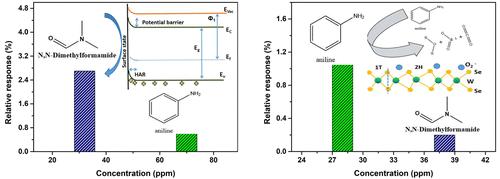
Here, we report the room-temperature dual discrimination of N,N-dimethylformamide (DMF) and aniline using a 1T′/2H mixed phase tungsten diselenide (WSe2) chemiresistive gas sensor. Mixed phase WSe2 microspheres were synthesized in a thermally controlled environment via a facile solvothermal method. Structural analysis using various characterization techniques confirmed the spherical flower-like morphology and presence of mixed phases. Further, a slight increase in the 1T′/2H ratio of WSe2 showed a significant conductivity change, as confirmed using electrochemical impedance spectroscopy and two-terminal current voltage measurements. The sensing properties were investigated under varying relative humidity (40–90%) for two different devices made from WSe2 synthesized at 200 and 220 °C, respectively. The sensing device created with WSe2 synthesized at 200 °C exhibited response and recovery times of 157 and 68 s, respectively, for DMF (4 ppm). This device revealed a response of 2.77% toward 32 ppm DMF and a theoretically calculated limit of detection (LOD) of ∼114 ppb. The sensor created with WSe2 synthesized at 220 °C displayed response and recovery times of 78 and 89 s, respectively, for aniline (3 ppm) under ambient conditions. This device exhibited a significant drop in response (0.04%) toward DMF in comparison to aniline and displayed a response of (1.07%) at room temperature with a calculated LOD of ∼250 ppb. The sensors showed higher resilience toward increased humidity levels. The absolutely clean, stable, and reproducible responses (2.35% and 1.61%) toward DMF and (0.9% and 0.66%) aniline vapors under relative humidities of 40% and 90%, respectively, confirm the durable behavior of the devices. The gas sensing mechanism was explained using appropriate energy level diagrams, as well as adequate surface reactions, which were then validated using the gas chromatography–mass spectroscopy (GC-MS) approach. The present work emphasizes a straightforward and facile approach to develop 1T′/2H mixed phase WSe2 for the dual detection of DMF and aniline under ambient conditions.
期刊介绍:
ACS Applied Engineering Materials is an international and interdisciplinary forum devoted to original research covering all aspects of engineered materials complementing the ACS Applied Materials portfolio. Papers that describe theory simulation modeling or machine learning assisted design of materials and that provide new insights into engineering applications are welcomed. The journal also considers experimental research that includes novel methods of preparing characterizing and evaluating new materials designed for timely applications. With its focus on innovative applications ACS Applied Engineering Materials also complements and expands the scope of existing ACS publications that focus on materials science discovery including Biomacromolecules Chemistry of Materials Crystal Growth & Design Industrial & Engineering Chemistry Research Inorganic Chemistry Langmuir and Macromolecules.The scope of ACS Applied Engineering Materials includes high quality research of an applied nature that integrates knowledge in materials science engineering physics mechanics and chemistry.




 京公网安备 11010802042870号
京ICP备2023020795号-1
京公网安备 11010802042870号
京ICP备2023020795号-1

 分享
分享
 求助内容:
求助内容: 应助结果提醒方式:
 扫码关注我们
