{"title":"Eu3+掺杂单晶中的声子辅助光致发光激发(PLE)光谱","authors":"Fangyan Wang, Fei Liang*, Fangli Jing, Dazhi Lu, Haohai Yu*, Huaijin Zhang* and Yicheng Wu, ","doi":"10.1021/acs.cgd.4c01658","DOIUrl":null,"url":null,"abstract":"<p >The europium (Eu<sup>3+</sup>) ion is an important lanthanide cation for rare-earth phosphors, with red emission around 620 nm. It exhibits two typical hypersensitive transitions, namely, absorbed <sup>7</sup>F<sub>0</sub> → <sup>5</sup>D<sub>2</sub> and emitted <sup>5</sup>D<sub>0</sub> → <sup>7</sup>F<sub>2</sub>, where the transition electric dipole intensities among electron levels are strongly correlated to ligands and lattices. This case indicates that Eu<sup>3+</sup> should be an excellent fluorescence probe to investigate the weak and sensitive electron–phonon coupling effect in 4f–4f transitions. Here, we established a qualitative relation between the hypersensitive transitions and electron–phonon coupling by two parameters, bond length and average polarizability of ligand, that short length and large polarizability are beneficial for strengthened electron–phonon coupling. In addition, we grew three Eu<sup>3+</sup>-doped crystals: Eu:La<sub>2</sub>CaB<sub>10</sub>O<sub>19</sub>, Eu:Lu<sub>2</sub>O<sub>3</sub>, and Eu:Y<sub>2</sub>O(SiO<sub>4</sub>), and measured their photoluminescence-excited (PLE) and photoluminescence (PL) spectra, respectively. We found clear phonon sidebands in their PLE spectra, with some satellites at shorter wavelengths associated with phonon-assisted excitation. Based on the calculated Huang–Rhys factors, we demonstrated that the special “free-oxygen” motif in Eu:Y<sub>2</sub>O(SiO<sub>4</sub>) is beneficial for strengthening phonon-assisted excitations. This work provides a helpful guideline for searching for strong electron–phonon coupling crystals in rare-earth materials.</p>","PeriodicalId":34,"journal":{"name":"Crystal Growth & Design","volume":"25 3","pages":"838–848 838–848"},"PeriodicalIF":3.6000,"publicationDate":"2025-01-27","publicationTypes":"Journal Article","fieldsOfStudy":null,"isOpenAccess":false,"openAccessPdf":"","citationCount":"0","resultStr":"{\"title\":\"Phonon-Assisted Photoluminescence-Excited (PLE) Spectrum in Eu3+-Doped Single Crystals\",\"authors\":\"Fangyan Wang, Fei Liang*, Fangli Jing, Dazhi Lu, Haohai Yu*, Huaijin Zhang* and Yicheng Wu, \",\"doi\":\"10.1021/acs.cgd.4c01658\",\"DOIUrl\":null,\"url\":null,\"abstract\":\"<p >The europium (Eu<sup>3+</sup>) ion is an important lanthanide cation for rare-earth phosphors, with red emission around 620 nm. It exhibits two typical hypersensitive transitions, namely, absorbed <sup>7</sup>F<sub>0</sub> → <sup>5</sup>D<sub>2</sub> and emitted <sup>5</sup>D<sub>0</sub> → <sup>7</sup>F<sub>2</sub>, where the transition electric dipole intensities among electron levels are strongly correlated to ligands and lattices. This case indicates that Eu<sup>3+</sup> should be an excellent fluorescence probe to investigate the weak and sensitive electron–phonon coupling effect in 4f–4f transitions. Here, we established a qualitative relation between the hypersensitive transitions and electron–phonon coupling by two parameters, bond length and average polarizability of ligand, that short length and large polarizability are beneficial for strengthened electron–phonon coupling. In addition, we grew three Eu<sup>3+</sup>-doped crystals: Eu:La<sub>2</sub>CaB<sub>10</sub>O<sub>19</sub>, Eu:Lu<sub>2</sub>O<sub>3</sub>, and Eu:Y<sub>2</sub>O(SiO<sub>4</sub>), and measured their photoluminescence-excited (PLE) and photoluminescence (PL) spectra, respectively. We found clear phonon sidebands in their PLE spectra, with some satellites at shorter wavelengths associated with phonon-assisted excitation. Based on the calculated Huang–Rhys factors, we demonstrated that the special “free-oxygen” motif in Eu:Y<sub>2</sub>O(SiO<sub>4</sub>) is beneficial for strengthening phonon-assisted excitations. This work provides a helpful guideline for searching for strong electron–phonon coupling crystals in rare-earth materials.</p>\",\"PeriodicalId\":34,\"journal\":{\"name\":\"Crystal Growth & Design\",\"volume\":\"25 3\",\"pages\":\"838–848 838–848\"},\"PeriodicalIF\":3.6000,\"publicationDate\":\"2025-01-27\",\"publicationTypes\":\"Journal Article\",\"fieldsOfStudy\":null,\"isOpenAccess\":false,\"openAccessPdf\":\"\",\"citationCount\":\"0\",\"resultStr\":null,\"platform\":\"Semanticscholar\",\"paperid\":null,\"PeriodicalName\":\"Crystal Growth & Design\",\"FirstCategoryId\":\"92\",\"ListUrlMain\":\"https://pubs.acs.org/doi/10.1021/acs.cgd.4c01658\",\"RegionNum\":2,\"RegionCategory\":\"化学\",\"ArticlePicture\":[],\"TitleCN\":null,\"AbstractTextCN\":null,\"PMCID\":null,\"EPubDate\":\"\",\"PubModel\":\"\",\"JCR\":\"Q2\",\"JCRName\":\"CHEMISTRY, MULTIDISCIPLINARY\",\"Score\":null,\"Total\":0}","platform":"Semanticscholar","paperid":null,"PeriodicalName":"Crystal Growth & Design","FirstCategoryId":"92","ListUrlMain":"https://pubs.acs.org/doi/10.1021/acs.cgd.4c01658","RegionNum":2,"RegionCategory":"化学","ArticlePicture":[],"TitleCN":null,"AbstractTextCN":null,"PMCID":null,"EPubDate":"","PubModel":"","JCR":"Q2","JCRName":"CHEMISTRY, MULTIDISCIPLINARY","Score":null,"Total":0}
Phonon-Assisted Photoluminescence-Excited (PLE) Spectrum in Eu3+-Doped Single Crystals
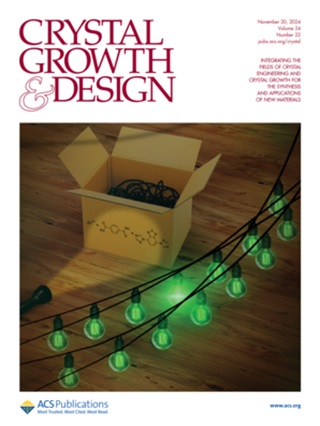
The europium (Eu3+) ion is an important lanthanide cation for rare-earth phosphors, with red emission around 620 nm. It exhibits two typical hypersensitive transitions, namely, absorbed 7F0 → 5D2 and emitted 5D0 → 7F2, where the transition electric dipole intensities among electron levels are strongly correlated to ligands and lattices. This case indicates that Eu3+ should be an excellent fluorescence probe to investigate the weak and sensitive electron–phonon coupling effect in 4f–4f transitions. Here, we established a qualitative relation between the hypersensitive transitions and electron–phonon coupling by two parameters, bond length and average polarizability of ligand, that short length and large polarizability are beneficial for strengthened electron–phonon coupling. In addition, we grew three Eu3+-doped crystals: Eu:La2CaB10O19, Eu:Lu2O3, and Eu:Y2O(SiO4), and measured their photoluminescence-excited (PLE) and photoluminescence (PL) spectra, respectively. We found clear phonon sidebands in their PLE spectra, with some satellites at shorter wavelengths associated with phonon-assisted excitation. Based on the calculated Huang–Rhys factors, we demonstrated that the special “free-oxygen” motif in Eu:Y2O(SiO4) is beneficial for strengthening phonon-assisted excitations. This work provides a helpful guideline for searching for strong electron–phonon coupling crystals in rare-earth materials.
期刊介绍:
The aim of Crystal Growth & Design is to stimulate crossfertilization of knowledge among scientists and engineers working in the fields of crystal growth, crystal engineering, and the industrial application of crystalline materials.
Crystal Growth & Design publishes theoretical and experimental studies of the physical, chemical, and biological phenomena and processes related to the design, growth, and application of crystalline materials. Synergistic approaches originating from different disciplines and technologies and integrating the fields of crystal growth, crystal engineering, intermolecular interactions, and industrial application are encouraged.





 京公网安备 11010802042870号
京ICP备2023020795号-1
京公网安备 11010802042870号
京ICP备2023020795号-1

 分享
分享
 求助内容:
求助内容: 应助结果提醒方式:
 扫码关注我们
