Baolin Liu , Zibin Liu , Xianglong Li , Haokun Xiao , Jingting Deng , Shuxia Li , Yongqiang Yang , Huilin Liu , Changhui Song
{"title":"致密熔融造粒制粒筒温度场及成形性的实验研究","authors":"Baolin Liu , Zibin Liu , Xianglong Li , Haokun Xiao , Jingting Deng , Shuxia Li , Yongqiang Yang , Huilin Liu , Changhui Song","doi":"10.1016/j.jmapro.2025.01.009","DOIUrl":null,"url":null,"abstract":"<div><div>To address the problems of material agglomeration caused by unreasonable temperature field in compact screw extruders, an original Heat Break-like Structure (HBS) was introduced to realize accurate zonal control of the temperature field within the barrel. A novel barrel was iteratively designed through temperature field simulation. The temperature gradient across the feeding zone can be linearly adjusted by altering the internal wall thickness and the external wall depth of HBS. After optimization, the overall length of the device was reduced by 30 %, and the temperature difference across feeding zone reached 30.9 °C, 6.92 times higher than that of traditional structure. In addition, the PLA material was formed by an iteratively optimized Fused Granulation Fabrication (FGF) barrel. The tensile strength reached 41.67 MPa when the feed temperature was 160 °C and the printing temperature was 195 °C. However, the tensile strength dropped to 34.25 MPa when the feed temperature was 155 °C and the printing temperature was 210 °C. The iterative development of this novel compact FGF device eliminates the need for filament preparation, simplifying the manufacturing process, and holds great significance for achieving a low-carbon economy.</div></div>","PeriodicalId":16148,"journal":{"name":"Journal of Manufacturing Processes","volume":"134 ","pages":"Pages 697-708"},"PeriodicalIF":6.8000,"publicationDate":"2025-01-31","publicationTypes":"Journal Article","fieldsOfStudy":null,"isOpenAccess":false,"openAccessPdf":"","citationCount":"0","resultStr":"{\"title\":\"Experimental investigation of temperature field and formability of compact fused granulation fabrication barrel\",\"authors\":\"Baolin Liu , Zibin Liu , Xianglong Li , Haokun Xiao , Jingting Deng , Shuxia Li , Yongqiang Yang , Huilin Liu , Changhui Song\",\"doi\":\"10.1016/j.jmapro.2025.01.009\",\"DOIUrl\":null,\"url\":null,\"abstract\":\"<div><div>To address the problems of material agglomeration caused by unreasonable temperature field in compact screw extruders, an original Heat Break-like Structure (HBS) was introduced to realize accurate zonal control of the temperature field within the barrel. A novel barrel was iteratively designed through temperature field simulation. The temperature gradient across the feeding zone can be linearly adjusted by altering the internal wall thickness and the external wall depth of HBS. After optimization, the overall length of the device was reduced by 30 %, and the temperature difference across feeding zone reached 30.9 °C, 6.92 times higher than that of traditional structure. In addition, the PLA material was formed by an iteratively optimized Fused Granulation Fabrication (FGF) barrel. The tensile strength reached 41.67 MPa when the feed temperature was 160 °C and the printing temperature was 195 °C. However, the tensile strength dropped to 34.25 MPa when the feed temperature was 155 °C and the printing temperature was 210 °C. The iterative development of this novel compact FGF device eliminates the need for filament preparation, simplifying the manufacturing process, and holds great significance for achieving a low-carbon economy.</div></div>\",\"PeriodicalId\":16148,\"journal\":{\"name\":\"Journal of Manufacturing Processes\",\"volume\":\"134 \",\"pages\":\"Pages 697-708\"},\"PeriodicalIF\":6.8000,\"publicationDate\":\"2025-01-31\",\"publicationTypes\":\"Journal Article\",\"fieldsOfStudy\":null,\"isOpenAccess\":false,\"openAccessPdf\":\"\",\"citationCount\":\"0\",\"resultStr\":null,\"platform\":\"Semanticscholar\",\"paperid\":null,\"PeriodicalName\":\"Journal of Manufacturing Processes\",\"FirstCategoryId\":\"5\",\"ListUrlMain\":\"https://www.sciencedirect.com/science/article/pii/S1526612525000155\",\"RegionNum\":1,\"RegionCategory\":\"工程技术\",\"ArticlePicture\":[],\"TitleCN\":null,\"AbstractTextCN\":null,\"PMCID\":null,\"EPubDate\":\"2025/1/8 0:00:00\",\"PubModel\":\"Epub\",\"JCR\":\"Q1\",\"JCRName\":\"ENGINEERING, MANUFACTURING\",\"Score\":null,\"Total\":0}","platform":"Semanticscholar","paperid":null,"PeriodicalName":"Journal of Manufacturing Processes","FirstCategoryId":"5","ListUrlMain":"https://www.sciencedirect.com/science/article/pii/S1526612525000155","RegionNum":1,"RegionCategory":"工程技术","ArticlePicture":[],"TitleCN":null,"AbstractTextCN":null,"PMCID":null,"EPubDate":"2025/1/8 0:00:00","PubModel":"Epub","JCR":"Q1","JCRName":"ENGINEERING, MANUFACTURING","Score":null,"Total":0}
Experimental investigation of temperature field and formability of compact fused granulation fabrication barrel
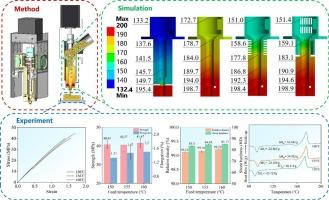
To address the problems of material agglomeration caused by unreasonable temperature field in compact screw extruders, an original Heat Break-like Structure (HBS) was introduced to realize accurate zonal control of the temperature field within the barrel. A novel barrel was iteratively designed through temperature field simulation. The temperature gradient across the feeding zone can be linearly adjusted by altering the internal wall thickness and the external wall depth of HBS. After optimization, the overall length of the device was reduced by 30 %, and the temperature difference across feeding zone reached 30.9 °C, 6.92 times higher than that of traditional structure. In addition, the PLA material was formed by an iteratively optimized Fused Granulation Fabrication (FGF) barrel. The tensile strength reached 41.67 MPa when the feed temperature was 160 °C and the printing temperature was 195 °C. However, the tensile strength dropped to 34.25 MPa when the feed temperature was 155 °C and the printing temperature was 210 °C. The iterative development of this novel compact FGF device eliminates the need for filament preparation, simplifying the manufacturing process, and holds great significance for achieving a low-carbon economy.
期刊介绍:
The aim of the Journal of Manufacturing Processes (JMP) is to exchange current and future directions of manufacturing processes research, development and implementation, and to publish archival scholarly literature with a view to advancing state-of-the-art manufacturing processes and encouraging innovation for developing new and efficient processes. The journal will also publish from other research communities for rapid communication of innovative new concepts. Special-topic issues on emerging technologies and invited papers will also be published.





 京公网安备 11010802042870号
京ICP备2023020795号-1
京公网安备 11010802042870号
京ICP备2023020795号-1

 分享
分享
 求助内容:
求助内容: 应助结果提醒方式:
 扫码关注我们
