Jing Yang , Xia Wang , Di Cheng , Chong Li , Zhe Qin , Huaixia Yang
{"title":"基于Novozym 435酶开环聚合的电化学生物传感器检测CEA","authors":"Jing Yang , Xia Wang , Di Cheng , Chong Li , Zhe Qin , Huaixia Yang","doi":"10.1016/j.jelechem.2024.118846","DOIUrl":null,"url":null,"abstract":"<div><div>Carcinoembryonic antigen (CEA) is a broad-spectrum tumour marker, with its concentration levels serving as a crucial predictor of cancer diagnosis. In this study, we synthesized a polycaprolactone (PCL) macromolecular polymer via enzyme ring-opening polymerization (eROP). This polymer was then utilized as a signal amplification element in the “sandwich structure” electrochemical impedance biosensor designed for CEA detection. Initially, 3-mercaptopropionic acid (MPA) was self-assembled onto the electrode surface via a gold-sulfur bond. The carboxyl terminus of MPA was then activated using carbodiimide hydrochloride (EDC) and <em>N</em>-hydroxysuccinimide (NHS). Subsequently, antibody 1 (Ab1) was immobilised on the electrode surface through the formation of an amide bond, serving as a recognition probe. To prevent non-specific binding, the remaining sites were blocked with Bovine Serum Albumin (BSA). Following the specific capture of CEA by Ab1, the unreacted amino group on the electrode surface was sealed using acrolein. Antibody-2 (Ab2) was then introduced to specifically recognize CEA, forming a classic antibody–antigen–antibody “sandwich structure.” Finally, a DMPA (2,2-dihydroxymethylpropionic acid)-PCL (Polycaprolactone) polymer was conjugated to the electrode surface as a signal amplification unit. The impedance signal strength was subsequently measured using Electrochemical Impedance Spectroscopy (EIS). Under optimal conditions, the biosensor demonstrated a wide linear range (1 pg mL<sup>−1</sup>–100 ng mL<sup>−1</sup>) and a low detection limit of 0.38 pg mL<sup>−1</sup>. The sensor also exhibited high selectivity, stability and reproducibility when tested with clinical serum samples, highlighting its potential applications for early diagnosis and clinical monitoring.</div></div>","PeriodicalId":355,"journal":{"name":"Journal of Electroanalytical Chemistry","volume":"977 ","pages":"Article 118846"},"PeriodicalIF":4.1000,"publicationDate":"2025-01-15","publicationTypes":"Journal Article","fieldsOfStudy":null,"isOpenAccess":false,"openAccessPdf":"","citationCount":"0","resultStr":"{\"title\":\"Electrochemical biosensor based on Novozym 435 enzymatic ring-opening polymerization for CEA detection\",\"authors\":\"Jing Yang , Xia Wang , Di Cheng , Chong Li , Zhe Qin , Huaixia Yang\",\"doi\":\"10.1016/j.jelechem.2024.118846\",\"DOIUrl\":null,\"url\":null,\"abstract\":\"<div><div>Carcinoembryonic antigen (CEA) is a broad-spectrum tumour marker, with its concentration levels serving as a crucial predictor of cancer diagnosis. In this study, we synthesized a polycaprolactone (PCL) macromolecular polymer via enzyme ring-opening polymerization (eROP). This polymer was then utilized as a signal amplification element in the “sandwich structure” electrochemical impedance biosensor designed for CEA detection. Initially, 3-mercaptopropionic acid (MPA) was self-assembled onto the electrode surface via a gold-sulfur bond. The carboxyl terminus of MPA was then activated using carbodiimide hydrochloride (EDC) and <em>N</em>-hydroxysuccinimide (NHS). Subsequently, antibody 1 (Ab1) was immobilised on the electrode surface through the formation of an amide bond, serving as a recognition probe. To prevent non-specific binding, the remaining sites were blocked with Bovine Serum Albumin (BSA). Following the specific capture of CEA by Ab1, the unreacted amino group on the electrode surface was sealed using acrolein. Antibody-2 (Ab2) was then introduced to specifically recognize CEA, forming a classic antibody–antigen–antibody “sandwich structure.” Finally, a DMPA (2,2-dihydroxymethylpropionic acid)-PCL (Polycaprolactone) polymer was conjugated to the electrode surface as a signal amplification unit. The impedance signal strength was subsequently measured using Electrochemical Impedance Spectroscopy (EIS). Under optimal conditions, the biosensor demonstrated a wide linear range (1 pg mL<sup>−1</sup>–100 ng mL<sup>−1</sup>) and a low detection limit of 0.38 pg mL<sup>−1</sup>. The sensor also exhibited high selectivity, stability and reproducibility when tested with clinical serum samples, highlighting its potential applications for early diagnosis and clinical monitoring.</div></div>\",\"PeriodicalId\":355,\"journal\":{\"name\":\"Journal of Electroanalytical Chemistry\",\"volume\":\"977 \",\"pages\":\"Article 118846\"},\"PeriodicalIF\":4.1000,\"publicationDate\":\"2025-01-15\",\"publicationTypes\":\"Journal Article\",\"fieldsOfStudy\":null,\"isOpenAccess\":false,\"openAccessPdf\":\"\",\"citationCount\":\"0\",\"resultStr\":null,\"platform\":\"Semanticscholar\",\"paperid\":null,\"PeriodicalName\":\"Journal of Electroanalytical Chemistry\",\"FirstCategoryId\":\"92\",\"ListUrlMain\":\"https://www.sciencedirect.com/science/article/pii/S1572665724008257\",\"RegionNum\":3,\"RegionCategory\":\"化学\",\"ArticlePicture\":[],\"TitleCN\":null,\"AbstractTextCN\":null,\"PMCID\":null,\"EPubDate\":\"2024/12/2 0:00:00\",\"PubModel\":\"Epub\",\"JCR\":\"Q1\",\"JCRName\":\"CHEMISTRY, ANALYTICAL\",\"Score\":null,\"Total\":0}","platform":"Semanticscholar","paperid":null,"PeriodicalName":"Journal of Electroanalytical Chemistry","FirstCategoryId":"92","ListUrlMain":"https://www.sciencedirect.com/science/article/pii/S1572665724008257","RegionNum":3,"RegionCategory":"化学","ArticlePicture":[],"TitleCN":null,"AbstractTextCN":null,"PMCID":null,"EPubDate":"2024/12/2 0:00:00","PubModel":"Epub","JCR":"Q1","JCRName":"CHEMISTRY, ANALYTICAL","Score":null,"Total":0}
Electrochemical biosensor based on Novozym 435 enzymatic ring-opening polymerization for CEA detection
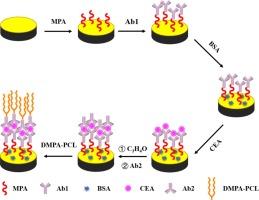
Carcinoembryonic antigen (CEA) is a broad-spectrum tumour marker, with its concentration levels serving as a crucial predictor of cancer diagnosis. In this study, we synthesized a polycaprolactone (PCL) macromolecular polymer via enzyme ring-opening polymerization (eROP). This polymer was then utilized as a signal amplification element in the “sandwich structure” electrochemical impedance biosensor designed for CEA detection. Initially, 3-mercaptopropionic acid (MPA) was self-assembled onto the electrode surface via a gold-sulfur bond. The carboxyl terminus of MPA was then activated using carbodiimide hydrochloride (EDC) and N-hydroxysuccinimide (NHS). Subsequently, antibody 1 (Ab1) was immobilised on the electrode surface through the formation of an amide bond, serving as a recognition probe. To prevent non-specific binding, the remaining sites were blocked with Bovine Serum Albumin (BSA). Following the specific capture of CEA by Ab1, the unreacted amino group on the electrode surface was sealed using acrolein. Antibody-2 (Ab2) was then introduced to specifically recognize CEA, forming a classic antibody–antigen–antibody “sandwich structure.” Finally, a DMPA (2,2-dihydroxymethylpropionic acid)-PCL (Polycaprolactone) polymer was conjugated to the electrode surface as a signal amplification unit. The impedance signal strength was subsequently measured using Electrochemical Impedance Spectroscopy (EIS). Under optimal conditions, the biosensor demonstrated a wide linear range (1 pg mL−1–100 ng mL−1) and a low detection limit of 0.38 pg mL−1. The sensor also exhibited high selectivity, stability and reproducibility when tested with clinical serum samples, highlighting its potential applications for early diagnosis and clinical monitoring.
期刊介绍:
The Journal of Electroanalytical Chemistry is the foremost international journal devoted to the interdisciplinary subject of electrochemistry in all its aspects, theoretical as well as applied.
Electrochemistry is a wide ranging area that is in a state of continuous evolution. Rather than compiling a long list of topics covered by the Journal, the editors would like to draw particular attention to the key issues of novelty, topicality and quality. Papers should present new and interesting electrochemical science in a way that is accessible to the reader. The presentation and discussion should be at a level that is consistent with the international status of the Journal. Reports describing the application of well-established techniques to problems that are essentially technical will not be accepted. Similarly, papers that report observations but fail to provide adequate interpretation will be rejected by the Editors. Papers dealing with technical electrochemistry should be submitted to other specialist journals unless the authors can show that their work provides substantially new insights into electrochemical processes.




 京公网安备 11010802042870号
京ICP备2023020795号-1
京公网安备 11010802042870号
京ICP备2023020795号-1

 分享
分享
 求助内容:
求助内容: 应助结果提醒方式:
 扫码关注我们
