Lin Li , Haoran Su , Jiahong Lei , Yihua Peng , Yunlin Peng , Aimin Jia , Hong Jiang , Yan Cai
{"title":"IHH基因中的错义变异c.298G > T:扩展短趾A1型的表型谱","authors":"Lin Li , Haoran Su , Jiahong Lei , Yihua Peng , Yunlin Peng , Aimin Jia , Hong Jiang , Yan Cai","doi":"10.1016/j.genrep.2024.102116","DOIUrl":null,"url":null,"abstract":"<div><div>Brachydactyly type A1 (BDA1) is an autosomal dominant disorder, marked by skeletal abnormalities in the middle and distal phalanges of the digits, a condition first linked to the Indian hedgehog (<em>IHH</em>) gene by Bell in 1951. In this report, we delineate a novel mutation within the <em>IHH</em> gene observed in a Chinese family with consanguineous marriages. The affected individuals exhibit phenotypic traits such as reduced stature and limb length, along with shortened fingers and toes, yet they do not display cognitive impairments. Employing Whole-exome Sequencing (WES), we identified a previously unreported heterozygous mutation, c.298G > T (p.D100Y), located in exon 1 of the <em>IHH</em> gene (NM_002181.3). This mutation was confirmed in the proband and corroborated in other affected relatives through PCR and Sanger sequencing. Subsequent bioinformatics analysis utilizing tools such as MutationTaster, PolyPhen-2, SIFT, and Swissmodel suggests that this variant is likely to be pathogenic. Consequently, we hypothesize that the c.298G > T mutation in the <em>IHH</em> gene may lead to a functional impairment of the IHH protein, thereby inducing the skeletal abnormalities characteristic of BDA1 in the affected members of this family. Future functional studies are warranted to ascertain the pathogenic potential of this mutation.</div></div>","PeriodicalId":12673,"journal":{"name":"Gene Reports","volume":"38 ","pages":"Article 102116"},"PeriodicalIF":0.9000,"publicationDate":"2025-03-01","publicationTypes":"Journal Article","fieldsOfStudy":null,"isOpenAccess":false,"openAccessPdf":"","citationCount":"0","resultStr":"{\"title\":\"Missense variant c.298G > T in the IHH gene: Expanding the phenotypic spectrum of Brachydactyly type A1\",\"authors\":\"Lin Li , Haoran Su , Jiahong Lei , Yihua Peng , Yunlin Peng , Aimin Jia , Hong Jiang , Yan Cai\",\"doi\":\"10.1016/j.genrep.2024.102116\",\"DOIUrl\":null,\"url\":null,\"abstract\":\"<div><div>Brachydactyly type A1 (BDA1) is an autosomal dominant disorder, marked by skeletal abnormalities in the middle and distal phalanges of the digits, a condition first linked to the Indian hedgehog (<em>IHH</em>) gene by Bell in 1951. In this report, we delineate a novel mutation within the <em>IHH</em> gene observed in a Chinese family with consanguineous marriages. The affected individuals exhibit phenotypic traits such as reduced stature and limb length, along with shortened fingers and toes, yet they do not display cognitive impairments. Employing Whole-exome Sequencing (WES), we identified a previously unreported heterozygous mutation, c.298G > T (p.D100Y), located in exon 1 of the <em>IHH</em> gene (NM_002181.3). This mutation was confirmed in the proband and corroborated in other affected relatives through PCR and Sanger sequencing. Subsequent bioinformatics analysis utilizing tools such as MutationTaster, PolyPhen-2, SIFT, and Swissmodel suggests that this variant is likely to be pathogenic. Consequently, we hypothesize that the c.298G > T mutation in the <em>IHH</em> gene may lead to a functional impairment of the IHH protein, thereby inducing the skeletal abnormalities characteristic of BDA1 in the affected members of this family. Future functional studies are warranted to ascertain the pathogenic potential of this mutation.</div></div>\",\"PeriodicalId\":12673,\"journal\":{\"name\":\"Gene Reports\",\"volume\":\"38 \",\"pages\":\"Article 102116\"},\"PeriodicalIF\":0.9000,\"publicationDate\":\"2025-03-01\",\"publicationTypes\":\"Journal Article\",\"fieldsOfStudy\":null,\"isOpenAccess\":false,\"openAccessPdf\":\"\",\"citationCount\":\"0\",\"resultStr\":null,\"platform\":\"Semanticscholar\",\"paperid\":null,\"PeriodicalName\":\"Gene Reports\",\"FirstCategoryId\":\"1085\",\"ListUrlMain\":\"https://www.sciencedirect.com/science/article/pii/S2452014424002395\",\"RegionNum\":0,\"RegionCategory\":null,\"ArticlePicture\":[],\"TitleCN\":null,\"AbstractTextCN\":null,\"PMCID\":null,\"EPubDate\":\"2024/12/15 0:00:00\",\"PubModel\":\"Epub\",\"JCR\":\"Q4\",\"JCRName\":\"GENETICS & HEREDITY\",\"Score\":null,\"Total\":0}","platform":"Semanticscholar","paperid":null,"PeriodicalName":"Gene Reports","FirstCategoryId":"1085","ListUrlMain":"https://www.sciencedirect.com/science/article/pii/S2452014424002395","RegionNum":0,"RegionCategory":null,"ArticlePicture":[],"TitleCN":null,"AbstractTextCN":null,"PMCID":null,"EPubDate":"2024/12/15 0:00:00","PubModel":"Epub","JCR":"Q4","JCRName":"GENETICS & HEREDITY","Score":null,"Total":0}
Missense variant c.298G > T in the IHH gene: Expanding the phenotypic spectrum of Brachydactyly type A1
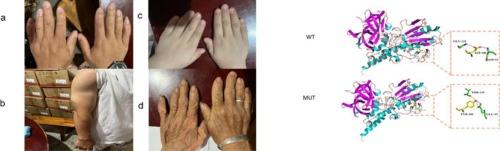
Brachydactyly type A1 (BDA1) is an autosomal dominant disorder, marked by skeletal abnormalities in the middle and distal phalanges of the digits, a condition first linked to the Indian hedgehog (IHH) gene by Bell in 1951. In this report, we delineate a novel mutation within the IHH gene observed in a Chinese family with consanguineous marriages. The affected individuals exhibit phenotypic traits such as reduced stature and limb length, along with shortened fingers and toes, yet they do not display cognitive impairments. Employing Whole-exome Sequencing (WES), we identified a previously unreported heterozygous mutation, c.298G > T (p.D100Y), located in exon 1 of the IHH gene (NM_002181.3). This mutation was confirmed in the proband and corroborated in other affected relatives through PCR and Sanger sequencing. Subsequent bioinformatics analysis utilizing tools such as MutationTaster, PolyPhen-2, SIFT, and Swissmodel suggests that this variant is likely to be pathogenic. Consequently, we hypothesize that the c.298G > T mutation in the IHH gene may lead to a functional impairment of the IHH protein, thereby inducing the skeletal abnormalities characteristic of BDA1 in the affected members of this family. Future functional studies are warranted to ascertain the pathogenic potential of this mutation.
Gene ReportsBiochemistry, Genetics and Molecular Biology-Genetics
CiteScore
3.30
自引率
7.70%
发文量
246
审稿时长
49 days
期刊介绍:
Gene Reports publishes papers that focus on the regulation, expression, function and evolution of genes in all biological contexts, including all prokaryotic and eukaryotic organisms, as well as viruses. Gene Reports strives to be a very diverse journal and topics in all fields will be considered for publication. Although not limited to the following, some general topics include: DNA Organization, Replication & Evolution -Focus on genomic DNA (chromosomal organization, comparative genomics, DNA replication, DNA repair, mobile DNA, mitochondrial DNA, chloroplast DNA). Expression & Function - Focus on functional RNAs (microRNAs, tRNAs, rRNAs, mRNA splicing, alternative polyadenylation) Regulation - Focus on processes that mediate gene-read out (epigenetics, chromatin, histone code, transcription, translation, protein degradation). Cell Signaling - Focus on mechanisms that control information flow into the nucleus to control gene expression (kinase and phosphatase pathways controlled by extra-cellular ligands, Wnt, Notch, TGFbeta/BMPs, FGFs, IGFs etc.) Profiling of gene expression and genetic variation - Focus on high throughput approaches (e.g., DeepSeq, ChIP-Seq, Affymetrix microarrays, proteomics) that define gene regulatory circuitry, molecular pathways and protein/protein networks. Genetics - Focus on development in model organisms (e.g., mouse, frog, fruit fly, worm), human genetic variation, population genetics, as well as agricultural and veterinary genetics. Molecular Pathology & Regenerative Medicine - Focus on the deregulation of molecular processes in human diseases and mechanisms supporting regeneration of tissues through pluripotent or multipotent stem cells.




 京公网安备 11010802042870号
京ICP备2023020795号-1
京公网安备 11010802042870号
京ICP备2023020795号-1

 分享
分享
 求助内容:
求助内容: 应助结果提醒方式:
 扫码关注我们
