Xiongfa Ji , Xin Qian , Guowen Luo , Wenjie Yang , Wenhan Huang , Zehua Lei , Jiaqi Zhou , Guoqing Zhong , Jielong Zhou , Nan Liu , Limin Ma , Mei Li , Xiangmei Liu , Shuilin Wu , Yu Zhang
{"title":"工程巨噬细胞纳米颗粒通过靶向CD47-SIRPα轴增强骨肉瘤的微波消融效果:一种新的仿生免疫治疗方法","authors":"Xiongfa Ji , Xin Qian , Guowen Luo , Wenjie Yang , Wenhan Huang , Zehua Lei , Jiaqi Zhou , Guoqing Zhong , Jielong Zhou , Nan Liu , Limin Ma , Mei Li , Xiangmei Liu , Shuilin Wu , Yu Zhang","doi":"10.1016/j.bioactmat.2025.01.012","DOIUrl":null,"url":null,"abstract":"<div><div>Osteosarcoma (OS) is a lethal bone tumor that primarily affects adolescents. OS is characterized by a high incidence of recurrence following surgical intervention, which is attributed to the presence of residual microscopic disease. Tumor-associated macrophages, which dominate the tumor microenvironment, often suppress immune responses and facilitate tumor progression and recurrence. This study developed an innovative nanotherapeutic approach by utilizing genetically engineered macrophage membranes with M1 polarization, stably overexpressing signal regulatory protein alpha (SIRPα), to encapsulate microwave-responsive nano-Prussian blue (SIRPα-M@nanoPB) nanoparticles. These nanoparticles induce tumor cell death selectively through hyperthermia and microwave dynamic effects upon targeted microwave irradiation. It is of critical importance to note that the enhancement of SIRPα on the nanoparticle surface actively targets and binds CD47 of tumor cells, thereby disrupting the \"don't-eat-me\" signal and effectively countering the immunosuppressive tumor environment. This action restores macrophage phagocytosis with M1 polarization, triggering potent immune responses. Our strategy holds considerable promise when it comes to improving the efficacy of microwave ablation through immune modulation, while reducing thermal damage to adjacent normal tissue and minimizing the risk of tumor recurrence. Thus, it offers a significant advancement in microwave therapies for patients with OS.</div></div>","PeriodicalId":8762,"journal":{"name":"Bioactive Materials","volume":"47 ","pages":"Pages 248-265"},"PeriodicalIF":18.0000,"publicationDate":"2025-05-01","publicationTypes":"Journal Article","fieldsOfStudy":null,"isOpenAccess":false,"openAccessPdf":"","citationCount":"0","resultStr":"{\"title\":\"Engineered macrophage nanoparticles enhance microwave ablation efficacy in osteosarcoma via targeting the CD47-SIRPα Axis: A novel Biomimetic immunotherapeutic approach\",\"authors\":\"Xiongfa Ji , Xin Qian , Guowen Luo , Wenjie Yang , Wenhan Huang , Zehua Lei , Jiaqi Zhou , Guoqing Zhong , Jielong Zhou , Nan Liu , Limin Ma , Mei Li , Xiangmei Liu , Shuilin Wu , Yu Zhang\",\"doi\":\"10.1016/j.bioactmat.2025.01.012\",\"DOIUrl\":null,\"url\":null,\"abstract\":\"<div><div>Osteosarcoma (OS) is a lethal bone tumor that primarily affects adolescents. OS is characterized by a high incidence of recurrence following surgical intervention, which is attributed to the presence of residual microscopic disease. Tumor-associated macrophages, which dominate the tumor microenvironment, often suppress immune responses and facilitate tumor progression and recurrence. This study developed an innovative nanotherapeutic approach by utilizing genetically engineered macrophage membranes with M1 polarization, stably overexpressing signal regulatory protein alpha (SIRPα), to encapsulate microwave-responsive nano-Prussian blue (SIRPα-M@nanoPB) nanoparticles. These nanoparticles induce tumor cell death selectively through hyperthermia and microwave dynamic effects upon targeted microwave irradiation. It is of critical importance to note that the enhancement of SIRPα on the nanoparticle surface actively targets and binds CD47 of tumor cells, thereby disrupting the \\\"don't-eat-me\\\" signal and effectively countering the immunosuppressive tumor environment. This action restores macrophage phagocytosis with M1 polarization, triggering potent immune responses. Our strategy holds considerable promise when it comes to improving the efficacy of microwave ablation through immune modulation, while reducing thermal damage to adjacent normal tissue and minimizing the risk of tumor recurrence. Thus, it offers a significant advancement in microwave therapies for patients with OS.</div></div>\",\"PeriodicalId\":8762,\"journal\":{\"name\":\"Bioactive Materials\",\"volume\":\"47 \",\"pages\":\"Pages 248-265\"},\"PeriodicalIF\":18.0000,\"publicationDate\":\"2025-05-01\",\"publicationTypes\":\"Journal Article\",\"fieldsOfStudy\":null,\"isOpenAccess\":false,\"openAccessPdf\":\"\",\"citationCount\":\"0\",\"resultStr\":null,\"platform\":\"Semanticscholar\",\"paperid\":null,\"PeriodicalName\":\"Bioactive Materials\",\"FirstCategoryId\":\"5\",\"ListUrlMain\":\"https://www.sciencedirect.com/science/article/pii/S2452199X25000118\",\"RegionNum\":1,\"RegionCategory\":\"医学\",\"ArticlePicture\":[],\"TitleCN\":null,\"AbstractTextCN\":null,\"PMCID\":null,\"EPubDate\":\"2025/1/24 0:00:00\",\"PubModel\":\"Epub\",\"JCR\":\"Q1\",\"JCRName\":\"ENGINEERING, BIOMEDICAL\",\"Score\":null,\"Total\":0}","platform":"Semanticscholar","paperid":null,"PeriodicalName":"Bioactive Materials","FirstCategoryId":"5","ListUrlMain":"https://www.sciencedirect.com/science/article/pii/S2452199X25000118","RegionNum":1,"RegionCategory":"医学","ArticlePicture":[],"TitleCN":null,"AbstractTextCN":null,"PMCID":null,"EPubDate":"2025/1/24 0:00:00","PubModel":"Epub","JCR":"Q1","JCRName":"ENGINEERING, BIOMEDICAL","Score":null,"Total":0}
Engineered macrophage nanoparticles enhance microwave ablation efficacy in osteosarcoma via targeting the CD47-SIRPα Axis: A novel Biomimetic immunotherapeutic approach
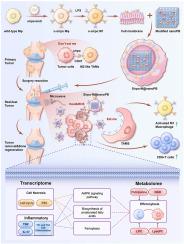
Osteosarcoma (OS) is a lethal bone tumor that primarily affects adolescents. OS is characterized by a high incidence of recurrence following surgical intervention, which is attributed to the presence of residual microscopic disease. Tumor-associated macrophages, which dominate the tumor microenvironment, often suppress immune responses and facilitate tumor progression and recurrence. This study developed an innovative nanotherapeutic approach by utilizing genetically engineered macrophage membranes with M1 polarization, stably overexpressing signal regulatory protein alpha (SIRPα), to encapsulate microwave-responsive nano-Prussian blue (SIRPα-M@nanoPB) nanoparticles. These nanoparticles induce tumor cell death selectively through hyperthermia and microwave dynamic effects upon targeted microwave irradiation. It is of critical importance to note that the enhancement of SIRPα on the nanoparticle surface actively targets and binds CD47 of tumor cells, thereby disrupting the "don't-eat-me" signal and effectively countering the immunosuppressive tumor environment. This action restores macrophage phagocytosis with M1 polarization, triggering potent immune responses. Our strategy holds considerable promise when it comes to improving the efficacy of microwave ablation through immune modulation, while reducing thermal damage to adjacent normal tissue and minimizing the risk of tumor recurrence. Thus, it offers a significant advancement in microwave therapies for patients with OS.
Bioactive MaterialsBiochemistry, Genetics and Molecular Biology-Biotechnology
CiteScore
28.00
自引率
6.30%
发文量
436
审稿时长
20 days
期刊介绍:
Bioactive Materials is a peer-reviewed research publication that focuses on advancements in bioactive materials. The journal accepts research papers, reviews, and rapid communications in the field of next-generation biomaterials that interact with cells, tissues, and organs in various living organisms.
The primary goal of Bioactive Materials is to promote the science and engineering of biomaterials that exhibit adaptiveness to the biological environment. These materials are specifically designed to stimulate or direct appropriate cell and tissue responses or regulate interactions with microorganisms.
The journal covers a wide range of bioactive materials, including those that are engineered or designed in terms of their physical form (e.g. particulate, fiber), topology (e.g. porosity, surface roughness), or dimensions (ranging from macro to nano-scales). Contributions are sought from the following categories of bioactive materials:
Bioactive metals and alloys
Bioactive inorganics: ceramics, glasses, and carbon-based materials
Bioactive polymers and gels
Bioactive materials derived from natural sources
Bioactive composites
These materials find applications in human and veterinary medicine, such as implants, tissue engineering scaffolds, cell/drug/gene carriers, as well as imaging and sensing devices.





 京公网安备 11010802042870号
京ICP备2023020795号-1
京公网安备 11010802042870号
京ICP备2023020795号-1

 分享
分享
 求助内容:
求助内容: 应助结果提醒方式:
 扫码关注我们
