{"title":"在弦启发的欧拉-海森堡理论中研究粒子运动和黑洞引力透镜效应","authors":"Muhammad Yasir , Farzan Mushtaq , Xia Tiecheng , Faisal Javed","doi":"10.1016/j.dark.2025.101838","DOIUrl":null,"url":null,"abstract":"<div><div>This paper is motivated by a study that discovered the properties of black holes with string-inspired Euler–Heisenberg theory in terms of particle dynamics and weak gravitational plasma lensing. We analyze particle dynamics using the effective potential and innermost stable circular orbits for massive particle and photon motion. This study examines the interaction of test particles with a black hole under various physical parameters, focusing on the behavior of the innermost stable circular orbit radius. Notably, we discover that particles with radii less than the innermost stable circular orbit converge towards the black hole singularity, whereas those beyond the innermost stable circular orbit advance towards infinity, demonstrating the dynamic influence of the black hole parameters on particle trajectories. To examine gravitational lensed photons, we consider a weak gravitational field. This objective of lensing is served by considering three plasma fields: uniform plasma, singular isothermal sphere, and non-singular isothermal sphere. We also investigate the deflection angles for non-plasma and plasma mediums. The bending angle under weak field limitations is calculated using optical geometry and the Gibbons–Werner technique. We found that the influence of these mediums enhances the black hole’s bending angle. We analyze the deflection angle of light based on the impact parameter and its graphical impact on the angle for both cases.</div></div>","PeriodicalId":48774,"journal":{"name":"Physics of the Dark Universe","volume":"48 ","pages":"Article 101838"},"PeriodicalIF":6.4000,"publicationDate":"2025-05-01","publicationTypes":"Journal Article","fieldsOfStudy":null,"isOpenAccess":false,"openAccessPdf":"","citationCount":"0","resultStr":"{\"title\":\"Investigating the effects of particle motion and gravitational lensing of black hole in string-inspired Euler–Heisenberg theory\",\"authors\":\"Muhammad Yasir , Farzan Mushtaq , Xia Tiecheng , Faisal Javed\",\"doi\":\"10.1016/j.dark.2025.101838\",\"DOIUrl\":null,\"url\":null,\"abstract\":\"<div><div>This paper is motivated by a study that discovered the properties of black holes with string-inspired Euler–Heisenberg theory in terms of particle dynamics and weak gravitational plasma lensing. We analyze particle dynamics using the effective potential and innermost stable circular orbits for massive particle and photon motion. This study examines the interaction of test particles with a black hole under various physical parameters, focusing on the behavior of the innermost stable circular orbit radius. Notably, we discover that particles with radii less than the innermost stable circular orbit converge towards the black hole singularity, whereas those beyond the innermost stable circular orbit advance towards infinity, demonstrating the dynamic influence of the black hole parameters on particle trajectories. To examine gravitational lensed photons, we consider a weak gravitational field. This objective of lensing is served by considering three plasma fields: uniform plasma, singular isothermal sphere, and non-singular isothermal sphere. We also investigate the deflection angles for non-plasma and plasma mediums. The bending angle under weak field limitations is calculated using optical geometry and the Gibbons–Werner technique. We found that the influence of these mediums enhances the black hole’s bending angle. We analyze the deflection angle of light based on the impact parameter and its graphical impact on the angle for both cases.</div></div>\",\"PeriodicalId\":48774,\"journal\":{\"name\":\"Physics of the Dark Universe\",\"volume\":\"48 \",\"pages\":\"Article 101838\"},\"PeriodicalIF\":6.4000,\"publicationDate\":\"2025-05-01\",\"publicationTypes\":\"Journal Article\",\"fieldsOfStudy\":null,\"isOpenAccess\":false,\"openAccessPdf\":\"\",\"citationCount\":\"0\",\"resultStr\":null,\"platform\":\"Semanticscholar\",\"paperid\":null,\"PeriodicalName\":\"Physics of the Dark Universe\",\"FirstCategoryId\":\"101\",\"ListUrlMain\":\"https://www.sciencedirect.com/science/article/pii/S2212686425000330\",\"RegionNum\":2,\"RegionCategory\":\"物理与天体物理\",\"ArticlePicture\":[],\"TitleCN\":null,\"AbstractTextCN\":null,\"PMCID\":null,\"EPubDate\":\"2025/1/31 0:00:00\",\"PubModel\":\"Epub\",\"JCR\":\"Q1\",\"JCRName\":\"ASTRONOMY & ASTROPHYSICS\",\"Score\":null,\"Total\":0}","platform":"Semanticscholar","paperid":null,"PeriodicalName":"Physics of the Dark Universe","FirstCategoryId":"101","ListUrlMain":"https://www.sciencedirect.com/science/article/pii/S2212686425000330","RegionNum":2,"RegionCategory":"物理与天体物理","ArticlePicture":[],"TitleCN":null,"AbstractTextCN":null,"PMCID":null,"EPubDate":"2025/1/31 0:00:00","PubModel":"Epub","JCR":"Q1","JCRName":"ASTRONOMY & ASTROPHYSICS","Score":null,"Total":0}
Investigating the effects of particle motion and gravitational lensing of black hole in string-inspired Euler–Heisenberg theory
This paper is motivated by a study that discovered the properties of black holes with string-inspired Euler–Heisenberg theory in terms of particle dynamics and weak gravitational plasma lensing. We analyze particle dynamics using the effective potential and innermost stable circular orbits for massive particle and photon motion. This study examines the interaction of test particles with a black hole under various physical parameters, focusing on the behavior of the innermost stable circular orbit radius. Notably, we discover that particles with radii less than the innermost stable circular orbit converge towards the black hole singularity, whereas those beyond the innermost stable circular orbit advance towards infinity, demonstrating the dynamic influence of the black hole parameters on particle trajectories. To examine gravitational lensed photons, we consider a weak gravitational field. This objective of lensing is served by considering three plasma fields: uniform plasma, singular isothermal sphere, and non-singular isothermal sphere. We also investigate the deflection angles for non-plasma and plasma mediums. The bending angle under weak field limitations is calculated using optical geometry and the Gibbons–Werner technique. We found that the influence of these mediums enhances the black hole’s bending angle. We analyze the deflection angle of light based on the impact parameter and its graphical impact on the angle for both cases.
期刊介绍:
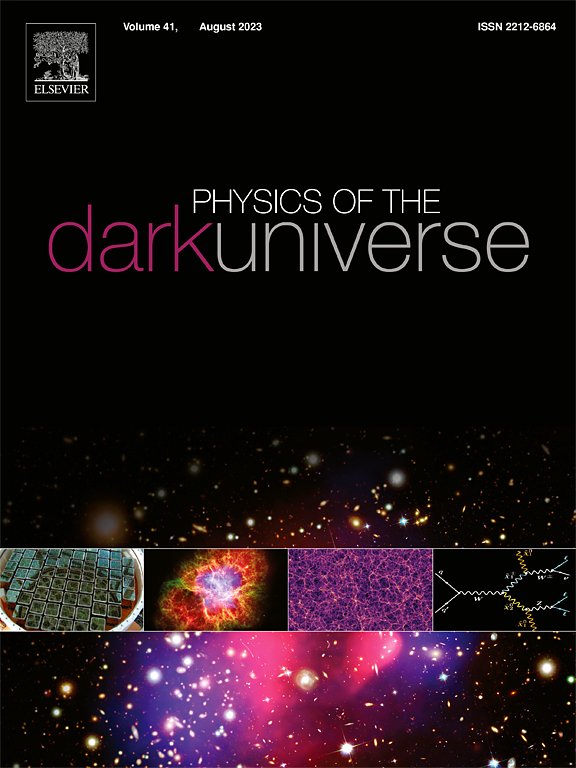
Physics of the Dark Universe is an innovative online-only journal that offers rapid publication of peer-reviewed, original research articles considered of high scientific impact.
The journal is focused on the understanding of Dark Matter, Dark Energy, Early Universe, gravitational waves and neutrinos, covering all theoretical, experimental and phenomenological aspects.




 京公网安备 11010802042870号
京ICP备2023020795号-1
京公网安备 11010802042870号
京ICP备2023020795号-1

 分享
分享
 求助内容:
求助内容: 应助结果提醒方式:
 扫码关注我们
