Shao-An Hua , Hsin-Yu Chang , Kai-Yan Chen , Mandy M. Lee , Yi-Hung Liu , Shih-Sheng Sun
{"title":"硫化吡啶-1,2,3-三唑配合物的光物理和光化学性质研究","authors":"Shao-An Hua , Hsin-Yu Chang , Kai-Yan Chen , Mandy M. Lee , Yi-Hung Liu , Shih-Sheng Sun","doi":"10.1016/j.poly.2025.117423","DOIUrl":null,"url":null,"abstract":"<div><div>In this study, we developed novel pyridine-triazole hybrid ligand scaffolds using the copper-catalyzed azide-alkyne cycloaddition (CuAAC) approach, followed by the incorporation of methylthio functionalization. These ligands were then employed to synthesize ruthenium(II) and iridium(III) complexes, which were comprehensively characterized by NMR spectroscopy, optical spectroscopy, electrochemistry, and single-crystal X-ray diffraction (sXRD). The introduction of a methylthio group in the triazole backbone led to significant anodic shifts in the reduction potentials of the ancillary ligands, attributed to LUMO + 2 stabilization as confirmed by DFT calculations. Ruthenium complexes demonstrated photochemical reactivity, with a low-lying <sup>3</sup>MC (metal-centered) state facilitating thermally accessible non-radiative deactivation via photo-induced ligand release, indicating their potential for photoactivated chemotherapy. In contrast, the iridium complexes exhibited structured emission bands, with triplet excited states localized on the <sup>3</sup>LC state and long luminescence lifetimes (∼1.5 μs), making them promising candidates as phosphors for advanced light-emitting devices. Notably, the dual methylthio groups offer further versatility, including potential for disulfide bond formation under reductive conditions and surface anchoring applications, underscoring the multifunctionality and broad applicability of this ligand design.</div></div>","PeriodicalId":20278,"journal":{"name":"Polyhedron","volume":"269 ","pages":"Article 117423"},"PeriodicalIF":2.8000,"publicationDate":"2025-03-01","publicationTypes":"Journal Article","fieldsOfStudy":null,"isOpenAccess":false,"openAccessPdf":"","citationCount":"0","resultStr":"{\"title\":\"Investigation on photophysical and photochemical properties of Ir and Ru complexes featuring sulfurated pyridine-1,2,3-triazole based ligands\",\"authors\":\"Shao-An Hua , Hsin-Yu Chang , Kai-Yan Chen , Mandy M. Lee , Yi-Hung Liu , Shih-Sheng Sun\",\"doi\":\"10.1016/j.poly.2025.117423\",\"DOIUrl\":null,\"url\":null,\"abstract\":\"<div><div>In this study, we developed novel pyridine-triazole hybrid ligand scaffolds using the copper-catalyzed azide-alkyne cycloaddition (CuAAC) approach, followed by the incorporation of methylthio functionalization. These ligands were then employed to synthesize ruthenium(II) and iridium(III) complexes, which were comprehensively characterized by NMR spectroscopy, optical spectroscopy, electrochemistry, and single-crystal X-ray diffraction (sXRD). The introduction of a methylthio group in the triazole backbone led to significant anodic shifts in the reduction potentials of the ancillary ligands, attributed to LUMO + 2 stabilization as confirmed by DFT calculations. Ruthenium complexes demonstrated photochemical reactivity, with a low-lying <sup>3</sup>MC (metal-centered) state facilitating thermally accessible non-radiative deactivation via photo-induced ligand release, indicating their potential for photoactivated chemotherapy. In contrast, the iridium complexes exhibited structured emission bands, with triplet excited states localized on the <sup>3</sup>LC state and long luminescence lifetimes (∼1.5 μs), making them promising candidates as phosphors for advanced light-emitting devices. Notably, the dual methylthio groups offer further versatility, including potential for disulfide bond formation under reductive conditions and surface anchoring applications, underscoring the multifunctionality and broad applicability of this ligand design.</div></div>\",\"PeriodicalId\":20278,\"journal\":{\"name\":\"Polyhedron\",\"volume\":\"269 \",\"pages\":\"Article 117423\"},\"PeriodicalIF\":2.8000,\"publicationDate\":\"2025-03-01\",\"publicationTypes\":\"Journal Article\",\"fieldsOfStudy\":null,\"isOpenAccess\":false,\"openAccessPdf\":\"\",\"citationCount\":\"0\",\"resultStr\":null,\"platform\":\"Semanticscholar\",\"paperid\":null,\"PeriodicalName\":\"Polyhedron\",\"FirstCategoryId\":\"92\",\"ListUrlMain\":\"https://www.sciencedirect.com/science/article/pii/S0277538725000373\",\"RegionNum\":3,\"RegionCategory\":\"化学\",\"ArticlePicture\":[],\"TitleCN\":null,\"AbstractTextCN\":null,\"PMCID\":null,\"EPubDate\":\"2025/1/27 0:00:00\",\"PubModel\":\"Epub\",\"JCR\":\"Q2\",\"JCRName\":\"CHEMISTRY, INORGANIC & NUCLEAR\",\"Score\":null,\"Total\":0}","platform":"Semanticscholar","paperid":null,"PeriodicalName":"Polyhedron","FirstCategoryId":"92","ListUrlMain":"https://www.sciencedirect.com/science/article/pii/S0277538725000373","RegionNum":3,"RegionCategory":"化学","ArticlePicture":[],"TitleCN":null,"AbstractTextCN":null,"PMCID":null,"EPubDate":"2025/1/27 0:00:00","PubModel":"Epub","JCR":"Q2","JCRName":"CHEMISTRY, INORGANIC & NUCLEAR","Score":null,"Total":0}
Investigation on photophysical and photochemical properties of Ir and Ru complexes featuring sulfurated pyridine-1,2,3-triazole based ligands
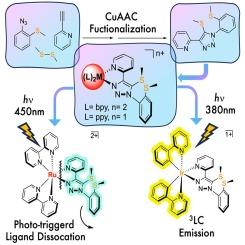
In this study, we developed novel pyridine-triazole hybrid ligand scaffolds using the copper-catalyzed azide-alkyne cycloaddition (CuAAC) approach, followed by the incorporation of methylthio functionalization. These ligands were then employed to synthesize ruthenium(II) and iridium(III) complexes, which were comprehensively characterized by NMR spectroscopy, optical spectroscopy, electrochemistry, and single-crystal X-ray diffraction (sXRD). The introduction of a methylthio group in the triazole backbone led to significant anodic shifts in the reduction potentials of the ancillary ligands, attributed to LUMO + 2 stabilization as confirmed by DFT calculations. Ruthenium complexes demonstrated photochemical reactivity, with a low-lying 3MC (metal-centered) state facilitating thermally accessible non-radiative deactivation via photo-induced ligand release, indicating their potential for photoactivated chemotherapy. In contrast, the iridium complexes exhibited structured emission bands, with triplet excited states localized on the 3LC state and long luminescence lifetimes (∼1.5 μs), making them promising candidates as phosphors for advanced light-emitting devices. Notably, the dual methylthio groups offer further versatility, including potential for disulfide bond formation under reductive conditions and surface anchoring applications, underscoring the multifunctionality and broad applicability of this ligand design.
期刊介绍:
Polyhedron publishes original, fundamental, experimental and theoretical work of the highest quality in all the major areas of inorganic chemistry. This includes synthetic chemistry, coordination chemistry, organometallic chemistry, bioinorganic chemistry, and solid-state and materials chemistry.
Papers should be significant pieces of work, and all new compounds must be appropriately characterized. The inclusion of single-crystal X-ray structural data is strongly encouraged, but papers reporting only the X-ray structure determination of a single compound will usually not be considered. Papers on solid-state or materials chemistry will be expected to have a significant molecular chemistry component (such as the synthesis and characterization of the molecular precursors and/or a systematic study of the use of different precursors or reaction conditions) or demonstrate a cutting-edge application (for example inorganic materials for energy applications). Papers dealing only with stability constants are not considered.




 京公网安备 11010802042870号
京ICP备2023020795号-1
京公网安备 11010802042870号
京ICP备2023020795号-1

 分享
分享
 求助内容:
求助内容: 应助结果提醒方式:
 扫码关注我们
