Mahinder Partap , Amit Kumar , Pawan Kumar , Dinesh Kumar , Ashish R. Warghat
{"title":"光谱光处理和外源前体饲喂均能提高黑蛾去分化细胞培养中微甜苷的含量","authors":"Mahinder Partap , Amit Kumar , Pawan Kumar , Dinesh Kumar , Ashish R. Warghat","doi":"10.1016/j.bcab.2025.103501","DOIUrl":null,"url":null,"abstract":"<div><div>The present investigation evaluates the impact of the light spectrum (red and blue) and precursors treatment on picrosides (P-I, P-II, P-III) and pathway precursors metabolites enrichment in the cell culture of <em>Picrorhiza kurroa</em>. Exogenously, vanillic acid (VA), phenylalanine (PAL), and trans-cinnamic acid (TCNA) precursors were used in 50–150 mg/L concentrations to leaf and rhizome cell suspension of <em>P. kurroa</em>. The maximum content of P-I (0.872 and 0.894 mg/g DW), P-II (0.892 and 0.837 mg/g DW), P-III (0.286 and 0.288 mg/g DW) were quantified in leaf and rhizome cell suspension cultures under red light treatment. The maximum content (mg/g DW) of picrosides (P-I; 9.881, P-II; 3.939, and P-III; 0.884), VA (0.236), and caffeic acid (CFA; 0.20) were quantified in 150 mg/L VA in leaf suspension culture. The maximum content of catalpol (CTP; 5.845 mg/g DW) was quantified in PAL 100 mg/L, while cinnamic acid (CAN; 0.176, 0.179, 0.162 mg/g DW) was quantified in 150 mg/L of VA, PAL, and TCNA. However, in rhizome suspension culture, the maximum content (mg/g DW) of P-I (7.881), P-III (0.964), and VA (0.324) were found in VA 150 mg/L. The results concluded that VA (100–150 mg/L) is most suitable for picrosides enrichment in the cell culture of <em>P. kurroa</em>. The study confirms that red light and vanillic acid (VA) treatment significantly enhanced the picrosides and precursor metabolite in cell cultures. By utilizing the current approach coupled with elicitor treatments and scale-up studies at bioreactor level could facilitate the large-scale production of picrosides.</div></div>","PeriodicalId":8774,"journal":{"name":"Biocatalysis and agricultural biotechnology","volume":"64 ","pages":"Article 103501"},"PeriodicalIF":3.8000,"publicationDate":"2025-02-01","publicationTypes":"Journal Article","fieldsOfStudy":null,"isOpenAccess":false,"openAccessPdf":"","citationCount":"0","resultStr":"{\"title\":\"Spectral light treatment and exogenous feeding of precursors enhanced the picrosides content in dedifferentiated cell culture of Picrorhiza kurroa\",\"authors\":\"Mahinder Partap , Amit Kumar , Pawan Kumar , Dinesh Kumar , Ashish R. Warghat\",\"doi\":\"10.1016/j.bcab.2025.103501\",\"DOIUrl\":null,\"url\":null,\"abstract\":\"<div><div>The present investigation evaluates the impact of the light spectrum (red and blue) and precursors treatment on picrosides (P-I, P-II, P-III) and pathway precursors metabolites enrichment in the cell culture of <em>Picrorhiza kurroa</em>. Exogenously, vanillic acid (VA), phenylalanine (PAL), and trans-cinnamic acid (TCNA) precursors were used in 50–150 mg/L concentrations to leaf and rhizome cell suspension of <em>P. kurroa</em>. The maximum content of P-I (0.872 and 0.894 mg/g DW), P-II (0.892 and 0.837 mg/g DW), P-III (0.286 and 0.288 mg/g DW) were quantified in leaf and rhizome cell suspension cultures under red light treatment. The maximum content (mg/g DW) of picrosides (P-I; 9.881, P-II; 3.939, and P-III; 0.884), VA (0.236), and caffeic acid (CFA; 0.20) were quantified in 150 mg/L VA in leaf suspension culture. The maximum content of catalpol (CTP; 5.845 mg/g DW) was quantified in PAL 100 mg/L, while cinnamic acid (CAN; 0.176, 0.179, 0.162 mg/g DW) was quantified in 150 mg/L of VA, PAL, and TCNA. However, in rhizome suspension culture, the maximum content (mg/g DW) of P-I (7.881), P-III (0.964), and VA (0.324) were found in VA 150 mg/L. The results concluded that VA (100–150 mg/L) is most suitable for picrosides enrichment in the cell culture of <em>P. kurroa</em>. The study confirms that red light and vanillic acid (VA) treatment significantly enhanced the picrosides and precursor metabolite in cell cultures. By utilizing the current approach coupled with elicitor treatments and scale-up studies at bioreactor level could facilitate the large-scale production of picrosides.</div></div>\",\"PeriodicalId\":8774,\"journal\":{\"name\":\"Biocatalysis and agricultural biotechnology\",\"volume\":\"64 \",\"pages\":\"Article 103501\"},\"PeriodicalIF\":3.8000,\"publicationDate\":\"2025-02-01\",\"publicationTypes\":\"Journal Article\",\"fieldsOfStudy\":null,\"isOpenAccess\":false,\"openAccessPdf\":\"\",\"citationCount\":\"0\",\"resultStr\":null,\"platform\":\"Semanticscholar\",\"paperid\":null,\"PeriodicalName\":\"Biocatalysis and agricultural biotechnology\",\"FirstCategoryId\":\"1085\",\"ListUrlMain\":\"https://www.sciencedirect.com/science/article/pii/S1878818125000143\",\"RegionNum\":0,\"RegionCategory\":null,\"ArticlePicture\":[],\"TitleCN\":null,\"AbstractTextCN\":null,\"PMCID\":null,\"EPubDate\":\"2025/1/24 0:00:00\",\"PubModel\":\"Epub\",\"JCR\":\"Q2\",\"JCRName\":\"BIOTECHNOLOGY & APPLIED MICROBIOLOGY\",\"Score\":null,\"Total\":0}","platform":"Semanticscholar","paperid":null,"PeriodicalName":"Biocatalysis and agricultural biotechnology","FirstCategoryId":"1085","ListUrlMain":"https://www.sciencedirect.com/science/article/pii/S1878818125000143","RegionNum":0,"RegionCategory":null,"ArticlePicture":[],"TitleCN":null,"AbstractTextCN":null,"PMCID":null,"EPubDate":"2025/1/24 0:00:00","PubModel":"Epub","JCR":"Q2","JCRName":"BIOTECHNOLOGY & APPLIED MICROBIOLOGY","Score":null,"Total":0}
Spectral light treatment and exogenous feeding of precursors enhanced the picrosides content in dedifferentiated cell culture of Picrorhiza kurroa
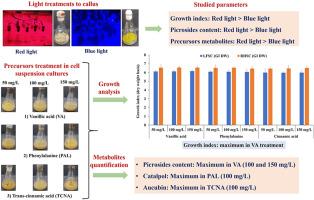
The present investigation evaluates the impact of the light spectrum (red and blue) and precursors treatment on picrosides (P-I, P-II, P-III) and pathway precursors metabolites enrichment in the cell culture of Picrorhiza kurroa. Exogenously, vanillic acid (VA), phenylalanine (PAL), and trans-cinnamic acid (TCNA) precursors were used in 50–150 mg/L concentrations to leaf and rhizome cell suspension of P. kurroa. The maximum content of P-I (0.872 and 0.894 mg/g DW), P-II (0.892 and 0.837 mg/g DW), P-III (0.286 and 0.288 mg/g DW) were quantified in leaf and rhizome cell suspension cultures under red light treatment. The maximum content (mg/g DW) of picrosides (P-I; 9.881, P-II; 3.939, and P-III; 0.884), VA (0.236), and caffeic acid (CFA; 0.20) were quantified in 150 mg/L VA in leaf suspension culture. The maximum content of catalpol (CTP; 5.845 mg/g DW) was quantified in PAL 100 mg/L, while cinnamic acid (CAN; 0.176, 0.179, 0.162 mg/g DW) was quantified in 150 mg/L of VA, PAL, and TCNA. However, in rhizome suspension culture, the maximum content (mg/g DW) of P-I (7.881), P-III (0.964), and VA (0.324) were found in VA 150 mg/L. The results concluded that VA (100–150 mg/L) is most suitable for picrosides enrichment in the cell culture of P. kurroa. The study confirms that red light and vanillic acid (VA) treatment significantly enhanced the picrosides and precursor metabolite in cell cultures. By utilizing the current approach coupled with elicitor treatments and scale-up studies at bioreactor level could facilitate the large-scale production of picrosides.
期刊介绍:
Biocatalysis and Agricultural Biotechnology is the official journal of the International Society of Biocatalysis and Agricultural Biotechnology (ISBAB). The journal publishes high quality articles especially in the science and technology of biocatalysis, bioprocesses, agricultural biotechnology, biomedical biotechnology, and, if appropriate, from other related areas of biotechnology. The journal will publish peer-reviewed basic and applied research papers, authoritative reviews, and feature articles. The scope of the journal encompasses the research, industrial, and commercial aspects of biotechnology, including the areas of: biocatalysis; bioprocesses; food and agriculture; genetic engineering; molecular biology; healthcare and pharmaceuticals; biofuels; genomics; nanotechnology; environment and biodiversity; and bioremediation.




 京公网安备 11010802042870号
京ICP备2023020795号-1
京公网安备 11010802042870号
京ICP备2023020795号-1

 分享
分享
 求助内容:
求助内容: 应助结果提醒方式:
 扫码关注我们
