Zhiheng Wei , Xiaoyi Chen , Dewei Chen , Jin Liang , Zijun Liao , Xiaoshan Li , Zongcheng Li , Jie Kong
{"title":"氮硫双掺杂与缺陷工程调制三维蜂窝状碳的电子结构以增强微波吸收","authors":"Zhiheng Wei , Xiaoyi Chen , Dewei Chen , Jin Liang , Zijun Liao , Xiaoshan Li , Zongcheng Li , Jie Kong","doi":"10.1016/j.carbon.2024.119925","DOIUrl":null,"url":null,"abstract":"<div><div>The rapid advancement of information technology has caused an increase in electromagnetic interference, making the development of high-efficiency electromagnetic (EM) wave absorbers an urgent area of interest. However, the design of EM wave absorbers faces certain bottlenecks, such as the lack of narrow bandwidths and heavy weights. In this study, novel nitrogen–sulfur dual-doped 3D honeycomb-like carbon was fabricated as an EM wave absorber by heteroatom doping and defect engineering to modulate the electronic structure to regulate the defect and migration energy barriers, thus facilitating impedance matching between nanosheets and air, enhancing charge transfer, and producing numerous active sites for dipole polarization. Crucially, the combination of honeycomb-like carbon and nanosheets provides an abundance of conductive paths, heterointerfaces, and inner cavities, resulting in lightweight and absorption bandwidth enhancement. Moreover, the material demonstrated excellent EM wave absorption properties, having a high-efficiency loss of −60.3 dB and an effective absorption bandwidth up to 7.36 GHz at only 8 wt% filler content. Additionally, this material showed a low corrosion current density (1.094 × 10<sup>−6</sup> A) and high polarization resistance (39.22 kΩ), maintaining excellent stability and corrosion resistance in simulated seawater. This research provides valuable perspectives for the investigation of dielectric loss and the advancement of multifunctional EM wave absorption materials.</div></div>","PeriodicalId":262,"journal":{"name":"Carbon","volume":"233 ","pages":"Article 119925"},"PeriodicalIF":11.6000,"publicationDate":"2025-02-01","publicationTypes":"Journal Article","fieldsOfStudy":null,"isOpenAccess":false,"openAccessPdf":"","citationCount":"0","resultStr":"{\"title\":\"N and S dual doping and defect engineering to modulate electronic structure of 3D honeycomb-like carbon for boosting microwave absorption\",\"authors\":\"Zhiheng Wei , Xiaoyi Chen , Dewei Chen , Jin Liang , Zijun Liao , Xiaoshan Li , Zongcheng Li , Jie Kong\",\"doi\":\"10.1016/j.carbon.2024.119925\",\"DOIUrl\":null,\"url\":null,\"abstract\":\"<div><div>The rapid advancement of information technology has caused an increase in electromagnetic interference, making the development of high-efficiency electromagnetic (EM) wave absorbers an urgent area of interest. However, the design of EM wave absorbers faces certain bottlenecks, such as the lack of narrow bandwidths and heavy weights. In this study, novel nitrogen–sulfur dual-doped 3D honeycomb-like carbon was fabricated as an EM wave absorber by heteroatom doping and defect engineering to modulate the electronic structure to regulate the defect and migration energy barriers, thus facilitating impedance matching between nanosheets and air, enhancing charge transfer, and producing numerous active sites for dipole polarization. Crucially, the combination of honeycomb-like carbon and nanosheets provides an abundance of conductive paths, heterointerfaces, and inner cavities, resulting in lightweight and absorption bandwidth enhancement. Moreover, the material demonstrated excellent EM wave absorption properties, having a high-efficiency loss of −60.3 dB and an effective absorption bandwidth up to 7.36 GHz at only 8 wt% filler content. Additionally, this material showed a low corrosion current density (1.094 × 10<sup>−6</sup> A) and high polarization resistance (39.22 kΩ), maintaining excellent stability and corrosion resistance in simulated seawater. This research provides valuable perspectives for the investigation of dielectric loss and the advancement of multifunctional EM wave absorption materials.</div></div>\",\"PeriodicalId\":262,\"journal\":{\"name\":\"Carbon\",\"volume\":\"233 \",\"pages\":\"Article 119925\"},\"PeriodicalIF\":11.6000,\"publicationDate\":\"2025-02-01\",\"publicationTypes\":\"Journal Article\",\"fieldsOfStudy\":null,\"isOpenAccess\":false,\"openAccessPdf\":\"\",\"citationCount\":\"0\",\"resultStr\":null,\"platform\":\"Semanticscholar\",\"paperid\":null,\"PeriodicalName\":\"Carbon\",\"FirstCategoryId\":\"88\",\"ListUrlMain\":\"https://www.sciencedirect.com/science/article/pii/S0008622324011448\",\"RegionNum\":2,\"RegionCategory\":\"材料科学\",\"ArticlePicture\":[],\"TitleCN\":null,\"AbstractTextCN\":null,\"PMCID\":null,\"EPubDate\":\"2024/12/16 0:00:00\",\"PubModel\":\"Epub\",\"JCR\":\"Q1\",\"JCRName\":\"CHEMISTRY, PHYSICAL\",\"Score\":null,\"Total\":0}","platform":"Semanticscholar","paperid":null,"PeriodicalName":"Carbon","FirstCategoryId":"88","ListUrlMain":"https://www.sciencedirect.com/science/article/pii/S0008622324011448","RegionNum":2,"RegionCategory":"材料科学","ArticlePicture":[],"TitleCN":null,"AbstractTextCN":null,"PMCID":null,"EPubDate":"2024/12/16 0:00:00","PubModel":"Epub","JCR":"Q1","JCRName":"CHEMISTRY, PHYSICAL","Score":null,"Total":0}
N and S dual doping and defect engineering to modulate electronic structure of 3D honeycomb-like carbon for boosting microwave absorption
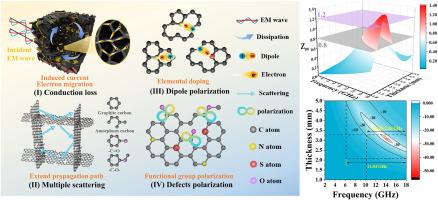
The rapid advancement of information technology has caused an increase in electromagnetic interference, making the development of high-efficiency electromagnetic (EM) wave absorbers an urgent area of interest. However, the design of EM wave absorbers faces certain bottlenecks, such as the lack of narrow bandwidths and heavy weights. In this study, novel nitrogen–sulfur dual-doped 3D honeycomb-like carbon was fabricated as an EM wave absorber by heteroatom doping and defect engineering to modulate the electronic structure to regulate the defect and migration energy barriers, thus facilitating impedance matching between nanosheets and air, enhancing charge transfer, and producing numerous active sites for dipole polarization. Crucially, the combination of honeycomb-like carbon and nanosheets provides an abundance of conductive paths, heterointerfaces, and inner cavities, resulting in lightweight and absorption bandwidth enhancement. Moreover, the material demonstrated excellent EM wave absorption properties, having a high-efficiency loss of −60.3 dB and an effective absorption bandwidth up to 7.36 GHz at only 8 wt% filler content. Additionally, this material showed a low corrosion current density (1.094 × 10⁻⁶ A) and high polarization resistance (39.22 kΩ), maintaining excellent stability and corrosion resistance in simulated seawater. This research provides valuable perspectives for the investigation of dielectric loss and the advancement of multifunctional EM wave absorption materials.
期刊介绍:
The journal Carbon is an international multidisciplinary forum for communicating scientific advances in the field of carbon materials. It reports new findings related to the formation, structure, properties, behaviors, and technological applications of carbons. Carbons are a broad class of ordered or disordered solid phases composed primarily of elemental carbon, including but not limited to carbon black, carbon fibers and filaments, carbon nanotubes, diamond and diamond-like carbon, fullerenes, glassy carbon, graphite, graphene, graphene-oxide, porous carbons, pyrolytic carbon, and other sp2 and non-sp2 hybridized carbon systems. Carbon is the companion title to the open access journal Carbon Trends. Relevant application areas for carbon materials include biology and medicine, catalysis, electronic, optoelectronic, spintronic, high-frequency, and photonic devices, energy storage and conversion systems, environmental applications and water treatment, smart materials and systems, and structural and thermal applications.




 京公网安备 11010802042870号
京ICP备2023020795号-1
京公网安备 11010802042870号
京ICP备2023020795号-1

 分享
分享
 求助内容:
求助内容: 应助结果提醒方式:
 扫码关注我们
