Abiodun A. Ajibola , Néstor Cubillán , Ludis Coba-Jiménez , Julia Kłak , Lesław Sieroń , Waldemar Maniukiewicz
{"title":"1,2 -邻菲罗啉双苯氧乙酸桥接双核锰配合物:合成、一维超分子结构、Hirshfeld表面分析、磁性和理论研究","authors":"Abiodun A. Ajibola , Néstor Cubillán , Ludis Coba-Jiménez , Julia Kłak , Lesław Sieroń , Waldemar Maniukiewicz","doi":"10.1016/j.poly.2024.117337","DOIUrl":null,"url":null,"abstract":"<div><div>We report herein the synthesis and characterization of [Mn<sub>2</sub>(POA)<sub>2</sub>(Phen)<sub>4</sub>](BF<sub>4</sub>)<sub>2</sub>·H<sub>2</sub>O, <strong>1</strong> where POA = phenoxyacetate; Phen = 1,10-phenthroline, respectively. The crystalline complex was obtained via slow evaporation at room temperature and characterized by single crystal X-ray diffraction. FTIR and UV–vis spectroscopy were utilized to elucidate the structure of the new compound. Complex <strong>1</strong> crystallizes in the monoclinic crystal system with space group <em>P</em>2<sub>1</sub>/n. Hirshfeld surface analysis revealed various intermolecular interactions in the crystal lattice. Quantum Theory of Atoms in Molecules (QTAIM), Reduced Density Gradient (RDG), and Natural Bond Orbital (NBO) analyses were employed to investigate the diverse non-covalent interactions stabilizing the crystal structure. In complex <strong>1</strong>, the BF<sub>4</sub><sup>−</sup> counterion plays a crucial role in crystal assembly through a network of F···H <img> C interactions with varying strengths governed by the interaction angle and consequent ellipticity. Additionally, B − F···π interactions were observed. Other interactions include weak-to-medium hydrogen bonds and π-interactions (CH···π and π···π) within the asymmetric units and dimers extracted from the unit cell. Notably, unconventional interactions were identified and characterized in complex <strong>1</strong>, which is C <img> H···π interactions with the σ(CH) orbital donating to an empty <em>p</em> orbital in the asymmetric unit of <strong>1</strong>. Variable-temperature magnetic susceptibility data disclosed the occurrence of weak antiferromagnetic coupling within the doubly bridged manganese(II) core with a <em>J</em> value of – 2.11 cm<sup>−1</sup>.</div></div>","PeriodicalId":20278,"journal":{"name":"Polyhedron","volume":"267 ","pages":"Article 117337"},"PeriodicalIF":2.6000,"publicationDate":"2025-02-01","publicationTypes":"Journal Article","fieldsOfStudy":null,"isOpenAccess":false,"openAccessPdf":"","citationCount":"0","resultStr":"{\"title\":\"A doubly Phenoxyacetate-bridged dinuclear manganese(II) complex with 1,10-Phenanthroline: Synthesis, 1-D supramolecular structure, Hirshfeld surface analysis, magnetic and theoretical studies\",\"authors\":\"Abiodun A. Ajibola , Néstor Cubillán , Ludis Coba-Jiménez , Julia Kłak , Lesław Sieroń , Waldemar Maniukiewicz\",\"doi\":\"10.1016/j.poly.2024.117337\",\"DOIUrl\":null,\"url\":null,\"abstract\":\"<div><div>We report herein the synthesis and characterization of [Mn<sub>2</sub>(POA)<sub>2</sub>(Phen)<sub>4</sub>](BF<sub>4</sub>)<sub>2</sub>·H<sub>2</sub>O, <strong>1</strong> where POA = phenoxyacetate; Phen = 1,10-phenthroline, respectively. The crystalline complex was obtained via slow evaporation at room temperature and characterized by single crystal X-ray diffraction. FTIR and UV–vis spectroscopy were utilized to elucidate the structure of the new compound. Complex <strong>1</strong> crystallizes in the monoclinic crystal system with space group <em>P</em>2<sub>1</sub>/n. Hirshfeld surface analysis revealed various intermolecular interactions in the crystal lattice. Quantum Theory of Atoms in Molecules (QTAIM), Reduced Density Gradient (RDG), and Natural Bond Orbital (NBO) analyses were employed to investigate the diverse non-covalent interactions stabilizing the crystal structure. In complex <strong>1</strong>, the BF<sub>4</sub><sup>−</sup> counterion plays a crucial role in crystal assembly through a network of F···H <img> C interactions with varying strengths governed by the interaction angle and consequent ellipticity. Additionally, B − F···π interactions were observed. Other interactions include weak-to-medium hydrogen bonds and π-interactions (CH···π and π···π) within the asymmetric units and dimers extracted from the unit cell. Notably, unconventional interactions were identified and characterized in complex <strong>1</strong>, which is C <img> H···π interactions with the σ(CH) orbital donating to an empty <em>p</em> orbital in the asymmetric unit of <strong>1</strong>. Variable-temperature magnetic susceptibility data disclosed the occurrence of weak antiferromagnetic coupling within the doubly bridged manganese(II) core with a <em>J</em> value of – 2.11 cm<sup>−1</sup>.</div></div>\",\"PeriodicalId\":20278,\"journal\":{\"name\":\"Polyhedron\",\"volume\":\"267 \",\"pages\":\"Article 117337\"},\"PeriodicalIF\":2.6000,\"publicationDate\":\"2025-02-01\",\"publicationTypes\":\"Journal Article\",\"fieldsOfStudy\":null,\"isOpenAccess\":false,\"openAccessPdf\":\"\",\"citationCount\":\"0\",\"resultStr\":null,\"platform\":\"Semanticscholar\",\"paperid\":null,\"PeriodicalName\":\"Polyhedron\",\"FirstCategoryId\":\"92\",\"ListUrlMain\":\"https://www.sciencedirect.com/science/article/pii/S0277538724005138\",\"RegionNum\":3,\"RegionCategory\":\"化学\",\"ArticlePicture\":[],\"TitleCN\":null,\"AbstractTextCN\":null,\"PMCID\":null,\"EPubDate\":\"2024/12/4 0:00:00\",\"PubModel\":\"Epub\",\"JCR\":\"Q2\",\"JCRName\":\"CHEMISTRY, INORGANIC & NUCLEAR\",\"Score\":null,\"Total\":0}","platform":"Semanticscholar","paperid":null,"PeriodicalName":"Polyhedron","FirstCategoryId":"92","ListUrlMain":"https://www.sciencedirect.com/science/article/pii/S0277538724005138","RegionNum":3,"RegionCategory":"化学","ArticlePicture":[],"TitleCN":null,"AbstractTextCN":null,"PMCID":null,"EPubDate":"2024/12/4 0:00:00","PubModel":"Epub","JCR":"Q2","JCRName":"CHEMISTRY, INORGANIC & NUCLEAR","Score":null,"Total":0}
A doubly Phenoxyacetate-bridged dinuclear manganese(II) complex with 1,10-Phenanthroline: Synthesis, 1-D supramolecular structure, Hirshfeld surface analysis, magnetic and theoretical studies
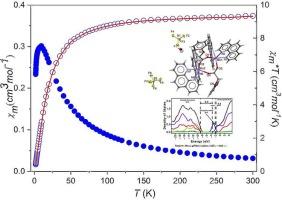
We report herein the synthesis and characterization of [Mn2(POA)2(Phen)4](BF4)2·H2O, 1 where POA = phenoxyacetate; Phen = 1,10-phenthroline, respectively. The crystalline complex was obtained via slow evaporation at room temperature and characterized by single crystal X-ray diffraction. FTIR and UV–vis spectroscopy were utilized to elucidate the structure of the new compound. Complex 1 crystallizes in the monoclinic crystal system with space group P21/n. Hirshfeld surface analysis revealed various intermolecular interactions in the crystal lattice. Quantum Theory of Atoms in Molecules (QTAIM), Reduced Density Gradient (RDG), and Natural Bond Orbital (NBO) analyses were employed to investigate the diverse non-covalent interactions stabilizing the crystal structure. In complex 1, the BF4− counterion plays a crucial role in crystal assembly through a network of F···H C interactions with varying strengths governed by the interaction angle and consequent ellipticity. Additionally, B − F···π interactions were observed. Other interactions include weak-to-medium hydrogen bonds and π-interactions (CH···π and π···π) within the asymmetric units and dimers extracted from the unit cell. Notably, unconventional interactions were identified and characterized in complex 1, which is C H···π interactions with the σ(CH) orbital donating to an empty p orbital in the asymmetric unit of 1. Variable-temperature magnetic susceptibility data disclosed the occurrence of weak antiferromagnetic coupling within the doubly bridged manganese(II) core with a J value of – 2.11 cm−1.
期刊介绍:
Polyhedron publishes original, fundamental, experimental and theoretical work of the highest quality in all the major areas of inorganic chemistry. This includes synthetic chemistry, coordination chemistry, organometallic chemistry, bioinorganic chemistry, and solid-state and materials chemistry.
Papers should be significant pieces of work, and all new compounds must be appropriately characterized. The inclusion of single-crystal X-ray structural data is strongly encouraged, but papers reporting only the X-ray structure determination of a single compound will usually not be considered. Papers on solid-state or materials chemistry will be expected to have a significant molecular chemistry component (such as the synthesis and characterization of the molecular precursors and/or a systematic study of the use of different precursors or reaction conditions) or demonstrate a cutting-edge application (for example inorganic materials for energy applications). Papers dealing only with stability constants are not considered.




 京公网安备 11010802042870号
京ICP备2023020795号-1
京公网安备 11010802042870号
京ICP备2023020795号-1

 分享
分享
 求助内容:
求助内容: 应助结果提醒方式:
 扫码关注我们
