Zheng Li , Ling Lin , Yuanhao Luo , Shenwen Fang , Hongdan Ao , Meirong Wang
{"title":"硅烷改性羟乙基纤维素/硅酸镁锂复合材料的耐温耐盐流变改性剂","authors":"Zheng Li , Ling Lin , Yuanhao Luo , Shenwen Fang , Hongdan Ao , Meirong Wang","doi":"10.1016/j.geoen.2025.213724","DOIUrl":null,"url":null,"abstract":"<div><div>The characteristics of natural materials for drilling fluid additives that are not resistant to high temperature and high salt are well known. In this paper, hydroxyethyl cellulose (HEC) was modified with different silane coupling agents (SCA). Then, lithium magnesium silicate (LMS) was introduced to prepare a composite material (HEC/APS/LMS) to further improve the structural strength of the polymer. FTIR and <sup>1</sup>H NMR showed that the composites were successfully prepared. TGA analysis showed that the degradation rate of the composites was much lower than that of unmodified HEC at 263 °C–320 °C. The rheological analysis of the drilling fluid after adding the composite material showed that the viscosity of the drilling fluid remained stable before and after aging at 160 °C, and the change rate was less than 10 %. After aging at 180 °C, the viscosity retention rate is still greater than 50 %. SCA is interpenetrated into the polymer network structure by chemical bonds, hydrogen bonds, and polycondensation to form a low molecular weight polysiloxane structure. The thermal stability of the polymer was enhanced. The introduction of LMS, through hydrogen bonding and electrostatic adsorption, further enhances the spatial network structure of drilling fluid, and improves the ability of drilling fluid to suspend cuttings and clean wellbore. Silanized cellulose materials provide a new way to reinforce the temperature and salt resistance of natural materials.</div></div>","PeriodicalId":100578,"journal":{"name":"Geoenergy Science and Engineering","volume":"247 ","pages":"Article 213724"},"PeriodicalIF":4.6000,"publicationDate":"2025-04-01","publicationTypes":"Journal Article","fieldsOfStudy":null,"isOpenAccess":false,"openAccessPdf":"","citationCount":"0","resultStr":"{\"title\":\"Silane-modified hydroxyethyl cellulose / lithium magnesium silicate composite as a rheology modifier for temperature and salt resistance\",\"authors\":\"Zheng Li , Ling Lin , Yuanhao Luo , Shenwen Fang , Hongdan Ao , Meirong Wang\",\"doi\":\"10.1016/j.geoen.2025.213724\",\"DOIUrl\":null,\"url\":null,\"abstract\":\"<div><div>The characteristics of natural materials for drilling fluid additives that are not resistant to high temperature and high salt are well known. In this paper, hydroxyethyl cellulose (HEC) was modified with different silane coupling agents (SCA). Then, lithium magnesium silicate (LMS) was introduced to prepare a composite material (HEC/APS/LMS) to further improve the structural strength of the polymer. FTIR and <sup>1</sup>H NMR showed that the composites were successfully prepared. TGA analysis showed that the degradation rate of the composites was much lower than that of unmodified HEC at 263 °C–320 °C. The rheological analysis of the drilling fluid after adding the composite material showed that the viscosity of the drilling fluid remained stable before and after aging at 160 °C, and the change rate was less than 10 %. After aging at 180 °C, the viscosity retention rate is still greater than 50 %. SCA is interpenetrated into the polymer network structure by chemical bonds, hydrogen bonds, and polycondensation to form a low molecular weight polysiloxane structure. The thermal stability of the polymer was enhanced. The introduction of LMS, through hydrogen bonding and electrostatic adsorption, further enhances the spatial network structure of drilling fluid, and improves the ability of drilling fluid to suspend cuttings and clean wellbore. Silanized cellulose materials provide a new way to reinforce the temperature and salt resistance of natural materials.</div></div>\",\"PeriodicalId\":100578,\"journal\":{\"name\":\"Geoenergy Science and Engineering\",\"volume\":\"247 \",\"pages\":\"Article 213724\"},\"PeriodicalIF\":4.6000,\"publicationDate\":\"2025-04-01\",\"publicationTypes\":\"Journal Article\",\"fieldsOfStudy\":null,\"isOpenAccess\":false,\"openAccessPdf\":\"\",\"citationCount\":\"0\",\"resultStr\":null,\"platform\":\"Semanticscholar\",\"paperid\":null,\"PeriodicalName\":\"Geoenergy Science and Engineering\",\"FirstCategoryId\":\"1085\",\"ListUrlMain\":\"https://www.sciencedirect.com/science/article/pii/S294989102500082X\",\"RegionNum\":0,\"RegionCategory\":null,\"ArticlePicture\":[],\"TitleCN\":null,\"AbstractTextCN\":null,\"PMCID\":null,\"EPubDate\":\"2025/1/29 0:00:00\",\"PubModel\":\"Epub\",\"JCR\":\"0\",\"JCRName\":\"ENERGY & FUELS\",\"Score\":null,\"Total\":0}","platform":"Semanticscholar","paperid":null,"PeriodicalName":"Geoenergy Science and Engineering","FirstCategoryId":"1085","ListUrlMain":"https://www.sciencedirect.com/science/article/pii/S294989102500082X","RegionNum":0,"RegionCategory":null,"ArticlePicture":[],"TitleCN":null,"AbstractTextCN":null,"PMCID":null,"EPubDate":"2025/1/29 0:00:00","PubModel":"Epub","JCR":"0","JCRName":"ENERGY & FUELS","Score":null,"Total":0}
Silane-modified hydroxyethyl cellulose / lithium magnesium silicate composite as a rheology modifier for temperature and salt resistance
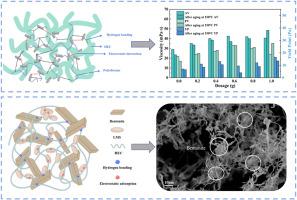
The characteristics of natural materials for drilling fluid additives that are not resistant to high temperature and high salt are well known. In this paper, hydroxyethyl cellulose (HEC) was modified with different silane coupling agents (SCA). Then, lithium magnesium silicate (LMS) was introduced to prepare a composite material (HEC/APS/LMS) to further improve the structural strength of the polymer. FTIR and 1H NMR showed that the composites were successfully prepared. TGA analysis showed that the degradation rate of the composites was much lower than that of unmodified HEC at 263 °C–320 °C. The rheological analysis of the drilling fluid after adding the composite material showed that the viscosity of the drilling fluid remained stable before and after aging at 160 °C, and the change rate was less than 10 %. After aging at 180 °C, the viscosity retention rate is still greater than 50 %. SCA is interpenetrated into the polymer network structure by chemical bonds, hydrogen bonds, and polycondensation to form a low molecular weight polysiloxane structure. The thermal stability of the polymer was enhanced. The introduction of LMS, through hydrogen bonding and electrostatic adsorption, further enhances the spatial network structure of drilling fluid, and improves the ability of drilling fluid to suspend cuttings and clean wellbore. Silanized cellulose materials provide a new way to reinforce the temperature and salt resistance of natural materials.




 京公网安备 11010802042870号
京ICP备2023020795号-1
京公网安备 11010802042870号
京ICP备2023020795号-1

 分享
分享

 求助内容:
求助内容: 应助结果提醒方式:
 扫码关注我们
