Ivan R. Siqueira , Michelle Durán-Chaves , Oliver S. Dewey , Steven M. Williams , Cedric J.S. Ginestra , Juan De La Garza , Yingru Song , Geoff Wehmeyer , Matteo Pasquali
{"title":"完全可回收的碳纳米管纤维","authors":"Ivan R. Siqueira , Michelle Durán-Chaves , Oliver S. Dewey , Steven M. Williams , Cedric J.S. Ginestra , Juan De La Garza , Yingru Song , Geoff Wehmeyer , Matteo Pasquali","doi":"10.1016/j.carbon.2024.119899","DOIUrl":null,"url":null,"abstract":"<div><div>Challenges and limitations in the recycling of metals, polymers, and carbon fibers have been a major concern to climate change and material circularity. With demonstrated property overlaps and increasingly efficient production, carbon nanotube (CNT) fibers can become a sustainable replacement to hard-to-decarbonize incumbent industrial materials. Here, we show that solution-spun CNT fibers can be fully and easily recycled without loss of properties and irrespective of their constituent CNTs. Continuous segments of virgin, single-source CNT fibers made from different CNTs were mixed together in solution and reprocessed into a recycled, mixed-source CNT fiber with the same morphology, structure, alignment, and properties of the virgin, mixed-source CNT fiber made by directly mixing the raw CNTs. Following the ongoing improvements in CNT synthesis and CNT fiber manufacturing, recyclability further positions CNT fibers as a promising alternative to realize the transition to a greener future with a circular economy.</div></div>","PeriodicalId":262,"journal":{"name":"Carbon","volume":"233 ","pages":"Article 119899"},"PeriodicalIF":12.7000,"publicationDate":"2025-02-01","publicationTypes":"Journal Article","fieldsOfStudy":null,"isOpenAccess":false,"openAccessPdf":"","citationCount":"0","resultStr":"{\"title\":\"Fully recyclable carbon nanotube fibers\",\"authors\":\"Ivan R. Siqueira , Michelle Durán-Chaves , Oliver S. Dewey , Steven M. Williams , Cedric J.S. Ginestra , Juan De La Garza , Yingru Song , Geoff Wehmeyer , Matteo Pasquali\",\"doi\":\"10.1016/j.carbon.2024.119899\",\"DOIUrl\":null,\"url\":null,\"abstract\":\"<div><div>Challenges and limitations in the recycling of metals, polymers, and carbon fibers have been a major concern to climate change and material circularity. With demonstrated property overlaps and increasingly efficient production, carbon nanotube (CNT) fibers can become a sustainable replacement to hard-to-decarbonize incumbent industrial materials. Here, we show that solution-spun CNT fibers can be fully and easily recycled without loss of properties and irrespective of their constituent CNTs. Continuous segments of virgin, single-source CNT fibers made from different CNTs were mixed together in solution and reprocessed into a recycled, mixed-source CNT fiber with the same morphology, structure, alignment, and properties of the virgin, mixed-source CNT fiber made by directly mixing the raw CNTs. Following the ongoing improvements in CNT synthesis and CNT fiber manufacturing, recyclability further positions CNT fibers as a promising alternative to realize the transition to a greener future with a circular economy.</div></div>\",\"PeriodicalId\":262,\"journal\":{\"name\":\"Carbon\",\"volume\":\"233 \",\"pages\":\"Article 119899\"},\"PeriodicalIF\":12.7000,\"publicationDate\":\"2025-02-01\",\"publicationTypes\":\"Journal Article\",\"fieldsOfStudy\":null,\"isOpenAccess\":false,\"openAccessPdf\":\"\",\"citationCount\":\"0\",\"resultStr\":null,\"platform\":\"Semanticscholar\",\"paperid\":null,\"PeriodicalName\":\"Carbon\",\"FirstCategoryId\":\"88\",\"ListUrlMain\":\"https://www.sciencedirect.com/science/article/pii/S0008622324011187\",\"RegionNum\":2,\"RegionCategory\":\"材料科学\",\"ArticlePicture\":[],\"TitleCN\":null,\"AbstractTextCN\":null,\"PMCID\":null,\"EPubDate\":\"2024/12/5 0:00:00\",\"PubModel\":\"Epub\",\"JCR\":\"Q1\",\"JCRName\":\"CHEMISTRY, PHYSICAL\",\"Score\":null,\"Total\":0}","platform":"Semanticscholar","paperid":null,"PeriodicalName":"Carbon","FirstCategoryId":"88","ListUrlMain":"https://www.sciencedirect.com/science/article/pii/S0008622324011187","RegionNum":2,"RegionCategory":"材料科学","ArticlePicture":[],"TitleCN":null,"AbstractTextCN":null,"PMCID":null,"EPubDate":"2024/12/5 0:00:00","PubModel":"Epub","JCR":"Q1","JCRName":"CHEMISTRY, PHYSICAL","Score":null,"Total":0}
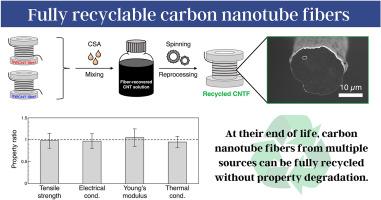
Challenges and limitations in the recycling of metals, polymers, and carbon fibers have been a major concern to climate change and material circularity. With demonstrated property overlaps and increasingly efficient production, carbon nanotube (CNT) fibers can become a sustainable replacement to hard-to-decarbonize incumbent industrial materials. Here, we show that solution-spun CNT fibers can be fully and easily recycled without loss of properties and irrespective of their constituent CNTs. Continuous segments of virgin, single-source CNT fibers made from different CNTs were mixed together in solution and reprocessed into a recycled, mixed-source CNT fiber with the same morphology, structure, alignment, and properties of the virgin, mixed-source CNT fiber made by directly mixing the raw CNTs. Following the ongoing improvements in CNT synthesis and CNT fiber manufacturing, recyclability further positions CNT fibers as a promising alternative to realize the transition to a greener future with a circular economy.
期刊介绍:
The journal Carbon is an international multidisciplinary forum for communicating scientific advances in the field of carbon materials. It reports new findings related to the formation, structure, properties, behaviors, and technological applications of carbons. Carbons are a broad class of ordered or disordered solid phases composed primarily of elemental carbon, including but not limited to carbon black, carbon fibers and filaments, carbon nanotubes, diamond and diamond-like carbon, fullerenes, glassy carbon, graphite, graphene, graphene-oxide, porous carbons, pyrolytic carbon, and other sp2 and non-sp2 hybridized carbon systems. Carbon is the companion title to the open access journal Carbon Trends. Relevant application areas for carbon materials include biology and medicine, catalysis, electronic, optoelectronic, spintronic, high-frequency, and photonic devices, energy storage and conversion systems, environmental applications and water treatment, smart materials and systems, and structural and thermal applications.




 京公网安备 11010802042870号
京ICP备2023020795号-1
京公网安备 11010802042870号
京ICP备2023020795号-1

 分享
分享
 求助内容:
求助内容: 应助结果提醒方式:
 扫码关注我们
