S.X. Wang , N.N. Liang , B.X. Wang , S.F. Li , R.D.K. Misra , X.M. Gan , L. Zhang , Y.F. Yang
{"title":"钛基复合材料晶内TiC纳米薄片的表征及取向依赖性强化行为","authors":"S.X. Wang , N.N. Liang , B.X. Wang , S.F. Li , R.D.K. Misra , X.M. Gan , L. Zhang , Y.F. Yang","doi":"10.1016/j.carbon.2024.119884","DOIUrl":null,"url":null,"abstract":"<div><div>We present here the intrinsic strengthening mechanism of newly developed Ti<sub>8</sub>C<sub>5</sub> nanoplatelet reinforcement in titanium matrix composites (TMCs) and the significant impact of their orientation characteristics on the mechanical properties and deformation behavior of Ti matrix. The unique two-dimensional structure, uniform intragranular distribution, and locally aligned orientation of nanoplatelets provide exceptional strengthening efficiency and a distinctive strengthening mechanism. The nanoplatelets significantly strengthened the Ti matrix by impeding <a> dislocation motion on prismatic and basal slip planes, resulting in massive dislocation pile-up. Moreover, the activation of pyramidal <c+a> slip system induced geometrically necessary dislocations to accommodate plastic deformation, thereby maintaining considerable ductility. Micro-compression studies revealed a strong dependence on strengthening behavior and effectiveness on the spatial orientation and the direction of local alignment of nanoplatelets. The maximum strengthening effect is achieved when the platelet planes align parallel to the loading direction, with compressive ultimate and yield strengths of 2.9 and 1.9 GPa, respectively. In contrast, increasing the angle between platelet plane and loading direction led to the evolution of platelet/α-Ti interface into a pseudo-slip system, which severely deteriorated both strength and ductility. These fundamental insights provide an optimal spatial architecture for fabricating high-performance alignment-strengthened TMCs together with a feasible tailoring strategy.</div></div>","PeriodicalId":262,"journal":{"name":"Carbon","volume":"233 ","pages":"Article 119884"},"PeriodicalIF":12.7000,"publicationDate":"2025-02-01","publicationTypes":"Journal Article","fieldsOfStudy":null,"isOpenAccess":false,"openAccessPdf":"","citationCount":"0","resultStr":"{\"title\":\"Characterization and orientation-dependent strengthening behavior of intragranular TiC nanoplatelets in titanium matrix composites\",\"authors\":\"S.X. Wang , N.N. Liang , B.X. Wang , S.F. Li , R.D.K. Misra , X.M. Gan , L. Zhang , Y.F. Yang\",\"doi\":\"10.1016/j.carbon.2024.119884\",\"DOIUrl\":null,\"url\":null,\"abstract\":\"<div><div>We present here the intrinsic strengthening mechanism of newly developed Ti<sub>8</sub>C<sub>5</sub> nanoplatelet reinforcement in titanium matrix composites (TMCs) and the significant impact of their orientation characteristics on the mechanical properties and deformation behavior of Ti matrix. The unique two-dimensional structure, uniform intragranular distribution, and locally aligned orientation of nanoplatelets provide exceptional strengthening efficiency and a distinctive strengthening mechanism. The nanoplatelets significantly strengthened the Ti matrix by impeding <a> dislocation motion on prismatic and basal slip planes, resulting in massive dislocation pile-up. Moreover, the activation of pyramidal <c+a> slip system induced geometrically necessary dislocations to accommodate plastic deformation, thereby maintaining considerable ductility. Micro-compression studies revealed a strong dependence on strengthening behavior and effectiveness on the spatial orientation and the direction of local alignment of nanoplatelets. The maximum strengthening effect is achieved when the platelet planes align parallel to the loading direction, with compressive ultimate and yield strengths of 2.9 and 1.9 GPa, respectively. In contrast, increasing the angle between platelet plane and loading direction led to the evolution of platelet/α-Ti interface into a pseudo-slip system, which severely deteriorated both strength and ductility. These fundamental insights provide an optimal spatial architecture for fabricating high-performance alignment-strengthened TMCs together with a feasible tailoring strategy.</div></div>\",\"PeriodicalId\":262,\"journal\":{\"name\":\"Carbon\",\"volume\":\"233 \",\"pages\":\"Article 119884\"},\"PeriodicalIF\":12.7000,\"publicationDate\":\"2025-02-01\",\"publicationTypes\":\"Journal Article\",\"fieldsOfStudy\":null,\"isOpenAccess\":false,\"openAccessPdf\":\"\",\"citationCount\":\"0\",\"resultStr\":null,\"platform\":\"Semanticscholar\",\"paperid\":null,\"PeriodicalName\":\"Carbon\",\"FirstCategoryId\":\"88\",\"ListUrlMain\":\"https://www.sciencedirect.com/science/article/pii/S0008622324011035\",\"RegionNum\":2,\"RegionCategory\":\"材料科学\",\"ArticlePicture\":[],\"TitleCN\":null,\"AbstractTextCN\":null,\"PMCID\":null,\"EPubDate\":\"2024/12/2 0:00:00\",\"PubModel\":\"Epub\",\"JCR\":\"Q1\",\"JCRName\":\"CHEMISTRY, PHYSICAL\",\"Score\":null,\"Total\":0}","platform":"Semanticscholar","paperid":null,"PeriodicalName":"Carbon","FirstCategoryId":"88","ListUrlMain":"https://www.sciencedirect.com/science/article/pii/S0008622324011035","RegionNum":2,"RegionCategory":"材料科学","ArticlePicture":[],"TitleCN":null,"AbstractTextCN":null,"PMCID":null,"EPubDate":"2024/12/2 0:00:00","PubModel":"Epub","JCR":"Q1","JCRName":"CHEMISTRY, PHYSICAL","Score":null,"Total":0}
Characterization and orientation-dependent strengthening behavior of intragranular TiC nanoplatelets in titanium matrix composites
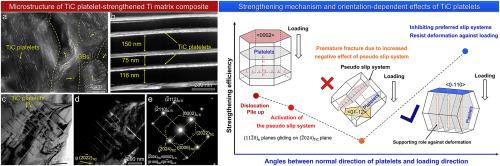
We present here the intrinsic strengthening mechanism of newly developed Ti8C5 nanoplatelet reinforcement in titanium matrix composites (TMCs) and the significant impact of their orientation characteristics on the mechanical properties and deformation behavior of Ti matrix. The unique two-dimensional structure, uniform intragranular distribution, and locally aligned orientation of nanoplatelets provide exceptional strengthening efficiency and a distinctive strengthening mechanism. The nanoplatelets significantly strengthened the Ti matrix by impeding <a> dislocation motion on prismatic and basal slip planes, resulting in massive dislocation pile-up. Moreover, the activation of pyramidal <c+a> slip system induced geometrically necessary dislocations to accommodate plastic deformation, thereby maintaining considerable ductility. Micro-compression studies revealed a strong dependence on strengthening behavior and effectiveness on the spatial orientation and the direction of local alignment of nanoplatelets. The maximum strengthening effect is achieved when the platelet planes align parallel to the loading direction, with compressive ultimate and yield strengths of 2.9 and 1.9 GPa, respectively. In contrast, increasing the angle between platelet plane and loading direction led to the evolution of platelet/α-Ti interface into a pseudo-slip system, which severely deteriorated both strength and ductility. These fundamental insights provide an optimal spatial architecture for fabricating high-performance alignment-strengthened TMCs together with a feasible tailoring strategy.
期刊介绍:
The journal Carbon is an international multidisciplinary forum for communicating scientific advances in the field of carbon materials. It reports new findings related to the formation, structure, properties, behaviors, and technological applications of carbons. Carbons are a broad class of ordered or disordered solid phases composed primarily of elemental carbon, including but not limited to carbon black, carbon fibers and filaments, carbon nanotubes, diamond and diamond-like carbon, fullerenes, glassy carbon, graphite, graphene, graphene-oxide, porous carbons, pyrolytic carbon, and other sp2 and non-sp2 hybridized carbon systems. Carbon is the companion title to the open access journal Carbon Trends. Relevant application areas for carbon materials include biology and medicine, catalysis, electronic, optoelectronic, spintronic, high-frequency, and photonic devices, energy storage and conversion systems, environmental applications and water treatment, smart materials and systems, and structural and thermal applications.




 京公网安备 11010802042870号
京ICP备2023020795号-1
京公网安备 11010802042870号
京ICP备2023020795号-1

 分享
分享
 求助内容:
求助内容: 应助结果提醒方式:
 扫码关注我们
