{"title":"1:1腈-路易斯碱配合物的弱分子相互作用:化学键性质的理论视角","authors":"Giridhar Baburao, Gopi Ragupathy","doi":"10.1016/j.comptc.2025.115072","DOIUrl":null,"url":null,"abstract":"<div><div>Our study focused on understanding how certain Lewis bases like H<span><math><msub><mrow></mrow><mrow><mn>2</mn></mrow></msub></math></span>O, NH<span><math><msub><mrow></mrow><mrow><mn>3</mn></mrow></msub></math></span>, HCl, and C<span><math><msub><mrow></mrow><mrow><mn>2</mn></mrow></msub></math></span>H<span><math><msub><mrow></mrow><mrow><mn>2</mn></mrow></msub></math></span>, interact with specific nitriles such as, Glycolonitrile (GLY), Cyanic acid (CYA), and 3-Hydroxy-2-propenenitrile (HPN). These interactions form 1:1 complexes through hydrogen bond. Here we observed weak hydrogen bonding interactions such as, C<span><math><mo>≡</mo></math></span>N<span><math><mi>⋅</mi></math></span> <span><math><mi>⋅</mi></math></span> <span><math><mi>⋅</mi></math></span>H, O-H<span><math><mrow><mo>⋯</mo><mspace></mspace></mrow></math></span>N, O-H<span><math><mrow><mo>⋯</mo><mspace></mspace></mrow></math></span>O, or O-H<span><math><mrow><mo>⋯</mo><mi>π</mi></mrow></math></span> in these complexes. In C<span><math><mo>≡</mo></math></span>N<span><math><mi>⋅</mi></math></span> <span><math><mi>⋅</mi></math></span> <span><math><mi>⋅</mi></math></span>H interaction, when a nitrile molecule interacts with a Lewis base, it acts as a proton acceptor, while the corresponding Lewis base acts as a proton donor. However, this is reversed when the molecule possesses an O-H<span><math><mrow><mo>⋯</mo><mspace></mspace></mrow></math></span>X (X = N, O, Cl, <span><math><mi>π</mi></math></span>) interaction. Among these, in most cases, the complexes with O-H<span><math><mrow><mo>⋯</mo><mspace></mspace></mrow></math></span>X interactions were the most stable, representing the global minima. Detailed Atom in Molecule (AIM) and Natural Bonding Orbital (NBO) analyses confirmed the presence of these hydrogen bonds. Intermolecular bond critical points (BCPs) were identified. The electron density at BCPs <span><math><mrow><mi>ρ</mi><mrow><mo>(</mo><msub><mrow><mi>r</mi></mrow><mrow><mi>c</mi></mrow></msub><mo>)</mo></mrow></mrow></math></span> was within the range of 0.002 to 0.035 a.u. as described in the Koch and Popelier study. The Laplacian of electron density <span><math><mrow><msup><mrow><mo>∇</mo></mrow><mrow><mn>2</mn></mrow></msup><mi>ρ</mi></mrow></math></span> was positive, further proving hydrogen bonding interaction. NBO analysis showed that O-H<span><math><mrow><mo>⋯</mo><mspace></mspace></mrow></math></span>N interactions had higher second order perturbation energies compared to O-H<span><math><mrow><mo>⋯</mo><mspace></mspace></mrow></math></span>O, O-H<span><math><mrow><mo>⋯</mo><mi>π</mi></mrow></math></span>, and O-H<span><math><mrow><mo>⋯</mo><mspace></mspace></mrow></math></span>Cl interactions.</div></div>","PeriodicalId":284,"journal":{"name":"Computational and Theoretical Chemistry","volume":"1244 ","pages":"Article 115072"},"PeriodicalIF":2.9000,"publicationDate":"2025-02-01","publicationTypes":"Journal Article","fieldsOfStudy":null,"isOpenAccess":false,"openAccessPdf":"","citationCount":"0","resultStr":"{\"title\":\"Weak molecular interactions of 1:1 Nitrile–Lewis base complexes: A theoretical perspective on nature of chemical bonding\",\"authors\":\"Giridhar Baburao, Gopi Ragupathy\",\"doi\":\"10.1016/j.comptc.2025.115072\",\"DOIUrl\":null,\"url\":null,\"abstract\":\"<div><div>Our study focused on understanding how certain Lewis bases like H<span><math><msub><mrow></mrow><mrow><mn>2</mn></mrow></msub></math></span>O, NH<span><math><msub><mrow></mrow><mrow><mn>3</mn></mrow></msub></math></span>, HCl, and C<span><math><msub><mrow></mrow><mrow><mn>2</mn></mrow></msub></math></span>H<span><math><msub><mrow></mrow><mrow><mn>2</mn></mrow></msub></math></span>, interact with specific nitriles such as, Glycolonitrile (GLY), Cyanic acid (CYA), and 3-Hydroxy-2-propenenitrile (HPN). These interactions form 1:1 complexes through hydrogen bond. Here we observed weak hydrogen bonding interactions such as, C<span><math><mo>≡</mo></math></span>N<span><math><mi>⋅</mi></math></span> <span><math><mi>⋅</mi></math></span> <span><math><mi>⋅</mi></math></span>H, O-H<span><math><mrow><mo>⋯</mo><mspace></mspace></mrow></math></span>N, O-H<span><math><mrow><mo>⋯</mo><mspace></mspace></mrow></math></span>O, or O-H<span><math><mrow><mo>⋯</mo><mi>π</mi></mrow></math></span> in these complexes. In C<span><math><mo>≡</mo></math></span>N<span><math><mi>⋅</mi></math></span> <span><math><mi>⋅</mi></math></span> <span><math><mi>⋅</mi></math></span>H interaction, when a nitrile molecule interacts with a Lewis base, it acts as a proton acceptor, while the corresponding Lewis base acts as a proton donor. However, this is reversed when the molecule possesses an O-H<span><math><mrow><mo>⋯</mo><mspace></mspace></mrow></math></span>X (X = N, O, Cl, <span><math><mi>π</mi></math></span>) interaction. Among these, in most cases, the complexes with O-H<span><math><mrow><mo>⋯</mo><mspace></mspace></mrow></math></span>X interactions were the most stable, representing the global minima. Detailed Atom in Molecule (AIM) and Natural Bonding Orbital (NBO) analyses confirmed the presence of these hydrogen bonds. Intermolecular bond critical points (BCPs) were identified. The electron density at BCPs <span><math><mrow><mi>ρ</mi><mrow><mo>(</mo><msub><mrow><mi>r</mi></mrow><mrow><mi>c</mi></mrow></msub><mo>)</mo></mrow></mrow></math></span> was within the range of 0.002 to 0.035 a.u. as described in the Koch and Popelier study. The Laplacian of electron density <span><math><mrow><msup><mrow><mo>∇</mo></mrow><mrow><mn>2</mn></mrow></msup><mi>ρ</mi></mrow></math></span> was positive, further proving hydrogen bonding interaction. NBO analysis showed that O-H<span><math><mrow><mo>⋯</mo><mspace></mspace></mrow></math></span>N interactions had higher second order perturbation energies compared to O-H<span><math><mrow><mo>⋯</mo><mspace></mspace></mrow></math></span>O, O-H<span><math><mrow><mo>⋯</mo><mi>π</mi></mrow></math></span>, and O-H<span><math><mrow><mo>⋯</mo><mspace></mspace></mrow></math></span>Cl interactions.</div></div>\",\"PeriodicalId\":284,\"journal\":{\"name\":\"Computational and Theoretical Chemistry\",\"volume\":\"1244 \",\"pages\":\"Article 115072\"},\"PeriodicalIF\":2.9000,\"publicationDate\":\"2025-02-01\",\"publicationTypes\":\"Journal Article\",\"fieldsOfStudy\":null,\"isOpenAccess\":false,\"openAccessPdf\":\"\",\"citationCount\":\"0\",\"resultStr\":null,\"platform\":\"Semanticscholar\",\"paperid\":null,\"PeriodicalName\":\"Computational and Theoretical Chemistry\",\"FirstCategoryId\":\"92\",\"ListUrlMain\":\"https://www.sciencedirect.com/science/article/pii/S2210271X25000088\",\"RegionNum\":3,\"RegionCategory\":\"化学\",\"ArticlePicture\":[],\"TitleCN\":null,\"AbstractTextCN\":null,\"PMCID\":null,\"EPubDate\":\"2025/1/9 0:00:00\",\"PubModel\":\"Epub\",\"JCR\":\"Q3\",\"JCRName\":\"CHEMISTRY, PHYSICAL\",\"Score\":null,\"Total\":0}","platform":"Semanticscholar","paperid":null,"PeriodicalName":"Computational and Theoretical Chemistry","FirstCategoryId":"92","ListUrlMain":"https://www.sciencedirect.com/science/article/pii/S2210271X25000088","RegionNum":3,"RegionCategory":"化学","ArticlePicture":[],"TitleCN":null,"AbstractTextCN":null,"PMCID":null,"EPubDate":"2025/1/9 0:00:00","PubModel":"Epub","JCR":"Q3","JCRName":"CHEMISTRY, PHYSICAL","Score":null,"Total":0}
Weak molecular interactions of 1:1 Nitrile–Lewis base complexes: A theoretical perspective on nature of chemical bonding
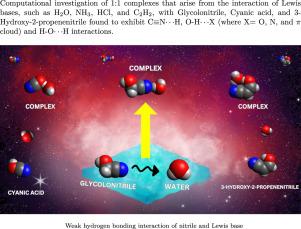
Our study focused on understanding how certain Lewis bases like HO, NH, HCl, and CH, interact with specific nitriles such as, Glycolonitrile (GLY), Cyanic acid (CYA), and 3-Hydroxy-2-propenenitrile (HPN). These interactions form 1:1 complexes through hydrogen bond. Here we observed weak hydrogen bonding interactions such as, CN H, O-HN, O-HO, or O-H in these complexes. In CN H interaction, when a nitrile molecule interacts with a Lewis base, it acts as a proton acceptor, while the corresponding Lewis base acts as a proton donor. However, this is reversed when the molecule possesses an O-HX (X = N, O, Cl, ) interaction. Among these, in most cases, the complexes with O-HX interactions were the most stable, representing the global minima. Detailed Atom in Molecule (AIM) and Natural Bonding Orbital (NBO) analyses confirmed the presence of these hydrogen bonds. Intermolecular bond critical points (BCPs) were identified. The electron density at BCPs was within the range of 0.002 to 0.035 a.u. as described in the Koch and Popelier study. The Laplacian of electron density was positive, further proving hydrogen bonding interaction. NBO analysis showed that O-HN interactions had higher second order perturbation energies compared to O-HO, O-H, and O-HCl interactions.
期刊介绍:
Computational and Theoretical Chemistry publishes high quality, original reports of significance in computational and theoretical chemistry including those that deal with problems of structure, properties, energetics, weak interactions, reaction mechanisms, catalysis, and reaction rates involving atoms, molecules, clusters, surfaces, and bulk matter.




 京公网安备 11010802042870号
京ICP备2023020795号-1
京公网安备 11010802042870号
京ICP备2023020795号-1

 分享
分享
 求助内容:
求助内容: 应助结果提醒方式:
 扫码关注我们
