Maria A.C. Wester Trejo , Maryam Sadeghi , Shivam Singh , Naghmeh Mahmoodian , Samir Sharifli , Zdenka Hruskova , Vladimír Tesař , Xavier Puéchal , Jan Anthonie Bruijn , Georg Göbel , Ingeborg M. Bajema , Andreas Kronbichler
{"title":"基于深度学习的抗中性粒细胞胞浆自身抗体相关肾小球肾炎分类模型的可解释性","authors":"Maria A.C. Wester Trejo , Maryam Sadeghi , Shivam Singh , Naghmeh Mahmoodian , Samir Sharifli , Zdenka Hruskova , Vladimír Tesař , Xavier Puéchal , Jan Anthonie Bruijn , Georg Göbel , Ingeborg M. Bajema , Andreas Kronbichler","doi":"10.1016/j.ekir.2024.11.005","DOIUrl":null,"url":null,"abstract":"<div><h3>Introduction</h3><div>The histopathological classification for antineutrophil cytoplasmic autoantibody (ANCA)–associated glomerulonephritis (ANCA-GN) is a well-established tool to reflect the variety of patterns and severity of lesions that can occur in kidney biopsies. It was demonstrated previously that deep learning (DL) approaches can aid in identifying histopathological classes of kidney diseases; for example, of diabetic kidney disease. These models can potentially be used as decision support tools for kidney pathologists. Although they reach high prediction accuracies, their “black box” structure makes them nontransparent. Explainable (X) artificial intelligence (AI) techniques can be used to make the AI model decisions accessible for human experts. We have developed a DL-based model, which detects and classifies the glomerular lesions according to the Berden classification.</div></div><div><h3>Methods</h3><div>Kidney biopsy slides of 80 patients with ANCA-GN from 3 European centers, who underwent a diagnostic kidney biopsy between 1991 and 2011, were included. We also investigated the explainability of our model using Gradient-weighted Class Activation Mapping (Grad-CAM) heatmaps. These maps were analyzed by pathologists to compare the decision-making criteria of humans and the DL model and assess the impact of different training settings.</div></div><div><h3>Results</h3><div>The DL model shows a prediction accuracy of 93% for classifying lesions. The heatmaps from our trained DL models showed that the most predictive areas in the image correlated well with the areas deemed to be important by the pathologist.</div></div><div><h3>Conclusion</h3><div>We present the first DL-based computational pipeline for classifying ANCA-GN kidney biopsies as per the Berden classification. XAI techniques helped us to make the decision-making criteria of the DL accessible for renal pathologists, potentially improving clinical decision-making.</div></div>","PeriodicalId":17761,"journal":{"name":"Kidney International Reports","volume":"10 2","pages":"Pages 457-465"},"PeriodicalIF":5.7000,"publicationDate":"2025-02-01","publicationTypes":"Journal Article","fieldsOfStudy":null,"isOpenAccess":false,"openAccessPdf":"","citationCount":"0","resultStr":"{\"title\":\"Explainability of a Deep Learning-Based Classification Model for Antineutrophil Cytoplasmic Autoantibody–Associated Glomerulonephritis\",\"authors\":\"Maria A.C. Wester Trejo , Maryam Sadeghi , Shivam Singh , Naghmeh Mahmoodian , Samir Sharifli , Zdenka Hruskova , Vladimír Tesař , Xavier Puéchal , Jan Anthonie Bruijn , Georg Göbel , Ingeborg M. Bajema , Andreas Kronbichler\",\"doi\":\"10.1016/j.ekir.2024.11.005\",\"DOIUrl\":null,\"url\":null,\"abstract\":\"<div><h3>Introduction</h3><div>The histopathological classification for antineutrophil cytoplasmic autoantibody (ANCA)–associated glomerulonephritis (ANCA-GN) is a well-established tool to reflect the variety of patterns and severity of lesions that can occur in kidney biopsies. It was demonstrated previously that deep learning (DL) approaches can aid in identifying histopathological classes of kidney diseases; for example, of diabetic kidney disease. These models can potentially be used as decision support tools for kidney pathologists. Although they reach high prediction accuracies, their “black box” structure makes them nontransparent. Explainable (X) artificial intelligence (AI) techniques can be used to make the AI model decisions accessible for human experts. We have developed a DL-based model, which detects and classifies the glomerular lesions according to the Berden classification.</div></div><div><h3>Methods</h3><div>Kidney biopsy slides of 80 patients with ANCA-GN from 3 European centers, who underwent a diagnostic kidney biopsy between 1991 and 2011, were included. We also investigated the explainability of our model using Gradient-weighted Class Activation Mapping (Grad-CAM) heatmaps. These maps were analyzed by pathologists to compare the decision-making criteria of humans and the DL model and assess the impact of different training settings.</div></div><div><h3>Results</h3><div>The DL model shows a prediction accuracy of 93% for classifying lesions. The heatmaps from our trained DL models showed that the most predictive areas in the image correlated well with the areas deemed to be important by the pathologist.</div></div><div><h3>Conclusion</h3><div>We present the first DL-based computational pipeline for classifying ANCA-GN kidney biopsies as per the Berden classification. XAI techniques helped us to make the decision-making criteria of the DL accessible for renal pathologists, potentially improving clinical decision-making.</div></div>\",\"PeriodicalId\":17761,\"journal\":{\"name\":\"Kidney International Reports\",\"volume\":\"10 2\",\"pages\":\"Pages 457-465\"},\"PeriodicalIF\":5.7000,\"publicationDate\":\"2025-02-01\",\"publicationTypes\":\"Journal Article\",\"fieldsOfStudy\":null,\"isOpenAccess\":false,\"openAccessPdf\":\"\",\"citationCount\":\"0\",\"resultStr\":null,\"platform\":\"Semanticscholar\",\"paperid\":null,\"PeriodicalName\":\"Kidney International Reports\",\"FirstCategoryId\":\"3\",\"ListUrlMain\":\"https://www.sciencedirect.com/science/article/pii/S2468024924020163\",\"RegionNum\":2,\"RegionCategory\":\"医学\",\"ArticlePicture\":[],\"TitleCN\":null,\"AbstractTextCN\":null,\"PMCID\":null,\"EPubDate\":\"2024/11/14 0:00:00\",\"PubModel\":\"Epub\",\"JCR\":\"Q1\",\"JCRName\":\"UROLOGY & NEPHROLOGY\",\"Score\":null,\"Total\":0}","platform":"Semanticscholar","paperid":null,"PeriodicalName":"Kidney International Reports","FirstCategoryId":"3","ListUrlMain":"https://www.sciencedirect.com/science/article/pii/S2468024924020163","RegionNum":2,"RegionCategory":"医学","ArticlePicture":[],"TitleCN":null,"AbstractTextCN":null,"PMCID":null,"EPubDate":"2024/11/14 0:00:00","PubModel":"Epub","JCR":"Q1","JCRName":"UROLOGY & NEPHROLOGY","Score":null,"Total":0}
Explainability of a Deep Learning-Based Classification Model for Antineutrophil Cytoplasmic Autoantibody–Associated Glomerulonephritis
Introduction
The histopathological classification for antineutrophil cytoplasmic autoantibody (ANCA)–associated glomerulonephritis (ANCA-GN) is a well-established tool to reflect the variety of patterns and severity of lesions that can occur in kidney biopsies. It was demonstrated previously that deep learning (DL) approaches can aid in identifying histopathological classes of kidney diseases; for example, of diabetic kidney disease. These models can potentially be used as decision support tools for kidney pathologists. Although they reach high prediction accuracies, their “black box” structure makes them nontransparent. Explainable (X) artificial intelligence (AI) techniques can be used to make the AI model decisions accessible for human experts. We have developed a DL-based model, which detects and classifies the glomerular lesions according to the Berden classification.
Methods
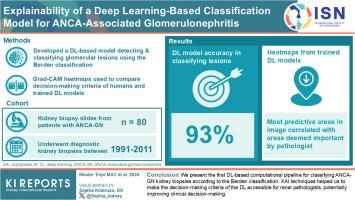
Kidney biopsy slides of 80 patients with ANCA-GN from 3 European centers, who underwent a diagnostic kidney biopsy between 1991 and 2011, were included. We also investigated the explainability of our model using Gradient-weighted Class Activation Mapping (Grad-CAM) heatmaps. These maps were analyzed by pathologists to compare the decision-making criteria of humans and the DL model and assess the impact of different training settings.
Results
The DL model shows a prediction accuracy of 93% for classifying lesions. The heatmaps from our trained DL models showed that the most predictive areas in the image correlated well with the areas deemed to be important by the pathologist.
Conclusion
We present the first DL-based computational pipeline for classifying ANCA-GN kidney biopsies as per the Berden classification. XAI techniques helped us to make the decision-making criteria of the DL accessible for renal pathologists, potentially improving clinical decision-making.
期刊介绍:
Kidney International Reports, an official journal of the International Society of Nephrology, is a peer-reviewed, open access journal devoted to the publication of leading research and developments related to kidney disease. With the primary aim of contributing to improved care of patients with kidney disease, the journal will publish original clinical and select translational articles and educational content related to the pathogenesis, evaluation and management of acute and chronic kidney disease, end stage renal disease (including transplantation), acid-base, fluid and electrolyte disturbances and hypertension. Of particular interest are submissions related to clinical trials, epidemiology, systematic reviews (including meta-analyses) and outcomes research. The journal will also provide a platform for wider dissemination of national and regional guidelines as well as consensus meeting reports.





 京公网安备 11010802042870号
京ICP备2023020795号-1
京公网安备 11010802042870号
京ICP备2023020795号-1

 分享
分享
 求助内容:
求助内容: 应助结果提醒方式:
 扫码关注我们
