Yu Tian , Shuran Li , Weidong Zhu , Keping Yan , Yinglin Ke
{"title":"直接和简单的升级回收再生碳纤维制成倾斜微毛阵列柔性触觉传感器","authors":"Yu Tian , Shuran Li , Weidong Zhu , Keping Yan , Yinglin Ke","doi":"10.1016/j.compositesb.2025.112176","DOIUrl":null,"url":null,"abstract":"<div><div>This study explores the development of a tactile sensor utilizing reclaimed carbon fibers (rCFs) arranged as a biomimetic tilted microhair array (TMA), offering a sustainable approach to reduce carbon footprints and promote circular economy principles. The TMA-based sensor, inspired by the structure of animal fur, demonstrates notable sensitivity to both pressure and shear forces, key to replicating skin-like tactile sensing. Through an innovative fabrication process, rCFs were aligned and pressed into a tilted array on a flexible substrate, forming a highly ordered structure with anisotropic properties. The sensor exhibited a wide pressure detection range from 0.02 kPa to 13 kPa, with a maximum sensitivity of 24.00% kPa⁻<sup>1</sup>. Additionally, its response to shear forces reveals distinct anisotropic properties, enabling precise differentiation between axial and radial directions. The underlying sensing mechanism, driven by changes in intrinsic and contact resistance, was analyzed to elucidate the sensor's response to mechanical stimuli. Overall, the functionality of sensor is closely linked to its innovative use of rCFs, which addresses common challenges in recycling by transforming these fibers into a valuable sensing technology.</div></div>","PeriodicalId":10660,"journal":{"name":"Composites Part B: Engineering","volume":"294 ","pages":"Article 112176"},"PeriodicalIF":14.2000,"publicationDate":"2025-04-01","publicationTypes":"Journal Article","fieldsOfStudy":null,"isOpenAccess":false,"openAccessPdf":"","citationCount":"0","resultStr":"{\"title\":\"Direct and simple upcycling of reclaimed carbon fiber into flexible tactile sensor with tilted microhair arrays\",\"authors\":\"Yu Tian , Shuran Li , Weidong Zhu , Keping Yan , Yinglin Ke\",\"doi\":\"10.1016/j.compositesb.2025.112176\",\"DOIUrl\":null,\"url\":null,\"abstract\":\"<div><div>This study explores the development of a tactile sensor utilizing reclaimed carbon fibers (rCFs) arranged as a biomimetic tilted microhair array (TMA), offering a sustainable approach to reduce carbon footprints and promote circular economy principles. The TMA-based sensor, inspired by the structure of animal fur, demonstrates notable sensitivity to both pressure and shear forces, key to replicating skin-like tactile sensing. Through an innovative fabrication process, rCFs were aligned and pressed into a tilted array on a flexible substrate, forming a highly ordered structure with anisotropic properties. The sensor exhibited a wide pressure detection range from 0.02 kPa to 13 kPa, with a maximum sensitivity of 24.00% kPa⁻<sup>1</sup>. Additionally, its response to shear forces reveals distinct anisotropic properties, enabling precise differentiation between axial and radial directions. The underlying sensing mechanism, driven by changes in intrinsic and contact resistance, was analyzed to elucidate the sensor's response to mechanical stimuli. Overall, the functionality of sensor is closely linked to its innovative use of rCFs, which addresses common challenges in recycling by transforming these fibers into a valuable sensing technology.</div></div>\",\"PeriodicalId\":10660,\"journal\":{\"name\":\"Composites Part B: Engineering\",\"volume\":\"294 \",\"pages\":\"Article 112176\"},\"PeriodicalIF\":14.2000,\"publicationDate\":\"2025-04-01\",\"publicationTypes\":\"Journal Article\",\"fieldsOfStudy\":null,\"isOpenAccess\":false,\"openAccessPdf\":\"\",\"citationCount\":\"0\",\"resultStr\":null,\"platform\":\"Semanticscholar\",\"paperid\":null,\"PeriodicalName\":\"Composites Part B: Engineering\",\"FirstCategoryId\":\"5\",\"ListUrlMain\":\"https://www.sciencedirect.com/science/article/pii/S1359836825000666\",\"RegionNum\":1,\"RegionCategory\":\"材料科学\",\"ArticlePicture\":[],\"TitleCN\":null,\"AbstractTextCN\":null,\"PMCID\":null,\"EPubDate\":\"2025/1/23 0:00:00\",\"PubModel\":\"Epub\",\"JCR\":\"Q1\",\"JCRName\":\"ENGINEERING, MULTIDISCIPLINARY\",\"Score\":null,\"Total\":0}","platform":"Semanticscholar","paperid":null,"PeriodicalName":"Composites Part B: Engineering","FirstCategoryId":"5","ListUrlMain":"https://www.sciencedirect.com/science/article/pii/S1359836825000666","RegionNum":1,"RegionCategory":"材料科学","ArticlePicture":[],"TitleCN":null,"AbstractTextCN":null,"PMCID":null,"EPubDate":"2025/1/23 0:00:00","PubModel":"Epub","JCR":"Q1","JCRName":"ENGINEERING, MULTIDISCIPLINARY","Score":null,"Total":0}
Direct and simple upcycling of reclaimed carbon fiber into flexible tactile sensor with tilted microhair arrays
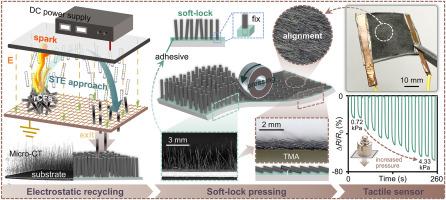
This study explores the development of a tactile sensor utilizing reclaimed carbon fibers (rCFs) arranged as a biomimetic tilted microhair array (TMA), offering a sustainable approach to reduce carbon footprints and promote circular economy principles. The TMA-based sensor, inspired by the structure of animal fur, demonstrates notable sensitivity to both pressure and shear forces, key to replicating skin-like tactile sensing. Through an innovative fabrication process, rCFs were aligned and pressed into a tilted array on a flexible substrate, forming a highly ordered structure with anisotropic properties. The sensor exhibited a wide pressure detection range from 0.02 kPa to 13 kPa, with a maximum sensitivity of 24.00% kPa⁻1. Additionally, its response to shear forces reveals distinct anisotropic properties, enabling precise differentiation between axial and radial directions. The underlying sensing mechanism, driven by changes in intrinsic and contact resistance, was analyzed to elucidate the sensor's response to mechanical stimuli. Overall, the functionality of sensor is closely linked to its innovative use of rCFs, which addresses common challenges in recycling by transforming these fibers into a valuable sensing technology.
期刊介绍:
Composites Part B: Engineering is a journal that publishes impactful research of high quality on composite materials. This research is supported by fundamental mechanics and materials science and engineering approaches. The targeted research can cover a wide range of length scales, ranging from nano to micro and meso, and even to the full product and structure level. The journal specifically focuses on engineering applications that involve high performance composites. These applications can range from low volume and high cost to high volume and low cost composite development.
The main goal of the journal is to provide a platform for the prompt publication of original and high quality research. The emphasis is on design, development, modeling, validation, and manufacturing of engineering details and concepts. The journal welcomes both basic research papers and proposals for review articles. Authors are encouraged to address challenges across various application areas. These areas include, but are not limited to, aerospace, automotive, and other surface transportation. The journal also covers energy-related applications, with a focus on renewable energy. Other application areas include infrastructure, off-shore and maritime projects, health care technology, and recreational products.




 京公网安备 11010802042870号
京ICP备2023020795号-1
京公网安备 11010802042870号
京ICP备2023020795号-1

 分享
分享
 求助内容:
求助内容: 应助结果提醒方式:
 扫码关注我们
