A. Zakharanka , L. Gubbels , B. Acevedo , M. Verwerft , V. Tyrpekl
{"title":"草酸钍的均匀沉淀:结构、动力学和形态方面","authors":"A. Zakharanka , L. Gubbels , B. Acevedo , M. Verwerft , V. Tyrpekl","doi":"10.1016/j.jnucmat.2024.155574","DOIUrl":null,"url":null,"abstract":"<div><div>Thorium oxalate hexahydrate, Th(C<sub>2</sub>O<sub>4</sub>)<sub>2</sub>·6H<sub>2</sub>O was produced by homogeneous precipitation from a thorium nitrate solution through the decomposition of oxamic acid (NH<sub>2</sub>COCOOH). Typically, lanthanide oxalates and actinide oxalates are prepared by heterogeneous precipitation using oxalic acid (COOH)<sub>2</sub>. However, in the present homogeneous precipitation reaction, oxalic acid was slowly generated by the acid-catalyzed hydrolysis of oxamic acid. While heterogeneous precipitation is rapid and typically yields small microcrystals, the slow generation of the precipitation agent (oxalic acid) during homogeneous precipitation resulted in the formation of large thorium oxalate crystals with atypical morphology. The reaction exhibited first-order kinetics and was assessed at 443, 453 and 463 K (70, 80, 90 °C). The morphology of crystals obtained at these different temperatures were investigated. Additionally, the sensitivity of thorium oxalate hexahydrate to drying conditions and its decomposition during calcination to ThO<sub>2</sub> were examined. Thorium oxalate hexahydrate tends to lose crystalline water, resulting in transition phases toward the dihydrate when dried under vacuum at 313 K (40 °C). This loss of crystalline water was not observed when drying was performed under ambient conditions. The further decomposition of the oxalate dihydrate to ThO<sub>2</sub> followed the well-known decomposition path. The developed reaction is affordable, convenient, and does not require demanding apparatus, making it a versatile preparation route for various thorium oxalate crystals of variable morphology suitable for crystallographic studies or applications demanding powders with large particle sizes.</div></div>","PeriodicalId":373,"journal":{"name":"Journal of Nuclear Materials","volume":"605 ","pages":"Article 155574"},"PeriodicalIF":3.3000,"publicationDate":"2025-02-01","publicationTypes":"Journal Article","fieldsOfStudy":null,"isOpenAccess":false,"openAccessPdf":"","citationCount":"0","resultStr":"{\"title\":\"Homogeneous precipitation of thorium oxalate: Structural, kinetic, and morphological aspects\",\"authors\":\"A. Zakharanka , L. Gubbels , B. Acevedo , M. Verwerft , V. Tyrpekl\",\"doi\":\"10.1016/j.jnucmat.2024.155574\",\"DOIUrl\":null,\"url\":null,\"abstract\":\"<div><div>Thorium oxalate hexahydrate, Th(C<sub>2</sub>O<sub>4</sub>)<sub>2</sub>·6H<sub>2</sub>O was produced by homogeneous precipitation from a thorium nitrate solution through the decomposition of oxamic acid (NH<sub>2</sub>COCOOH). Typically, lanthanide oxalates and actinide oxalates are prepared by heterogeneous precipitation using oxalic acid (COOH)<sub>2</sub>. However, in the present homogeneous precipitation reaction, oxalic acid was slowly generated by the acid-catalyzed hydrolysis of oxamic acid. While heterogeneous precipitation is rapid and typically yields small microcrystals, the slow generation of the precipitation agent (oxalic acid) during homogeneous precipitation resulted in the formation of large thorium oxalate crystals with atypical morphology. The reaction exhibited first-order kinetics and was assessed at 443, 453 and 463 K (70, 80, 90 °C). The morphology of crystals obtained at these different temperatures were investigated. Additionally, the sensitivity of thorium oxalate hexahydrate to drying conditions and its decomposition during calcination to ThO<sub>2</sub> were examined. Thorium oxalate hexahydrate tends to lose crystalline water, resulting in transition phases toward the dihydrate when dried under vacuum at 313 K (40 °C). This loss of crystalline water was not observed when drying was performed under ambient conditions. The further decomposition of the oxalate dihydrate to ThO<sub>2</sub> followed the well-known decomposition path. The developed reaction is affordable, convenient, and does not require demanding apparatus, making it a versatile preparation route for various thorium oxalate crystals of variable morphology suitable for crystallographic studies or applications demanding powders with large particle sizes.</div></div>\",\"PeriodicalId\":373,\"journal\":{\"name\":\"Journal of Nuclear Materials\",\"volume\":\"605 \",\"pages\":\"Article 155574\"},\"PeriodicalIF\":3.3000,\"publicationDate\":\"2025-02-01\",\"publicationTypes\":\"Journal Article\",\"fieldsOfStudy\":null,\"isOpenAccess\":false,\"openAccessPdf\":\"\",\"citationCount\":\"0\",\"resultStr\":null,\"platform\":\"Semanticscholar\",\"paperid\":null,\"PeriodicalName\":\"Journal of Nuclear Materials\",\"FirstCategoryId\":\"5\",\"ListUrlMain\":\"https://www.sciencedirect.com/science/article/pii/S0022311524006755\",\"RegionNum\":2,\"RegionCategory\":\"工程技术\",\"ArticlePicture\":[],\"TitleCN\":null,\"AbstractTextCN\":null,\"PMCID\":null,\"EPubDate\":\"2024/12/17 0:00:00\",\"PubModel\":\"Epub\",\"JCR\":\"Q3\",\"JCRName\":\"MATERIALS SCIENCE, MULTIDISCIPLINARY\",\"Score\":null,\"Total\":0}","platform":"Semanticscholar","paperid":null,"PeriodicalName":"Journal of Nuclear Materials","FirstCategoryId":"5","ListUrlMain":"https://www.sciencedirect.com/science/article/pii/S0022311524006755","RegionNum":2,"RegionCategory":"工程技术","ArticlePicture":[],"TitleCN":null,"AbstractTextCN":null,"PMCID":null,"EPubDate":"2024/12/17 0:00:00","PubModel":"Epub","JCR":"Q3","JCRName":"MATERIALS SCIENCE, MULTIDISCIPLINARY","Score":null,"Total":0}
Homogeneous precipitation of thorium oxalate: Structural, kinetic, and morphological aspects
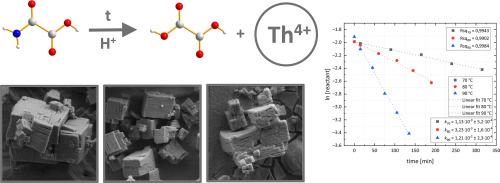
Thorium oxalate hexahydrate, Th(C2O4)2·6H2O was produced by homogeneous precipitation from a thorium nitrate solution through the decomposition of oxamic acid (NH2COCOOH). Typically, lanthanide oxalates and actinide oxalates are prepared by heterogeneous precipitation using oxalic acid (COOH)2. However, in the present homogeneous precipitation reaction, oxalic acid was slowly generated by the acid-catalyzed hydrolysis of oxamic acid. While heterogeneous precipitation is rapid and typically yields small microcrystals, the slow generation of the precipitation agent (oxalic acid) during homogeneous precipitation resulted in the formation of large thorium oxalate crystals with atypical morphology. The reaction exhibited first-order kinetics and was assessed at 443, 453 and 463 K (70, 80, 90 °C). The morphology of crystals obtained at these different temperatures were investigated. Additionally, the sensitivity of thorium oxalate hexahydrate to drying conditions and its decomposition during calcination to ThO2 were examined. Thorium oxalate hexahydrate tends to lose crystalline water, resulting in transition phases toward the dihydrate when dried under vacuum at 313 K (40 °C). This loss of crystalline water was not observed when drying was performed under ambient conditions. The further decomposition of the oxalate dihydrate to ThO2 followed the well-known decomposition path. The developed reaction is affordable, convenient, and does not require demanding apparatus, making it a versatile preparation route for various thorium oxalate crystals of variable morphology suitable for crystallographic studies or applications demanding powders with large particle sizes.
期刊介绍:
The Journal of Nuclear Materials publishes high quality papers in materials research for nuclear applications, primarily fission reactors, fusion reactors, and similar environments including radiation areas of charged particle accelerators. Both original research and critical review papers covering experimental, theoretical, and computational aspects of either fundamental or applied nature are welcome.
The breadth of the field is such that a wide range of processes and properties in the field of materials science and engineering is of interest to the readership, spanning atom-scale processes, microstructures, thermodynamics, mechanical properties, physical properties, and corrosion, for example.
Topics covered by JNM
Fission reactor materials, including fuels, cladding, core structures, pressure vessels, coolant interactions with materials, moderator and control components, fission product behavior.
Materials aspects of the entire fuel cycle.
Materials aspects of the actinides and their compounds.
Performance of nuclear waste materials; materials aspects of the immobilization of wastes.
Fusion reactor materials, including first walls, blankets, insulators and magnets.
Neutron and charged particle radiation effects in materials, including defects, transmutations, microstructures, phase changes and macroscopic properties.
Interaction of plasmas, ion beams, electron beams and electromagnetic radiation with materials relevant to nuclear systems.




 京公网安备 11010802042870号
京ICP备2023020795号-1
京公网安备 11010802042870号
京ICP备2023020795号-1

 分享
分享
 求助内容:
求助内容: 应助结果提醒方式:
 扫码关注我们
