Zihao Li , Shiqiang Li , Jiajing Liu , Zhifang Liu , Jianyin Lei , Zhihua Wang
{"title":"静、动载荷作用下混合片状TPMS晶格的响应机理及吸能性能","authors":"Zihao Li , Shiqiang Li , Jiajing Liu , Zhifang Liu , Jianyin Lei , Zhihua Wang","doi":"10.1016/j.tws.2025.112980","DOIUrl":null,"url":null,"abstract":"<div><div>Triple Periodic Minimal Surface (TPMS) is widely used in many fields as a porous structure with light weight and high energy absorption efficiency. Based on uniform sheet TPMS lattices, a Gyroid-IWP Hybrid (GIH) sheet TPMS lattice was designed by internal cylindrical Gyroid lattice and external cubic IWP lattice. Specimens were fabricated by selective laser melting (SLM) technique and subjected to quasi-static compression and direct-impact Hopkinson bar (DIHB) experiments. The experimental results show that the hybrid GIH lattices exhibit more significant strain-hardening effects and higher energy absorption capacities than the uniform Gyroid and IWP lattices. And the GIH-I lattice (the lattice is compressed along the axis of the cylindrical Gyroid region) exhibits a relatively uniform deformation pattern. While the localized collapse of the GIH-II lattice (the lattice is compressed perpendicular to the axis of the cylindrical Gyroid region) firstly occurs in the IWP region at the two ends of the lattice, and then symmetrically collapses and deforms towards the intermediate transition layer. Finite element simulation was used to investigate the inner deformation mechanisms and energy absorption characteristics during the deformation processes. The effects of normalized hybrid diameters of the internal Gyroid region and the width of transition layer on the mechanical properties of the GIH lattice are also investigated. The results indicated that the GIH-I lattice has better impact resistance at low and medium strain rates, while the GIH-II lattice exhibits superior mechanical properties at higher strain rates. The GIH-II lattice not only has the smallest initial peak stress, but also exhibits significant multi-stage platform energy absorption. In addition, compared with the Linear Gyroid-IWP Hybrid (LGIH) lattices, the GIH lattices designed in this paper have obvious advantages under dynamic impact loading, which can provide a better design idea for engineering applications.</div></div>","PeriodicalId":49435,"journal":{"name":"Thin-Walled Structures","volume":"210 ","pages":"Article 112980"},"PeriodicalIF":6.6000,"publicationDate":"2025-05-01","publicationTypes":"Journal Article","fieldsOfStudy":null,"isOpenAccess":false,"openAccessPdf":"","citationCount":"0","resultStr":"{\"title\":\"Response mechanisms and energy absorption properties of hybrid sheet TPMS lattices under static and dynamic loading\",\"authors\":\"Zihao Li , Shiqiang Li , Jiajing Liu , Zhifang Liu , Jianyin Lei , Zhihua Wang\",\"doi\":\"10.1016/j.tws.2025.112980\",\"DOIUrl\":null,\"url\":null,\"abstract\":\"<div><div>Triple Periodic Minimal Surface (TPMS) is widely used in many fields as a porous structure with light weight and high energy absorption efficiency. Based on uniform sheet TPMS lattices, a Gyroid-IWP Hybrid (GIH) sheet TPMS lattice was designed by internal cylindrical Gyroid lattice and external cubic IWP lattice. Specimens were fabricated by selective laser melting (SLM) technique and subjected to quasi-static compression and direct-impact Hopkinson bar (DIHB) experiments. The experimental results show that the hybrid GIH lattices exhibit more significant strain-hardening effects and higher energy absorption capacities than the uniform Gyroid and IWP lattices. And the GIH-I lattice (the lattice is compressed along the axis of the cylindrical Gyroid region) exhibits a relatively uniform deformation pattern. While the localized collapse of the GIH-II lattice (the lattice is compressed perpendicular to the axis of the cylindrical Gyroid region) firstly occurs in the IWP region at the two ends of the lattice, and then symmetrically collapses and deforms towards the intermediate transition layer. Finite element simulation was used to investigate the inner deformation mechanisms and energy absorption characteristics during the deformation processes. The effects of normalized hybrid diameters of the internal Gyroid region and the width of transition layer on the mechanical properties of the GIH lattice are also investigated. The results indicated that the GIH-I lattice has better impact resistance at low and medium strain rates, while the GIH-II lattice exhibits superior mechanical properties at higher strain rates. The GIH-II lattice not only has the smallest initial peak stress, but also exhibits significant multi-stage platform energy absorption. In addition, compared with the Linear Gyroid-IWP Hybrid (LGIH) lattices, the GIH lattices designed in this paper have obvious advantages under dynamic impact loading, which can provide a better design idea for engineering applications.</div></div>\",\"PeriodicalId\":49435,\"journal\":{\"name\":\"Thin-Walled Structures\",\"volume\":\"210 \",\"pages\":\"Article 112980\"},\"PeriodicalIF\":6.6000,\"publicationDate\":\"2025-05-01\",\"publicationTypes\":\"Journal Article\",\"fieldsOfStudy\":null,\"isOpenAccess\":false,\"openAccessPdf\":\"\",\"citationCount\":\"0\",\"resultStr\":null,\"platform\":\"Semanticscholar\",\"paperid\":null,\"PeriodicalName\":\"Thin-Walled Structures\",\"FirstCategoryId\":\"5\",\"ListUrlMain\":\"https://www.sciencedirect.com/science/article/pii/S0263823125000746\",\"RegionNum\":1,\"RegionCategory\":\"工程技术\",\"ArticlePicture\":[],\"TitleCN\":null,\"AbstractTextCN\":null,\"PMCID\":null,\"EPubDate\":\"2025/1/20 0:00:00\",\"PubModel\":\"Epub\",\"JCR\":\"Q1\",\"JCRName\":\"ENGINEERING, CIVIL\",\"Score\":null,\"Total\":0}","platform":"Semanticscholar","paperid":null,"PeriodicalName":"Thin-Walled Structures","FirstCategoryId":"5","ListUrlMain":"https://www.sciencedirect.com/science/article/pii/S0263823125000746","RegionNum":1,"RegionCategory":"工程技术","ArticlePicture":[],"TitleCN":null,"AbstractTextCN":null,"PMCID":null,"EPubDate":"2025/1/20 0:00:00","PubModel":"Epub","JCR":"Q1","JCRName":"ENGINEERING, CIVIL","Score":null,"Total":0}
Response mechanisms and energy absorption properties of hybrid sheet TPMS lattices under static and dynamic loading
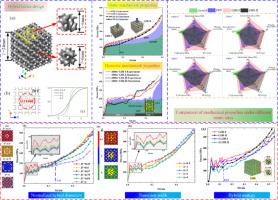
Triple Periodic Minimal Surface (TPMS) is widely used in many fields as a porous structure with light weight and high energy absorption efficiency. Based on uniform sheet TPMS lattices, a Gyroid-IWP Hybrid (GIH) sheet TPMS lattice was designed by internal cylindrical Gyroid lattice and external cubic IWP lattice. Specimens were fabricated by selective laser melting (SLM) technique and subjected to quasi-static compression and direct-impact Hopkinson bar (DIHB) experiments. The experimental results show that the hybrid GIH lattices exhibit more significant strain-hardening effects and higher energy absorption capacities than the uniform Gyroid and IWP lattices. And the GIH-I lattice (the lattice is compressed along the axis of the cylindrical Gyroid region) exhibits a relatively uniform deformation pattern. While the localized collapse of the GIH-II lattice (the lattice is compressed perpendicular to the axis of the cylindrical Gyroid region) firstly occurs in the IWP region at the two ends of the lattice, and then symmetrically collapses and deforms towards the intermediate transition layer. Finite element simulation was used to investigate the inner deformation mechanisms and energy absorption characteristics during the deformation processes. The effects of normalized hybrid diameters of the internal Gyroid region and the width of transition layer on the mechanical properties of the GIH lattice are also investigated. The results indicated that the GIH-I lattice has better impact resistance at low and medium strain rates, while the GIH-II lattice exhibits superior mechanical properties at higher strain rates. The GIH-II lattice not only has the smallest initial peak stress, but also exhibits significant multi-stage platform energy absorption. In addition, compared with the Linear Gyroid-IWP Hybrid (LGIH) lattices, the GIH lattices designed in this paper have obvious advantages under dynamic impact loading, which can provide a better design idea for engineering applications.
期刊介绍:
Thin-walled structures comprises an important and growing proportion of engineering construction with areas of application becoming increasingly diverse, ranging from aircraft, bridges, ships and oil rigs to storage vessels, industrial buildings and warehouses.
Many factors, including cost and weight economy, new materials and processes and the growth of powerful methods of analysis have contributed to this growth, and led to the need for a journal which concentrates specifically on structures in which problems arise due to the thinness of the walls. This field includes cold– formed sections, plate and shell structures, reinforced plastics structures and aluminium structures, and is of importance in many branches of engineering.
The primary criterion for consideration of papers in Thin–Walled Structures is that they must be concerned with thin–walled structures or the basic problems inherent in thin–walled structures. Provided this criterion is satisfied no restriction is placed on the type of construction, material or field of application. Papers on theory, experiment, design, etc., are published and it is expected that many papers will contain aspects of all three.




 京公网安备 11010802042870号
京ICP备2023020795号-1
京公网安备 11010802042870号
京ICP备2023020795号-1

 分享
分享
 求助内容:
求助内容: 应助结果提醒方式:
 扫码关注我们
