Jiakai Zhou;Jun Yang;Xiaoliang Wu;Wanlin Zhou;Yang Wang
{"title":"ETR:基于变压器的视频分类增强尾灯识别","authors":"Jiakai Zhou;Jun Yang;Xiaoliang Wu;Wanlin Zhou;Yang Wang","doi":"10.1109/TITS.2024.3509394","DOIUrl":null,"url":null,"abstract":"In autonomous driving, efficiently and accurately recognizing taillight states using dashcams is essential for interpreting other vehicles’ intentions. Recent video-based taillight recognition methods outperform earlier image-based approaches. However, they face challenges in efficiently integrating spatiotemporal information and managing high computational costs. In this paper, we introduce ETR, an accurate and efficient Transformer-based video classification model designed to enhance taillight recognition. Specifically, we first design a lightweight backbone to extract temporal and spatial features from videos and generate queries with prior information. Next, we develop a hierarchical progressive Transformer decoder that integrates feature maps from different levels of the backbone to enhance the model’s global information. Finally, we employ a classification head to predict the taillight state of the video. Additionally, we introduce a public dataset, ETR-Taillights, to address the current lack of open datasets for vehicle taillight recognition. The dataset contains 28,799 dashcam video clips, making it the largest public taillight recognition dataset. Experiments show that our method achieves a 91.69% F-measure on the ETR-Taillights dataset, surpassing the latest taillight recognition methods, VIF by 6.94% and CNN-LSTM by 10.82%. Additionally, it achieves an inference speed of 45.06 FPS, being 3.6 times faster than VIF. Furthermore, we conduct real-world road tests to demonstrate our method’s robustness and effectiveness in practical scenarios. Our model and dataset are available at <uri>https://github.com/yang590/vehicle-taillight</uri>.","PeriodicalId":13416,"journal":{"name":"IEEE Transactions on Intelligent Transportation Systems","volume":"26 2","pages":"2721-2733"},"PeriodicalIF":9.1000,"publicationDate":"2024-12-11","publicationTypes":"Journal Article","fieldsOfStudy":null,"isOpenAccess":false,"openAccessPdf":"","citationCount":"0","resultStr":"{\"title\":\"ETR: Enhancing Taillight Recognition via Transformer-Based Video Classification\",\"authors\":\"Jiakai Zhou;Jun Yang;Xiaoliang Wu;Wanlin Zhou;Yang Wang\",\"doi\":\"10.1109/TITS.2024.3509394\",\"DOIUrl\":null,\"url\":null,\"abstract\":\"In autonomous driving, efficiently and accurately recognizing taillight states using dashcams is essential for interpreting other vehicles’ intentions. Recent video-based taillight recognition methods outperform earlier image-based approaches. However, they face challenges in efficiently integrating spatiotemporal information and managing high computational costs. In this paper, we introduce ETR, an accurate and efficient Transformer-based video classification model designed to enhance taillight recognition. Specifically, we first design a lightweight backbone to extract temporal and spatial features from videos and generate queries with prior information. Next, we develop a hierarchical progressive Transformer decoder that integrates feature maps from different levels of the backbone to enhance the model’s global information. Finally, we employ a classification head to predict the taillight state of the video. Additionally, we introduce a public dataset, ETR-Taillights, to address the current lack of open datasets for vehicle taillight recognition. The dataset contains 28,799 dashcam video clips, making it the largest public taillight recognition dataset. Experiments show that our method achieves a 91.69% F-measure on the ETR-Taillights dataset, surpassing the latest taillight recognition methods, VIF by 6.94% and CNN-LSTM by 10.82%. Additionally, it achieves an inference speed of 45.06 FPS, being 3.6 times faster than VIF. Furthermore, we conduct real-world road tests to demonstrate our method’s robustness and effectiveness in practical scenarios. Our model and dataset are available at <uri>https://github.com/yang590/vehicle-taillight</uri>.\",\"PeriodicalId\":13416,\"journal\":{\"name\":\"IEEE Transactions on Intelligent Transportation Systems\",\"volume\":\"26 2\",\"pages\":\"2721-2733\"},\"PeriodicalIF\":9.1000,\"publicationDate\":\"2024-12-11\",\"publicationTypes\":\"Journal Article\",\"fieldsOfStudy\":null,\"isOpenAccess\":false,\"openAccessPdf\":\"\",\"citationCount\":\"0\",\"resultStr\":null,\"platform\":\"Semanticscholar\",\"paperid\":null,\"PeriodicalName\":\"IEEE Transactions on Intelligent Transportation Systems\",\"FirstCategoryId\":\"5\",\"ListUrlMain\":\"https://ieeexplore.ieee.org/document/10790923/\",\"RegionNum\":1,\"RegionCategory\":\"工程技术\",\"ArticlePicture\":[],\"TitleCN\":null,\"AbstractTextCN\":null,\"PMCID\":null,\"EPubDate\":\"\",\"PubModel\":\"\",\"JCR\":\"Q1\",\"JCRName\":\"ENGINEERING, CIVIL\",\"Score\":null,\"Total\":0}","platform":"Semanticscholar","paperid":null,"PeriodicalName":"IEEE Transactions on Intelligent Transportation Systems","FirstCategoryId":"5","ListUrlMain":"https://ieeexplore.ieee.org/document/10790923/","RegionNum":1,"RegionCategory":"工程技术","ArticlePicture":[],"TitleCN":null,"AbstractTextCN":null,"PMCID":null,"EPubDate":"","PubModel":"","JCR":"Q1","JCRName":"ENGINEERING, CIVIL","Score":null,"Total":0}
ETR: Enhancing Taillight Recognition via Transformer-Based Video Classification
In autonomous driving, efficiently and accurately recognizing taillight states using dashcams is essential for interpreting other vehicles’ intentions. Recent video-based taillight recognition methods outperform earlier image-based approaches. However, they face challenges in efficiently integrating spatiotemporal information and managing high computational costs. In this paper, we introduce ETR, an accurate and efficient Transformer-based video classification model designed to enhance taillight recognition. Specifically, we first design a lightweight backbone to extract temporal and spatial features from videos and generate queries with prior information. Next, we develop a hierarchical progressive Transformer decoder that integrates feature maps from different levels of the backbone to enhance the model’s global information. Finally, we employ a classification head to predict the taillight state of the video. Additionally, we introduce a public dataset, ETR-Taillights, to address the current lack of open datasets for vehicle taillight recognition. The dataset contains 28,799 dashcam video clips, making it the largest public taillight recognition dataset. Experiments show that our method achieves a 91.69% F-measure on the ETR-Taillights dataset, surpassing the latest taillight recognition methods, VIF by 6.94% and CNN-LSTM by 10.82%. Additionally, it achieves an inference speed of 45.06 FPS, being 3.6 times faster than VIF. Furthermore, we conduct real-world road tests to demonstrate our method’s robustness and effectiveness in practical scenarios. Our model and dataset are available at https://github.com/yang590/vehicle-taillight.
期刊介绍:
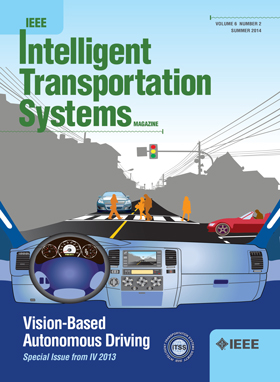
The theoretical, experimental and operational aspects of electrical and electronics engineering and information technologies as applied to Intelligent Transportation Systems (ITS). Intelligent Transportation Systems are defined as those systems utilizing synergistic technologies and systems engineering concepts to develop and improve transportation systems of all kinds. The scope of this interdisciplinary activity includes the promotion, consolidation and coordination of ITS technical activities among IEEE entities, and providing a focus for cooperative activities, both internally and externally.




 京公网安备 11010802042870号
京ICP备2023020795号-1
京公网安备 11010802042870号
京ICP备2023020795号-1

 分享
分享
 求助内容:
求助内容: 应助结果提醒方式:
 扫码关注我们
