Ying Xiong, Yinglong Guo, Xiaoxia Li, Pingyi Zhu, Jianyi Qu, Shunfa Huang, Run Wang, Jianjun Zhou, Jianfeng Huang, Chenchen Dai
{"title":"多参数MRI透明细胞可能性评分能在亚厘米病变中区分脂肪贫乏型AML和CcRCC吗?","authors":"Ying Xiong, Yinglong Guo, Xiaoxia Li, Pingyi Zhu, Jianyi Qu, Shunfa Huang, Run Wang, Jianjun Zhou, Jianfeng Huang, Chenchen Dai","doi":"10.1007/s00261-025-04822-1","DOIUrl":null,"url":null,"abstract":"<div><h3>Objective</h3><p>To investigate the potential of multiparametric MRI clear cell likelihood scores (ccLS) for differentiating between fat-poor angiomyolipoma (AML) and clear cell renal cell carcinoma (ccRCC) in subcentimeter Lesions (1 cm or smaller).</p><h3>Materials and methods</h3><p>This retrospective study included consecutive patients with subcentimeter renal masses who underwent multiparametric MRI between September 2009 and September 2022 across three hospitals. Clinical and MRI findings were analyzed to differentiate between fat-poor AML and ccRCC. Lesions were categorized using the ccLS and receiver operating characteristic curve analysis was performed to assess ccLS performance.</p><h3>Results</h3><p>Thirty-eight patients (mean age: 52 years ± 12; 19 women) with 39 lesions were included. Of the 39 lesions [mean size: 9.1 mm ± 1.0 (range, 6.0–10.0 mm)], 20 (51%) were ccRCC and 19 (49%) were fat-poor AML. Compared to the ccRCC, subcentimeter fat-poor AMLs were more likely to show hypointensity on T2WI (<i>P</i> < 0.001), homogeneous enhancement (<i>P</i> = 0.010), the presence of microscopic fat (<i>P</i> = 0.036), and the absence of a pseudocapsule (<i>P</i> = 0.020). The diagnostic percentage of fat-poor AML was 47% for a ccLS of 1 or 2, and ccRCC accounted for 75% in the ccLS 4 or 5 category. The AUC for discrimination was 0.846 (95% CI: 0.695–0.941, <i>P</i> < 0.001), with a sensitivity of 75.00% (95% CI: 50.9–91.3) and a specificity of 89.47% (95% CI: 66.9–98.7).</p><h3>Conclusion</h3><p>Multiparametric MRI clear cell likelihood scores can potentially be used to differentiate between fat-poor AML and ccRCC in lesions 1 cm or smaller.</p></div>","PeriodicalId":7126,"journal":{"name":"Abdominal Radiology","volume":"50 8","pages":"3599 - 3606"},"PeriodicalIF":2.2000,"publicationDate":"2025-02-05","publicationTypes":"Journal Article","fieldsOfStudy":null,"isOpenAccess":false,"openAccessPdf":"","citationCount":"0","resultStr":"{\"title\":\"Can multiparametric MRI clear cell likelihood scores differentiate fat-Poor AML from CcRCC in subcentimeter lesions?\",\"authors\":\"Ying Xiong, Yinglong Guo, Xiaoxia Li, Pingyi Zhu, Jianyi Qu, Shunfa Huang, Run Wang, Jianjun Zhou, Jianfeng Huang, Chenchen Dai\",\"doi\":\"10.1007/s00261-025-04822-1\",\"DOIUrl\":null,\"url\":null,\"abstract\":\"<div><h3>Objective</h3><p>To investigate the potential of multiparametric MRI clear cell likelihood scores (ccLS) for differentiating between fat-poor angiomyolipoma (AML) and clear cell renal cell carcinoma (ccRCC) in subcentimeter Lesions (1 cm or smaller).</p><h3>Materials and methods</h3><p>This retrospective study included consecutive patients with subcentimeter renal masses who underwent multiparametric MRI between September 2009 and September 2022 across three hospitals. Clinical and MRI findings were analyzed to differentiate between fat-poor AML and ccRCC. Lesions were categorized using the ccLS and receiver operating characteristic curve analysis was performed to assess ccLS performance.</p><h3>Results</h3><p>Thirty-eight patients (mean age: 52 years ± 12; 19 women) with 39 lesions were included. Of the 39 lesions [mean size: 9.1 mm ± 1.0 (range, 6.0–10.0 mm)], 20 (51%) were ccRCC and 19 (49%) were fat-poor AML. Compared to the ccRCC, subcentimeter fat-poor AMLs were more likely to show hypointensity on T2WI (<i>P</i> < 0.001), homogeneous enhancement (<i>P</i> = 0.010), the presence of microscopic fat (<i>P</i> = 0.036), and the absence of a pseudocapsule (<i>P</i> = 0.020). The diagnostic percentage of fat-poor AML was 47% for a ccLS of 1 or 2, and ccRCC accounted for 75% in the ccLS 4 or 5 category. The AUC for discrimination was 0.846 (95% CI: 0.695–0.941, <i>P</i> < 0.001), with a sensitivity of 75.00% (95% CI: 50.9–91.3) and a specificity of 89.47% (95% CI: 66.9–98.7).</p><h3>Conclusion</h3><p>Multiparametric MRI clear cell likelihood scores can potentially be used to differentiate between fat-poor AML and ccRCC in lesions 1 cm or smaller.</p></div>\",\"PeriodicalId\":7126,\"journal\":{\"name\":\"Abdominal Radiology\",\"volume\":\"50 8\",\"pages\":\"3599 - 3606\"},\"PeriodicalIF\":2.2000,\"publicationDate\":\"2025-02-05\",\"publicationTypes\":\"Journal Article\",\"fieldsOfStudy\":null,\"isOpenAccess\":false,\"openAccessPdf\":\"\",\"citationCount\":\"0\",\"resultStr\":null,\"platform\":\"Semanticscholar\",\"paperid\":null,\"PeriodicalName\":\"Abdominal Radiology\",\"FirstCategoryId\":\"3\",\"ListUrlMain\":\"https://link.springer.com/article/10.1007/s00261-025-04822-1\",\"RegionNum\":3,\"RegionCategory\":\"医学\",\"ArticlePicture\":[],\"TitleCN\":null,\"AbstractTextCN\":null,\"PMCID\":null,\"EPubDate\":\"\",\"PubModel\":\"\",\"JCR\":\"Q2\",\"JCRName\":\"RADIOLOGY, NUCLEAR MEDICINE & MEDICAL IMAGING\",\"Score\":null,\"Total\":0}","platform":"Semanticscholar","paperid":null,"PeriodicalName":"Abdominal Radiology","FirstCategoryId":"3","ListUrlMain":"https://link.springer.com/article/10.1007/s00261-025-04822-1","RegionNum":3,"RegionCategory":"医学","ArticlePicture":[],"TitleCN":null,"AbstractTextCN":null,"PMCID":null,"EPubDate":"","PubModel":"","JCR":"Q2","JCRName":"RADIOLOGY, NUCLEAR MEDICINE & MEDICAL IMAGING","Score":null,"Total":0}
Can multiparametric MRI clear cell likelihood scores differentiate fat-Poor AML from CcRCC in subcentimeter lesions?
Objective
To investigate the potential of multiparametric MRI clear cell likelihood scores (ccLS) for differentiating between fat-poor angiomyolipoma (AML) and clear cell renal cell carcinoma (ccRCC) in subcentimeter Lesions (1 cm or smaller).
Materials and methods
This retrospective study included consecutive patients with subcentimeter renal masses who underwent multiparametric MRI between September 2009 and September 2022 across three hospitals. Clinical and MRI findings were analyzed to differentiate between fat-poor AML and ccRCC. Lesions were categorized using the ccLS and receiver operating characteristic curve analysis was performed to assess ccLS performance.
Results
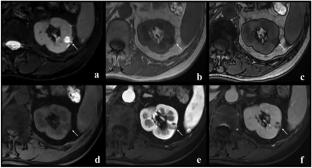
Thirty-eight patients (mean age: 52 years ± 12; 19 women) with 39 lesions were included. Of the 39 lesions [mean size: 9.1 mm ± 1.0 (range, 6.0–10.0 mm)], 20 (51%) were ccRCC and 19 (49%) were fat-poor AML. Compared to the ccRCC, subcentimeter fat-poor AMLs were more likely to show hypointensity on T2WI (P < 0.001), homogeneous enhancement (P = 0.010), the presence of microscopic fat (P = 0.036), and the absence of a pseudocapsule (P = 0.020). The diagnostic percentage of fat-poor AML was 47% for a ccLS of 1 or 2, and ccRCC accounted for 75% in the ccLS 4 or 5 category. The AUC for discrimination was 0.846 (95% CI: 0.695–0.941, P < 0.001), with a sensitivity of 75.00% (95% CI: 50.9–91.3) and a specificity of 89.47% (95% CI: 66.9–98.7).
Conclusion
Multiparametric MRI clear cell likelihood scores can potentially be used to differentiate between fat-poor AML and ccRCC in lesions 1 cm or smaller.
期刊介绍:
Abdominal Radiology seeks to meet the professional needs of the abdominal radiologist by publishing clinically pertinent original, review and practice related articles on the gastrointestinal and genitourinary tracts and abdominal interventional and radiologic procedures. Case reports are generally not accepted unless they are the first report of a new disease or condition, or part of a special solicited section.
Reasons to Publish Your Article in Abdominal Radiology:
· Official journal of the Society of Abdominal Radiology (SAR)
· Published in Cooperation with:
European Society of Gastrointestinal and Abdominal Radiology (ESGAR)
European Society of Urogenital Radiology (ESUR)
Asian Society of Abdominal Radiology (ASAR)
· Efficient handling and Expeditious review
· Author feedback is provided in a mentoring style
· Global readership
· Readers can earn CME credits




 京公网安备 11010802042870号
京ICP备2023020795号-1
京公网安备 11010802042870号
京ICP备2023020795号-1

 分享
分享
 求助内容:
求助内容: 应助结果提醒方式:
 扫码关注我们
