{"title":"人乳和支气管肺发育不良具有剂量依赖性:一项队列研究。","authors":"Jiaming Yang, Jiaxin Li, Huiyan Wang, Xueyu Chen, Chuanzhong Yang, Liga ChaoMu, Aifen Cao, Xiaoyun Xiong","doi":"10.1136/bmjpo-2024-002727","DOIUrl":null,"url":null,"abstract":"<p><strong>Background: </strong>Human milk (HM) is considered a potential protective factor against bronchopulmonary dysplasia (BPD), but the specific volume needed for its protective effect in mixed feeding is unclear. This study aimed to investigate the impact of different HM volumes on BPD risk.</p><p><strong>Methods: </strong>A retrospective cohort study examined the association between HM volume and BPD risk in very low birthweight (VLBW) infants. Dose-dependent analysis with spline smoothing curve and univariate, multivariate analyses and sensitivity analyses were conducted.</p><p><strong>Result: </strong>The study included 339 VLBW infants. BPD incidence was 4.7% (6 infants) in the high HM group (HM volume≥1190 mL), 27.0% (48 infants) in the low HM group (HM volume<1190 mL) and 9.1% (3 infants) in the exclusive formula group, and the difference is statistically significant. Both univariate and multivariate logistic regression analyses showed significantly higher BPD incidence in the low HM group (OR 3.237, 95% CI 0.81 to 12.89) compared with the exclusive formula group. The sensitivity analysis showed that low HM remained a risk factor for BPD (model I OR 3.26, 95% CI 0.92 to 11.53; model II OR 3.28, 95% CI 0.81 to 13.1).</p><p><strong>Conclusion: </strong>Higher HM volumes (≥1190 mL) were associated with decreased BPD risk compared with low HM and formula feeding. Although not statistically significant, the low HM group exhibited increased BPD incidence compared with the exclusive formula group. These findings emphasise the importance of considering HM quantity in mixed feeding practices.</p>","PeriodicalId":9069,"journal":{"name":"BMJ Paediatrics Open","volume":"9 1","pages":""},"PeriodicalIF":2.3000,"publicationDate":"2025-02-04","publicationTypes":"Journal Article","fieldsOfStudy":null,"isOpenAccess":false,"openAccessPdf":"https://www.ncbi.nlm.nih.gov/pmc/articles/PMC11795393/pdf/","citationCount":"0","resultStr":"{\"title\":\"Human milk and bronchopulmonary dysplasia have a dose-dependent effect: a cohort study.\",\"authors\":\"Jiaming Yang, Jiaxin Li, Huiyan Wang, Xueyu Chen, Chuanzhong Yang, Liga ChaoMu, Aifen Cao, Xiaoyun Xiong\",\"doi\":\"10.1136/bmjpo-2024-002727\",\"DOIUrl\":null,\"url\":null,\"abstract\":\"<p><strong>Background: </strong>Human milk (HM) is considered a potential protective factor against bronchopulmonary dysplasia (BPD), but the specific volume needed for its protective effect in mixed feeding is unclear. This study aimed to investigate the impact of different HM volumes on BPD risk.</p><p><strong>Methods: </strong>A retrospective cohort study examined the association between HM volume and BPD risk in very low birthweight (VLBW) infants. Dose-dependent analysis with spline smoothing curve and univariate, multivariate analyses and sensitivity analyses were conducted.</p><p><strong>Result: </strong>The study included 339 VLBW infants. BPD incidence was 4.7% (6 infants) in the high HM group (HM volume≥1190 mL), 27.0% (48 infants) in the low HM group (HM volume<1190 mL) and 9.1% (3 infants) in the exclusive formula group, and the difference is statistically significant. Both univariate and multivariate logistic regression analyses showed significantly higher BPD incidence in the low HM group (OR 3.237, 95% CI 0.81 to 12.89) compared with the exclusive formula group. The sensitivity analysis showed that low HM remained a risk factor for BPD (model I OR 3.26, 95% CI 0.92 to 11.53; model II OR 3.28, 95% CI 0.81 to 13.1).</p><p><strong>Conclusion: </strong>Higher HM volumes (≥1190 mL) were associated with decreased BPD risk compared with low HM and formula feeding. Although not statistically significant, the low HM group exhibited increased BPD incidence compared with the exclusive formula group. These findings emphasise the importance of considering HM quantity in mixed feeding practices.</p>\",\"PeriodicalId\":9069,\"journal\":{\"name\":\"BMJ Paediatrics Open\",\"volume\":\"9 1\",\"pages\":\"\"},\"PeriodicalIF\":2.3000,\"publicationDate\":\"2025-02-04\",\"publicationTypes\":\"Journal Article\",\"fieldsOfStudy\":null,\"isOpenAccess\":false,\"openAccessPdf\":\"https://www.ncbi.nlm.nih.gov/pmc/articles/PMC11795393/pdf/\",\"citationCount\":\"0\",\"resultStr\":null,\"platform\":\"Semanticscholar\",\"paperid\":null,\"PeriodicalName\":\"BMJ Paediatrics Open\",\"FirstCategoryId\":\"3\",\"ListUrlMain\":\"https://doi.org/10.1136/bmjpo-2024-002727\",\"RegionNum\":4,\"RegionCategory\":\"医学\",\"ArticlePicture\":[],\"TitleCN\":null,\"AbstractTextCN\":null,\"PMCID\":null,\"EPubDate\":\"\",\"PubModel\":\"\",\"JCR\":\"Q2\",\"JCRName\":\"PEDIATRICS\",\"Score\":null,\"Total\":0}","platform":"Semanticscholar","paperid":null,"PeriodicalName":"BMJ Paediatrics Open","FirstCategoryId":"3","ListUrlMain":"https://doi.org/10.1136/bmjpo-2024-002727","RegionNum":4,"RegionCategory":"医学","ArticlePicture":[],"TitleCN":null,"AbstractTextCN":null,"PMCID":null,"EPubDate":"","PubModel":"","JCR":"Q2","JCRName":"PEDIATRICS","Score":null,"Total":0}
Human milk and bronchopulmonary dysplasia have a dose-dependent effect: a cohort study.
Background: Human milk (HM) is considered a potential protective factor against bronchopulmonary dysplasia (BPD), but the specific volume needed for its protective effect in mixed feeding is unclear. This study aimed to investigate the impact of different HM volumes on BPD risk.
Methods: A retrospective cohort study examined the association between HM volume and BPD risk in very low birthweight (VLBW) infants. Dose-dependent analysis with spline smoothing curve and univariate, multivariate analyses and sensitivity analyses were conducted.
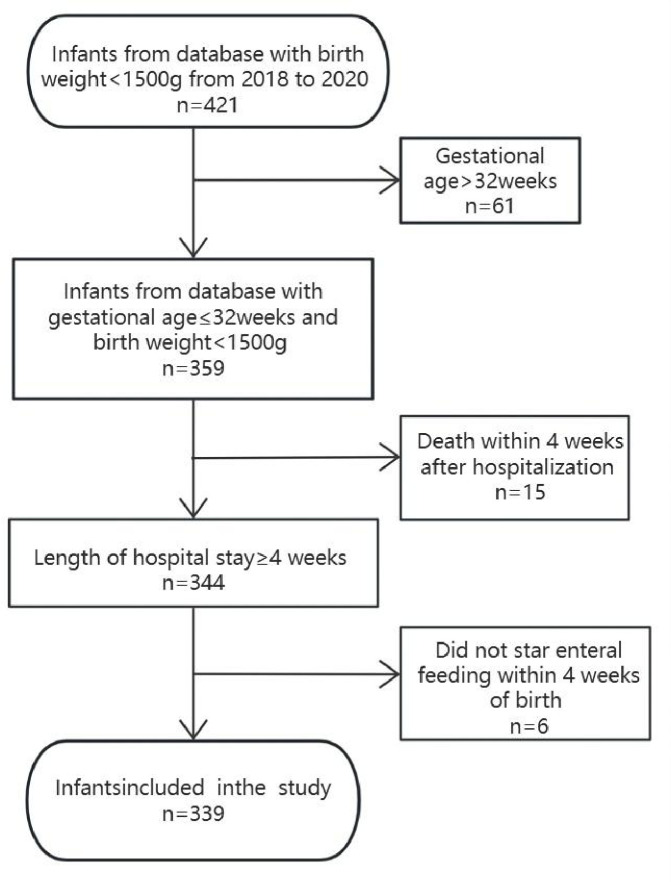
Result: The study included 339 VLBW infants. BPD incidence was 4.7% (6 infants) in the high HM group (HM volume≥1190 mL), 27.0% (48 infants) in the low HM group (HM volume<1190 mL) and 9.1% (3 infants) in the exclusive formula group, and the difference is statistically significant. Both univariate and multivariate logistic regression analyses showed significantly higher BPD incidence in the low HM group (OR 3.237, 95% CI 0.81 to 12.89) compared with the exclusive formula group. The sensitivity analysis showed that low HM remained a risk factor for BPD (model I OR 3.26, 95% CI 0.92 to 11.53; model II OR 3.28, 95% CI 0.81 to 13.1).
Conclusion: Higher HM volumes (≥1190 mL) were associated with decreased BPD risk compared with low HM and formula feeding. Although not statistically significant, the low HM group exhibited increased BPD incidence compared with the exclusive formula group. These findings emphasise the importance of considering HM quantity in mixed feeding practices.






 京公网安备 11010802042870号
京ICP备2023020795号-1
京公网安备 11010802042870号
京ICP备2023020795号-1

 分享
分享
 求助内容:
求助内容: 应助结果提醒方式:
 扫码关注我们
