{"title":"一项针对电子竞技运动员的为期8周的体育锻炼干预提高了他们的身体表现,而不是短期的电子竞技表现参数——一项随机对照试验。","authors":"Felix Wachholz, Nicole Gamper, Martin Schnitzer","doi":"10.3389/fspor.2024.1504205","DOIUrl":null,"url":null,"abstract":"<p><strong>Introduction: </strong>Esports have been suggested to enhance hand-eye coordination, fine motor skills, and reaction times. While physical exercise is known to improve these abilities, its impact on short-term esports performance is under-researched. This study aims to evaluate the effects of specific and general physical training on gaming performance, hypothesizing improvements in both physical and gaming-related variables.</p><p><strong>Methods: </strong>Baseline and follow-up tests measured global coordination, grip strength, Aimlabs performance, single and 4-fold reaction times, and anticipation. Participants completed a weekly and an ending questionnaire. Twenty-eight participants (12.3 ± 10.1 h gaming/week) were assigned to specific (<i>N</i> = 10), general (<i>N</i> = 9), and no training (<i>N</i> = 9) groups for an 8-week intervention. Variable changes over time and between groups were analyzed using a repeated measures ANCOVA.</p><p><strong>Results: </strong>Training significantly improved the overall coordination of those participants engaging in physical training compared to the control group [F(2,25) = 3.858, <i>p</i> = 0.035, <i>η</i> <sup>2</sup> = 0.236]. Grip strength also showed significant improvement [F(2,25) = 6.084, <i>p</i> = 0.007, <i>η</i> <sup>2</sup> = 0.327]. There were no significant time or group effects for the gaming variables, but the hours played by participants positively influenced Grid Shot [F(1,24) = 4.746, <i>p</i> = 0.039, <i>η</i> <sup>2</sup> = 0.165] and Track Point [F(1,24) = 9.613, <i>p</i> = 0.005, <i>η</i> <sup>2</sup> = 0.286] performance. The weekly questionnaire indicated a significant improvement in participants' well-being.</p><p><strong>Discussion: </strong>While training improved physical variables, no effects were observed in suggested short-term performance. However, gaming hours and experience during the intervention positively influenced performance. Future research should consider the amount of time spent playing as it may affect short-term performance. Furthermore, future research should strive to differentiate between various types of esports performance, such as short-term vs. long-term outcomes. Participants reported that engaging in physical activity within the context of esports and gaming positively contributed to their overall well-being.</p><p><strong>Clinical trial registration: </strong>ClinicalTrials.gov, identifier (NCT06264375).</p>","PeriodicalId":12716,"journal":{"name":"Frontiers in Sports and Active Living","volume":"6 ","pages":"1504205"},"PeriodicalIF":3.0000,"publicationDate":"2025-01-21","publicationTypes":"Journal Article","fieldsOfStudy":null,"isOpenAccess":false,"openAccessPdf":"https://www.ncbi.nlm.nih.gov/pmc/articles/PMC11790659/pdf/","citationCount":"0","resultStr":"{\"title\":\"An 8-week physical exercise intervention for e'athletes improves physical performance rather than short-term esports performance parameters - a randomized controlled trial.\",\"authors\":\"Felix Wachholz, Nicole Gamper, Martin Schnitzer\",\"doi\":\"10.3389/fspor.2024.1504205\",\"DOIUrl\":null,\"url\":null,\"abstract\":\"<p><strong>Introduction: </strong>Esports have been suggested to enhance hand-eye coordination, fine motor skills, and reaction times. While physical exercise is known to improve these abilities, its impact on short-term esports performance is under-researched. This study aims to evaluate the effects of specific and general physical training on gaming performance, hypothesizing improvements in both physical and gaming-related variables.</p><p><strong>Methods: </strong>Baseline and follow-up tests measured global coordination, grip strength, Aimlabs performance, single and 4-fold reaction times, and anticipation. Participants completed a weekly and an ending questionnaire. Twenty-eight participants (12.3 ± 10.1 h gaming/week) were assigned to specific (<i>N</i> = 10), general (<i>N</i> = 9), and no training (<i>N</i> = 9) groups for an 8-week intervention. Variable changes over time and between groups were analyzed using a repeated measures ANCOVA.</p><p><strong>Results: </strong>Training significantly improved the overall coordination of those participants engaging in physical training compared to the control group [F(2,25) = 3.858, <i>p</i> = 0.035, <i>η</i> <sup>2</sup> = 0.236]. Grip strength also showed significant improvement [F(2,25) = 6.084, <i>p</i> = 0.007, <i>η</i> <sup>2</sup> = 0.327]. There were no significant time or group effects for the gaming variables, but the hours played by participants positively influenced Grid Shot [F(1,24) = 4.746, <i>p</i> = 0.039, <i>η</i> <sup>2</sup> = 0.165] and Track Point [F(1,24) = 9.613, <i>p</i> = 0.005, <i>η</i> <sup>2</sup> = 0.286] performance. The weekly questionnaire indicated a significant improvement in participants' well-being.</p><p><strong>Discussion: </strong>While training improved physical variables, no effects were observed in suggested short-term performance. However, gaming hours and experience during the intervention positively influenced performance. Future research should consider the amount of time spent playing as it may affect short-term performance. Furthermore, future research should strive to differentiate between various types of esports performance, such as short-term vs. long-term outcomes. Participants reported that engaging in physical activity within the context of esports and gaming positively contributed to their overall well-being.</p><p><strong>Clinical trial registration: </strong>ClinicalTrials.gov, identifier (NCT06264375).</p>\",\"PeriodicalId\":12716,\"journal\":{\"name\":\"Frontiers in Sports and Active Living\",\"volume\":\"6 \",\"pages\":\"1504205\"},\"PeriodicalIF\":3.0000,\"publicationDate\":\"2025-01-21\",\"publicationTypes\":\"Journal Article\",\"fieldsOfStudy\":null,\"isOpenAccess\":false,\"openAccessPdf\":\"https://www.ncbi.nlm.nih.gov/pmc/articles/PMC11790659/pdf/\",\"citationCount\":\"0\",\"resultStr\":null,\"platform\":\"Semanticscholar\",\"paperid\":null,\"PeriodicalName\":\"Frontiers in Sports and Active Living\",\"FirstCategoryId\":\"1085\",\"ListUrlMain\":\"https://doi.org/10.3389/fspor.2024.1504205\",\"RegionNum\":0,\"RegionCategory\":null,\"ArticlePicture\":[],\"TitleCN\":null,\"AbstractTextCN\":null,\"PMCID\":null,\"EPubDate\":\"2024/1/1 0:00:00\",\"PubModel\":\"eCollection\",\"JCR\":\"Q2\",\"JCRName\":\"SPORT SCIENCES\",\"Score\":null,\"Total\":0}","platform":"Semanticscholar","paperid":null,"PeriodicalName":"Frontiers in Sports and Active Living","FirstCategoryId":"1085","ListUrlMain":"https://doi.org/10.3389/fspor.2024.1504205","RegionNum":0,"RegionCategory":null,"ArticlePicture":[],"TitleCN":null,"AbstractTextCN":null,"PMCID":null,"EPubDate":"2024/1/1 0:00:00","PubModel":"eCollection","JCR":"Q2","JCRName":"SPORT SCIENCES","Score":null,"Total":0}
引用次数: 0
摘要
电子竞技被认为可以提高手眼协调能力、精细运动技能和反应时间。虽然人们知道体育锻炼可以提高这些能力,但它对短期电竞表现的影响还没有得到充分研究。本研究旨在评估特定和一般体育训练对游戏表现的影响,并假设在身体和游戏相关变量方面都有改善。方法:基线和随访测试测量整体协调性、握力、Aimlabs性能、单次和4次反应时间和预期。参与者完成了每周和期末问卷调查。28名参与者(游戏时间为12.3±10.1小时/周)被分为特殊组(N = 10)、普通组(N = 9)和无训练组(N = 9),进行为期8周的干预。使用重复测量ANCOVA分析变量随时间和组间的变化。结果:与对照组相比,运动组的整体协调性显著提高[F(2,25) = 3.858, p = 0.035, η 2 = 0.236]。握力也有显著提高[F(2,25) = 6.084, p = 0.007, η 2 = 0.327]。游戏变量不存在显著的时间或群体效应,但被试的游戏时间正向影响栅格射击[F(1,24) = 4.746, p = 0.039, η 2 = 0.165]和轨迹点[F(1,24) = 9.613, p = 0.005, η 2 = 0.286]的表现。每周的问卷调查表明参与者的幸福感有了显著的改善。讨论:虽然训练改善了身体变量,但在建议的短期表现中没有观察到任何影响。然而,干预期间的游戏时间和体验对表现有积极影响。未来的研究应该考虑花在玩游戏上的时间,因为它可能会影响短期表现。此外,未来的研究应该努力区分不同类型的电子竞技表现,比如短期和长期结果。参与者报告说,在电子竞技和游戏的背景下从事体育活动对他们的整体健康有积极的贡献。临床试验注册:ClinicalTrials.gov,标识符(NCT06264375)。
An 8-week physical exercise intervention for e'athletes improves physical performance rather than short-term esports performance parameters - a randomized controlled trial.
Introduction: Esports have been suggested to enhance hand-eye coordination, fine motor skills, and reaction times. While physical exercise is known to improve these abilities, its impact on short-term esports performance is under-researched. This study aims to evaluate the effects of specific and general physical training on gaming performance, hypothesizing improvements in both physical and gaming-related variables.
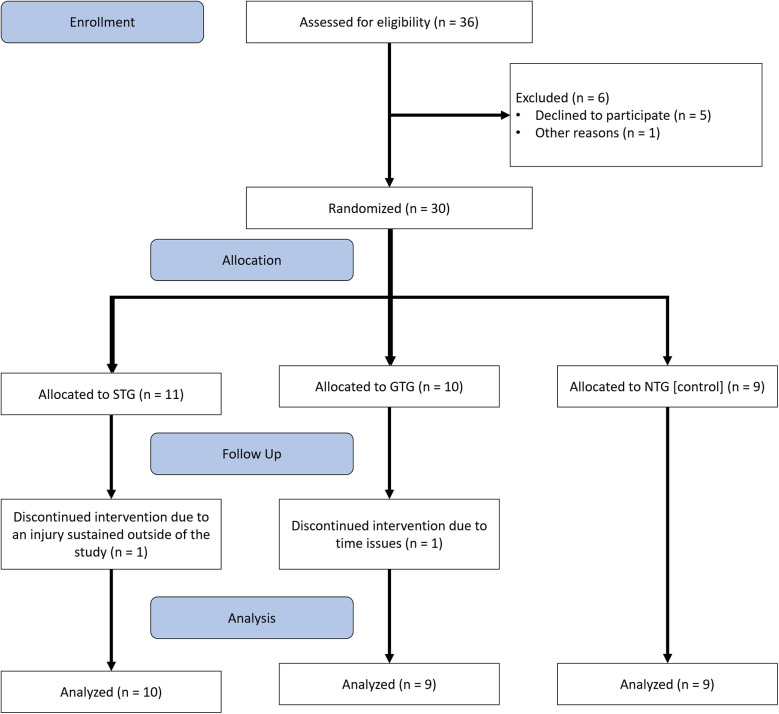
Methods: Baseline and follow-up tests measured global coordination, grip strength, Aimlabs performance, single and 4-fold reaction times, and anticipation. Participants completed a weekly and an ending questionnaire. Twenty-eight participants (12.3 ± 10.1 h gaming/week) were assigned to specific (N = 10), general (N = 9), and no training (N = 9) groups for an 8-week intervention. Variable changes over time and between groups were analyzed using a repeated measures ANCOVA.
Results: Training significantly improved the overall coordination of those participants engaging in physical training compared to the control group [F(2,25) = 3.858, p = 0.035, η2 = 0.236]. Grip strength also showed significant improvement [F(2,25) = 6.084, p = 0.007, η2 = 0.327]. There were no significant time or group effects for the gaming variables, but the hours played by participants positively influenced Grid Shot [F(1,24) = 4.746, p = 0.039, η2 = 0.165] and Track Point [F(1,24) = 9.613, p = 0.005, η2 = 0.286] performance. The weekly questionnaire indicated a significant improvement in participants' well-being.
Discussion: While training improved physical variables, no effects were observed in suggested short-term performance. However, gaming hours and experience during the intervention positively influenced performance. Future research should consider the amount of time spent playing as it may affect short-term performance. Furthermore, future research should strive to differentiate between various types of esports performance, such as short-term vs. long-term outcomes. Participants reported that engaging in physical activity within the context of esports and gaming positively contributed to their overall well-being.







 京公网安备 11010802042870号
京ICP备2023020795号-1
京公网安备 11010802042870号
京ICP备2023020795号-1

 分享
分享
 求助内容:
求助内容: 应助结果提醒方式:
 扫码关注我们
