Yong Sun Kim, Soo-Hyun Seok, Jae-Ho Lee, Sung-Dae Kim
{"title":"东北亚海域温度和盐度气候图谱。","authors":"Yong Sun Kim, Soo-Hyun Seok, Jae-Ho Lee, Sung-Dae Kim","doi":"10.1038/s41597-025-04543-6","DOIUrl":null,"url":null,"abstract":"<p><p>This study describes a monthly Atlas for the Northeast Asian Seas 2023 (ANAS23) with a 1/10° horizontal resolution and 73 vertical levels. For ANAS23, over 1.6 million hydrographic profiles were analyzed, utilizing a simple kriging interpolation technique, which considers data density and their covariance at each grid point, along with a profile stabilizing method to minimize damage to water-mass structures. Comparison of ANAS23 with previously published atlases, repeated sectional observations, and satellite-based geostrophic current fields reveals that the ANAS23 provides reliable descriptions of the spatial distribution of water masses, currents, thermohaline fronts, and mesoscale eddies while avoiding spike-shape noises, vertical instabilities, and artificial waters, particularly over large-topographic features. The ANAS23 could be utilized as a baseline to assess the dynamic state of climatological mean fields and their changes under evolving climates. The fact that uncertainty among atlases is still apparent, particularly in a region of scarce observations, calls for a collaborative international effort to collect qualified hydrographic observations for a better-performing regional atlas, thus improving predictive skills for future climate.</p>","PeriodicalId":21597,"journal":{"name":"Scientific Data","volume":"12 1","pages":"206"},"PeriodicalIF":7.2000,"publicationDate":"2025-02-04","publicationTypes":"Journal Article","fieldsOfStudy":null,"isOpenAccess":false,"openAccessPdf":"https://www.ncbi.nlm.nih.gov/pmc/articles/PMC11794869/pdf/","citationCount":"0","resultStr":"{\"title\":\"Climatological Atlas of Temperature and Salinity for the Northeast Asian Seas.\",\"authors\":\"Yong Sun Kim, Soo-Hyun Seok, Jae-Ho Lee, Sung-Dae Kim\",\"doi\":\"10.1038/s41597-025-04543-6\",\"DOIUrl\":null,\"url\":null,\"abstract\":\"<p><p>This study describes a monthly Atlas for the Northeast Asian Seas 2023 (ANAS23) with a 1/10° horizontal resolution and 73 vertical levels. For ANAS23, over 1.6 million hydrographic profiles were analyzed, utilizing a simple kriging interpolation technique, which considers data density and their covariance at each grid point, along with a profile stabilizing method to minimize damage to water-mass structures. Comparison of ANAS23 with previously published atlases, repeated sectional observations, and satellite-based geostrophic current fields reveals that the ANAS23 provides reliable descriptions of the spatial distribution of water masses, currents, thermohaline fronts, and mesoscale eddies while avoiding spike-shape noises, vertical instabilities, and artificial waters, particularly over large-topographic features. The ANAS23 could be utilized as a baseline to assess the dynamic state of climatological mean fields and their changes under evolving climates. The fact that uncertainty among atlases is still apparent, particularly in a region of scarce observations, calls for a collaborative international effort to collect qualified hydrographic observations for a better-performing regional atlas, thus improving predictive skills for future climate.</p>\",\"PeriodicalId\":21597,\"journal\":{\"name\":\"Scientific Data\",\"volume\":\"12 1\",\"pages\":\"206\"},\"PeriodicalIF\":7.2000,\"publicationDate\":\"2025-02-04\",\"publicationTypes\":\"Journal Article\",\"fieldsOfStudy\":null,\"isOpenAccess\":false,\"openAccessPdf\":\"https://www.ncbi.nlm.nih.gov/pmc/articles/PMC11794869/pdf/\",\"citationCount\":\"0\",\"resultStr\":null,\"platform\":\"Semanticscholar\",\"paperid\":null,\"PeriodicalName\":\"Scientific Data\",\"FirstCategoryId\":\"103\",\"ListUrlMain\":\"https://doi.org/10.1038/s41597-025-04543-6\",\"RegionNum\":2,\"RegionCategory\":\"综合性期刊\",\"ArticlePicture\":[],\"TitleCN\":null,\"AbstractTextCN\":null,\"PMCID\":null,\"EPubDate\":\"\",\"PubModel\":\"\",\"JCR\":\"Q1\",\"JCRName\":\"MULTIDISCIPLINARY SCIENCES\",\"Score\":null,\"Total\":0}","platform":"Semanticscholar","paperid":null,"PeriodicalName":"Scientific Data","FirstCategoryId":"103","ListUrlMain":"https://doi.org/10.1038/s41597-025-04543-6","RegionNum":2,"RegionCategory":"综合性期刊","ArticlePicture":[],"TitleCN":null,"AbstractTextCN":null,"PMCID":null,"EPubDate":"","PubModel":"","JCR":"Q1","JCRName":"MULTIDISCIPLINARY SCIENCES","Score":null,"Total":0}
Climatological Atlas of Temperature and Salinity for the Northeast Asian Seas.
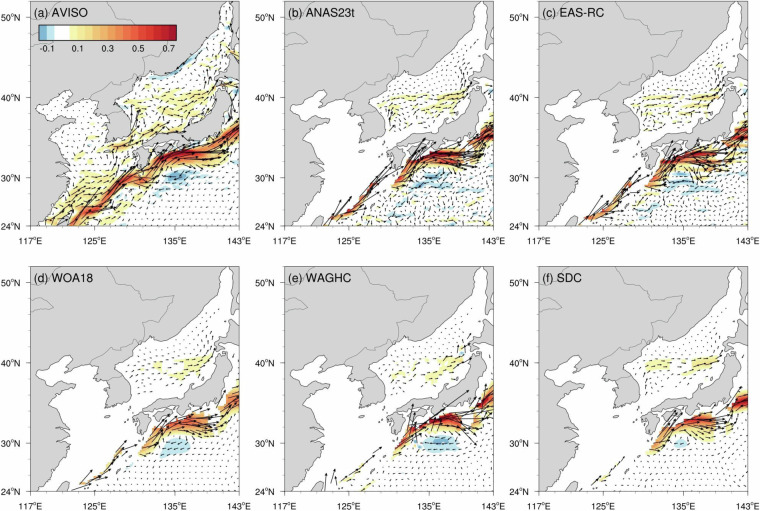
This study describes a monthly Atlas for the Northeast Asian Seas 2023 (ANAS23) with a 1/10° horizontal resolution and 73 vertical levels. For ANAS23, over 1.6 million hydrographic profiles were analyzed, utilizing a simple kriging interpolation technique, which considers data density and their covariance at each grid point, along with a profile stabilizing method to minimize damage to water-mass structures. Comparison of ANAS23 with previously published atlases, repeated sectional observations, and satellite-based geostrophic current fields reveals that the ANAS23 provides reliable descriptions of the spatial distribution of water masses, currents, thermohaline fronts, and mesoscale eddies while avoiding spike-shape noises, vertical instabilities, and artificial waters, particularly over large-topographic features. The ANAS23 could be utilized as a baseline to assess the dynamic state of climatological mean fields and their changes under evolving climates. The fact that uncertainty among atlases is still apparent, particularly in a region of scarce observations, calls for a collaborative international effort to collect qualified hydrographic observations for a better-performing regional atlas, thus improving predictive skills for future climate.
期刊介绍:
Scientific Data is an open-access journal focused on data, publishing descriptions of research datasets and articles on data sharing across natural sciences, medicine, engineering, and social sciences. Its goal is to enhance the sharing and reuse of scientific data, encourage broader data sharing, and acknowledge those who share their data.
The journal primarily publishes Data Descriptors, which offer detailed descriptions of research datasets, including data collection methods and technical analyses validating data quality. These descriptors aim to facilitate data reuse rather than testing hypotheses or presenting new interpretations, methods, or in-depth analyses.






 京公网安备 11010802042870号
京ICP备2023020795号-1
京公网安备 11010802042870号
京ICP备2023020795号-1

 分享
分享
 求助内容:
求助内容: 应助结果提醒方式:
 扫码关注我们
