Lu Li, Hongxia Zhang, Botao Zhang, Fangyuan Yang, Mengting Wang, Wenlong Qiu, Lina Fu, Menghua Chen, Na Tian
{"title":"较低的时间平均血清尿酸与腹膜透析患者死亡率增加有关。","authors":"Lu Li, Hongxia Zhang, Botao Zhang, Fangyuan Yang, Mengting Wang, Wenlong Qiu, Lina Fu, Menghua Chen, Na Tian","doi":"10.1111/1744-9987.14252","DOIUrl":null,"url":null,"abstract":"<p><strong>Background: </strong>The relationship between time-averaged serum uric acid (TA-SUA) levels and prognosis in peritoneal dialysis (PD) patients are rarely discussed.</p><p><strong>Methods: </strong>This was a retrospective cohort study. PD patients recruited from January 1, 2011, to December 31, 2020, were included. Baseline and follow-up uric acid levels over 1 year were collected to calculate time-averaged serum uric acid (TA-SUA) levels. Patients were divided into four groups based on TA-SUA quartiles: Q1 (<5.1 mg/dl), Q2 (5.1-5.8 mg/dl), Q3 (5.8-6.8 mg/dl), and Q4 (>6.8 mg/dl).</p><p><strong>Results: </strong>A total 487 PD patients with a mean age of 52.0 ± 14.2 were enrolled, including114 (23.4%) diabetes. Q1 (n = 121, 24.8%), Q2 (n = 118, 24.2%), Q3 (n = 125, 25.7%), and Q4 (n = 123, 25.3%). The Q1 group exhibited characteristics of increased age, malnutrition, and a higher prevalence of diabetes. During the 48.1 months follow-up time, 197 (35.8%) died, 109 (55.3%) cardiovascular disease (CVD), 38 (19.3%) infections. Kaplan-Meier analysis revealed that both all-cause mortality and cardiovascular mortality were significantly higher in the Q1 and Q4 groups (log-rank = 24.373, p < 0.001). COX regression analysis showed that decreased TA-SUA level was an independent risk factor for all-cause mortality in PD patients after adjustment for confounding factors. Each 1 mg/dl decrease in TA-SUA level was associated with a 23.46% increase in all-cause mortality (HR = 0.81, 95% CI, 0.71-0.94; p = 0.004*). Lower serum albumin level was associated with increased all-cause mortality.</p><p><strong>Conclusion: </strong>PD patients with lower TA-SUA were older and had a higher proportion of diabetes and malnourishment than those with higher TA-SUA. Long-term exposure to low TA-SUA levels was an independent predictor of all-cause and cardiovascular mortality in PD patients.</p>","PeriodicalId":94253,"journal":{"name":"Therapeutic apheresis and dialysis : official peer-reviewed journal of the International Society for Apheresis, the Japanese Society for Apheresis, the Japanese Society for Dialysis Therapy","volume":" ","pages":"479-490"},"PeriodicalIF":1.2000,"publicationDate":"2025-06-01","publicationTypes":"Journal Article","fieldsOfStudy":null,"isOpenAccess":false,"openAccessPdf":"https://www.ncbi.nlm.nih.gov/pmc/articles/PMC12050137/pdf/","citationCount":"0","resultStr":"{\"title\":\"Lower time-averaged serum uric acid was associated with increased mortality in peritoneal dialysis patients.\",\"authors\":\"Lu Li, Hongxia Zhang, Botao Zhang, Fangyuan Yang, Mengting Wang, Wenlong Qiu, Lina Fu, Menghua Chen, Na Tian\",\"doi\":\"10.1111/1744-9987.14252\",\"DOIUrl\":null,\"url\":null,\"abstract\":\"<p><strong>Background: </strong>The relationship between time-averaged serum uric acid (TA-SUA) levels and prognosis in peritoneal dialysis (PD) patients are rarely discussed.</p><p><strong>Methods: </strong>This was a retrospective cohort study. PD patients recruited from January 1, 2011, to December 31, 2020, were included. Baseline and follow-up uric acid levels over 1 year were collected to calculate time-averaged serum uric acid (TA-SUA) levels. Patients were divided into four groups based on TA-SUA quartiles: Q1 (<5.1 mg/dl), Q2 (5.1-5.8 mg/dl), Q3 (5.8-6.8 mg/dl), and Q4 (>6.8 mg/dl).</p><p><strong>Results: </strong>A total 487 PD patients with a mean age of 52.0 ± 14.2 were enrolled, including114 (23.4%) diabetes. Q1 (n = 121, 24.8%), Q2 (n = 118, 24.2%), Q3 (n = 125, 25.7%), and Q4 (n = 123, 25.3%). The Q1 group exhibited characteristics of increased age, malnutrition, and a higher prevalence of diabetes. During the 48.1 months follow-up time, 197 (35.8%) died, 109 (55.3%) cardiovascular disease (CVD), 38 (19.3%) infections. Kaplan-Meier analysis revealed that both all-cause mortality and cardiovascular mortality were significantly higher in the Q1 and Q4 groups (log-rank = 24.373, p < 0.001). COX regression analysis showed that decreased TA-SUA level was an independent risk factor for all-cause mortality in PD patients after adjustment for confounding factors. Each 1 mg/dl decrease in TA-SUA level was associated with a 23.46% increase in all-cause mortality (HR = 0.81, 95% CI, 0.71-0.94; p = 0.004*). Lower serum albumin level was associated with increased all-cause mortality.</p><p><strong>Conclusion: </strong>PD patients with lower TA-SUA were older and had a higher proportion of diabetes and malnourishment than those with higher TA-SUA. Long-term exposure to low TA-SUA levels was an independent predictor of all-cause and cardiovascular mortality in PD patients.</p>\",\"PeriodicalId\":94253,\"journal\":{\"name\":\"Therapeutic apheresis and dialysis : official peer-reviewed journal of the International Society for Apheresis, the Japanese Society for Apheresis, the Japanese Society for Dialysis Therapy\",\"volume\":\" \",\"pages\":\"479-490\"},\"PeriodicalIF\":1.2000,\"publicationDate\":\"2025-06-01\",\"publicationTypes\":\"Journal Article\",\"fieldsOfStudy\":null,\"isOpenAccess\":false,\"openAccessPdf\":\"https://www.ncbi.nlm.nih.gov/pmc/articles/PMC12050137/pdf/\",\"citationCount\":\"0\",\"resultStr\":null,\"platform\":\"Semanticscholar\",\"paperid\":null,\"PeriodicalName\":\"Therapeutic apheresis and dialysis : official peer-reviewed journal of the International Society for Apheresis, the Japanese Society for Apheresis, the Japanese Society for Dialysis Therapy\",\"FirstCategoryId\":\"1085\",\"ListUrlMain\":\"https://doi.org/10.1111/1744-9987.14252\",\"RegionNum\":0,\"RegionCategory\":null,\"ArticlePicture\":[],\"TitleCN\":null,\"AbstractTextCN\":null,\"PMCID\":null,\"EPubDate\":\"2025/2/4 0:00:00\",\"PubModel\":\"Epub\",\"JCR\":\"\",\"JCRName\":\"\",\"Score\":null,\"Total\":0}","platform":"Semanticscholar","paperid":null,"PeriodicalName":"Therapeutic apheresis and dialysis : official peer-reviewed journal of the International Society for Apheresis, the Japanese Society for Apheresis, the Japanese Society for Dialysis Therapy","FirstCategoryId":"1085","ListUrlMain":"https://doi.org/10.1111/1744-9987.14252","RegionNum":0,"RegionCategory":null,"ArticlePicture":[],"TitleCN":null,"AbstractTextCN":null,"PMCID":null,"EPubDate":"2025/2/4 0:00:00","PubModel":"Epub","JCR":"","JCRName":"","Score":null,"Total":0}
Lower time-averaged serum uric acid was associated with increased mortality in peritoneal dialysis patients.
Background: The relationship between time-averaged serum uric acid (TA-SUA) levels and prognosis in peritoneal dialysis (PD) patients are rarely discussed.
Methods: This was a retrospective cohort study. PD patients recruited from January 1, 2011, to December 31, 2020, were included. Baseline and follow-up uric acid levels over 1 year were collected to calculate time-averaged serum uric acid (TA-SUA) levels. Patients were divided into four groups based on TA-SUA quartiles: Q1 (<5.1 mg/dl), Q2 (5.1-5.8 mg/dl), Q3 (5.8-6.8 mg/dl), and Q4 (>6.8 mg/dl).
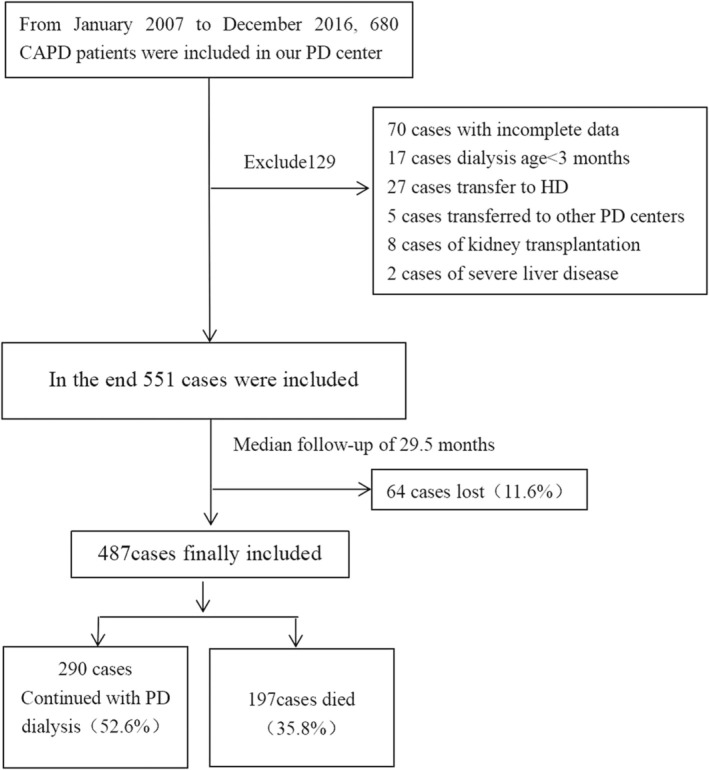
Results: A total 487 PD patients with a mean age of 52.0 ± 14.2 were enrolled, including114 (23.4%) diabetes. Q1 (n = 121, 24.8%), Q2 (n = 118, 24.2%), Q3 (n = 125, 25.7%), and Q4 (n = 123, 25.3%). The Q1 group exhibited characteristics of increased age, malnutrition, and a higher prevalence of diabetes. During the 48.1 months follow-up time, 197 (35.8%) died, 109 (55.3%) cardiovascular disease (CVD), 38 (19.3%) infections. Kaplan-Meier analysis revealed that both all-cause mortality and cardiovascular mortality were significantly higher in the Q1 and Q4 groups (log-rank = 24.373, p < 0.001). COX regression analysis showed that decreased TA-SUA level was an independent risk factor for all-cause mortality in PD patients after adjustment for confounding factors. Each 1 mg/dl decrease in TA-SUA level was associated with a 23.46% increase in all-cause mortality (HR = 0.81, 95% CI, 0.71-0.94; p = 0.004*). Lower serum albumin level was associated with increased all-cause mortality.
Conclusion: PD patients with lower TA-SUA were older and had a higher proportion of diabetes and malnourishment than those with higher TA-SUA. Long-term exposure to low TA-SUA levels was an independent predictor of all-cause and cardiovascular mortality in PD patients.






 京公网安备 11010802042870号
京ICP备2023020795号-1
京公网安备 11010802042870号
京ICP备2023020795号-1

 分享
分享

 求助内容:
求助内容: 应助结果提醒方式:
 扫码关注我们
