Changdong Wang;Zhou Shu;Jingli Yang;Zhenyu Zhao;Huamin Jie;Yongqi Chang;Shiqi Jiang;Kye Yak See
{"title":"非平衡开集泛化学习:一种增强机械诊断的元学习框架","authors":"Changdong Wang;Zhou Shu;Jingli Yang;Zhenyu Zhao;Huamin Jie;Yongqi Chang;Shiqi Jiang;Kye Yak See","doi":"10.1109/TCYB.2025.3531494","DOIUrl":null,"url":null,"abstract":"To alleviate data distribution under different operating conditions, domain generalization (DG) has been applied in mechanical diagnosis. Still, its effectiveness is limited when unknown fault states appear in the target domain. Consequently, open set DG (OSDG) has emerged to identify unknown classes in unknown domains. However, data collection costs and safety concerns have resulted in a significant class imbalance in OSDG. This imbalance causes the decision boundary to be skewed toward abundant positive classes, ultimately leading to misclassifying unknown states and increasing security risks. Currently, there is a lack of methods to simultaneously address domain shift and class shift in an imbalanced unknown domain. To tackle this issue, this article proposes a multisource domain-class gradient coordination meta-learning (MDGCML) framework, which can learn the generalized boundaries of all tasks by coordinating gradients between interdomains and interclasses. Based on the MDGCML, a joint learning paradigm involving the sharing of parameters between open-set classifiers and closed-set classifiers is constructed to enable quick adaption of the model to unknown domains. The superior performance of the proposed framework has been verified on two datasets.","PeriodicalId":13112,"journal":{"name":"IEEE Transactions on Cybernetics","volume":"55 3","pages":"1464-1475"},"PeriodicalIF":11.3000,"publicationDate":"2025-02-05","publicationTypes":"Journal Article","fieldsOfStudy":null,"isOpenAccess":false,"openAccessPdf":"","citationCount":"0","resultStr":"{\"title\":\"Learning to Imbalanced Open Set Generalize: A Meta-Learning Framework for Enhanced Mechanical Diagnosis\",\"authors\":\"Changdong Wang;Zhou Shu;Jingli Yang;Zhenyu Zhao;Huamin Jie;Yongqi Chang;Shiqi Jiang;Kye Yak See\",\"doi\":\"10.1109/TCYB.2025.3531494\",\"DOIUrl\":null,\"url\":null,\"abstract\":\"To alleviate data distribution under different operating conditions, domain generalization (DG) has been applied in mechanical diagnosis. Still, its effectiveness is limited when unknown fault states appear in the target domain. Consequently, open set DG (OSDG) has emerged to identify unknown classes in unknown domains. However, data collection costs and safety concerns have resulted in a significant class imbalance in OSDG. This imbalance causes the decision boundary to be skewed toward abundant positive classes, ultimately leading to misclassifying unknown states and increasing security risks. Currently, there is a lack of methods to simultaneously address domain shift and class shift in an imbalanced unknown domain. To tackle this issue, this article proposes a multisource domain-class gradient coordination meta-learning (MDGCML) framework, which can learn the generalized boundaries of all tasks by coordinating gradients between interdomains and interclasses. Based on the MDGCML, a joint learning paradigm involving the sharing of parameters between open-set classifiers and closed-set classifiers is constructed to enable quick adaption of the model to unknown domains. The superior performance of the proposed framework has been verified on two datasets.\",\"PeriodicalId\":13112,\"journal\":{\"name\":\"IEEE Transactions on Cybernetics\",\"volume\":\"55 3\",\"pages\":\"1464-1475\"},\"PeriodicalIF\":11.3000,\"publicationDate\":\"2025-02-05\",\"publicationTypes\":\"Journal Article\",\"fieldsOfStudy\":null,\"isOpenAccess\":false,\"openAccessPdf\":\"\",\"citationCount\":\"0\",\"resultStr\":null,\"platform\":\"Semanticscholar\",\"paperid\":null,\"PeriodicalName\":\"IEEE Transactions on Cybernetics\",\"FirstCategoryId\":\"94\",\"ListUrlMain\":\"https://ieeexplore.ieee.org/document/10874183/\",\"RegionNum\":1,\"RegionCategory\":\"计算机科学\",\"ArticlePicture\":[],\"TitleCN\":null,\"AbstractTextCN\":null,\"PMCID\":null,\"EPubDate\":\"\",\"PubModel\":\"\",\"JCR\":\"Q1\",\"JCRName\":\"AUTOMATION & CONTROL SYSTEMS\",\"Score\":null,\"Total\":0}","platform":"Semanticscholar","paperid":null,"PeriodicalName":"IEEE Transactions on Cybernetics","FirstCategoryId":"94","ListUrlMain":"https://ieeexplore.ieee.org/document/10874183/","RegionNum":1,"RegionCategory":"计算机科学","ArticlePicture":[],"TitleCN":null,"AbstractTextCN":null,"PMCID":null,"EPubDate":"","PubModel":"","JCR":"Q1","JCRName":"AUTOMATION & CONTROL SYSTEMS","Score":null,"Total":0}
Learning to Imbalanced Open Set Generalize: A Meta-Learning Framework for Enhanced Mechanical Diagnosis
To alleviate data distribution under different operating conditions, domain generalization (DG) has been applied in mechanical diagnosis. Still, its effectiveness is limited when unknown fault states appear in the target domain. Consequently, open set DG (OSDG) has emerged to identify unknown classes in unknown domains. However, data collection costs and safety concerns have resulted in a significant class imbalance in OSDG. This imbalance causes the decision boundary to be skewed toward abundant positive classes, ultimately leading to misclassifying unknown states and increasing security risks. Currently, there is a lack of methods to simultaneously address domain shift and class shift in an imbalanced unknown domain. To tackle this issue, this article proposes a multisource domain-class gradient coordination meta-learning (MDGCML) framework, which can learn the generalized boundaries of all tasks by coordinating gradients between interdomains and interclasses. Based on the MDGCML, a joint learning paradigm involving the sharing of parameters between open-set classifiers and closed-set classifiers is constructed to enable quick adaption of the model to unknown domains. The superior performance of the proposed framework has been verified on two datasets.
期刊介绍:
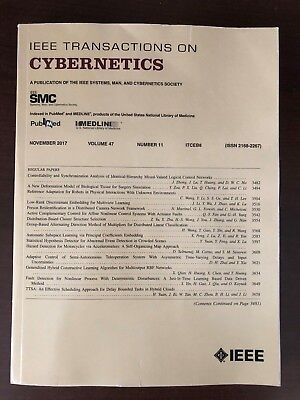
The scope of the IEEE Transactions on Cybernetics includes computational approaches to the field of cybernetics. Specifically, the transactions welcomes papers on communication and control across machines or machine, human, and organizations. The scope includes such areas as computational intelligence, computer vision, neural networks, genetic algorithms, machine learning, fuzzy systems, cognitive systems, decision making, and robotics, to the extent that they contribute to the theme of cybernetics or demonstrate an application of cybernetics principles.




 京公网安备 11010802042870号
京ICP备2023020795号-1
京公网安备 11010802042870号
京ICP备2023020795号-1

 分享
分享
 求助内容:
求助内容: 应助结果提醒方式:
 扫码关注我们
