Impact of airflow-assisted spraying technology on droplet drift: a solution for reducing pesticide drift under multidirectional strong wind conditions
BACKGROUND
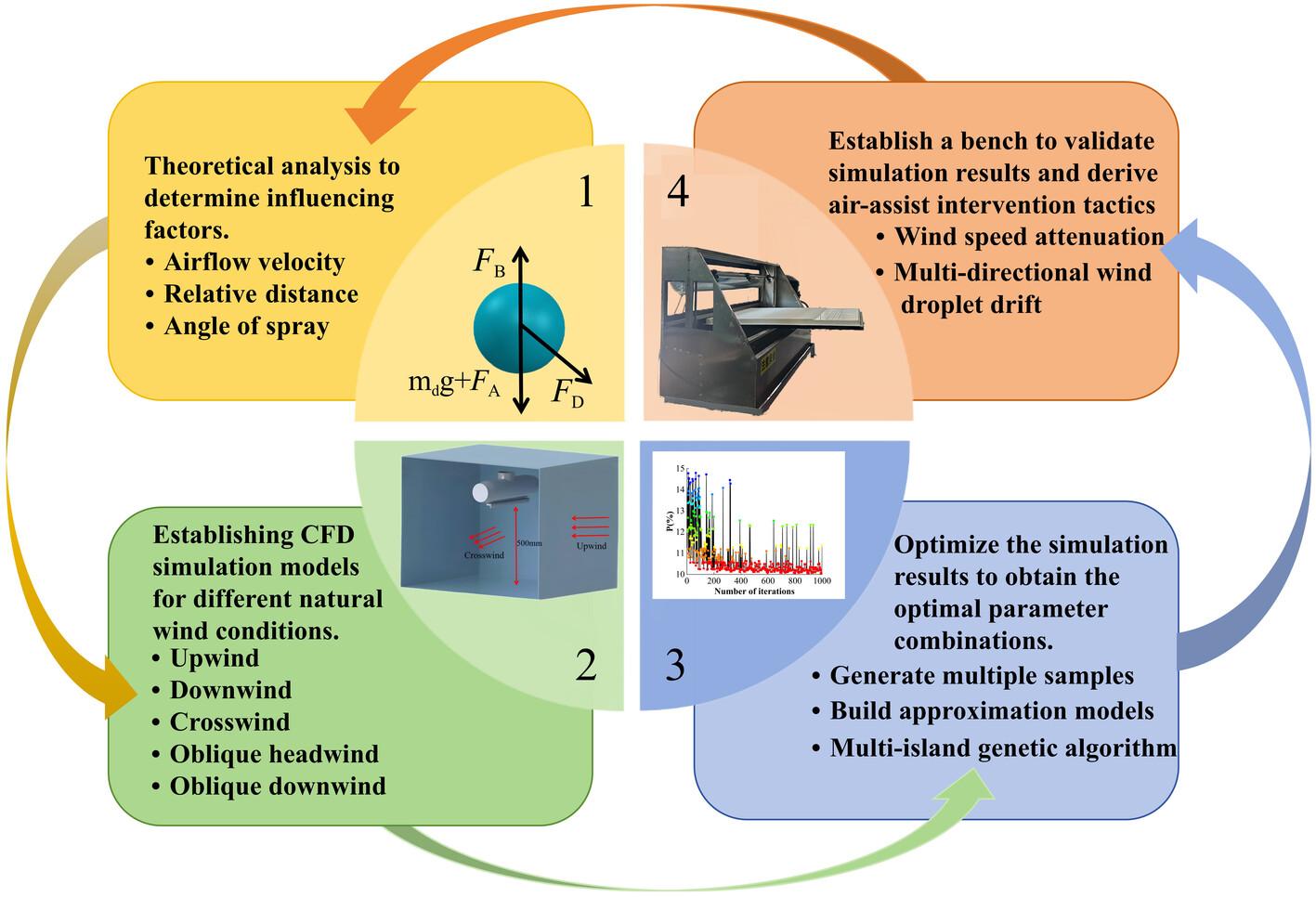
In agricultural production, pesticide application is often influenced by natural wind, leading to pesticide drift. This reduces the effectiveness of pest and disease control on target crops and poses risks of pesticide damage to nontarget crops, which can result in serious environmental and food contamination issues. This study addresses the issue of droplet drift in complex farmland environments by developing a simulation model that couples auxiliary airflow with multidirectional wind. The model analyzes the complex movement trajectories and dynamic characteristics of droplets within the coupled flow field, identifies the key factors influencing drift under the effect of auxiliary airflow, and adjusts spraying parameters based on different wind directions and speeds to reduce droplet drift.
RESULTS
Numerical simulations were conducted using the optimized auxiliary airflow parameters in multidirectional wind. The results demonstrated that for winds of 3.3 ~ 7.9 m s−1, the optimized auxiliary airflow significantly reduced both the drift rate and amount of droplets: compared to conventional spraying, the drift rate and amount decreased by 50.6% and 84.9%, respectively; compared to conventional airflow-assisted spraying, they decreased by 11.54% and 49.8%, respectively. Moreover, bench tests validated the simulation model with an error rate of 7.7 ± 0.2%.
期刊介绍:
Pest Management Science is the international journal of research and development in crop protection and pest control. Since its launch in 1970, the journal has become the premier forum for papers on the discovery, application, and impact on the environment of products and strategies designed for pest management.
Published for SCI by John Wiley & Sons Ltd.







 京公网安备 11010802042870号
京ICP备2023020795号-1
京公网安备 11010802042870号
京ICP备2023020795号-1

 分享
分享
 求助内容:
求助内容: 应助结果提醒方式:
 扫码关注我们
