Emmanuelle Genoyer, Jonathan Wilson, Joshua M. Ames, Caleb Stokes, Dante Moreno, Noa Etzyon, Andrew Oberst, Michael Gale
{"title":"在细胞质中暴露负义病毒RNA启动对西尼罗病毒的先天免疫","authors":"Emmanuelle Genoyer, Jonathan Wilson, Joshua M. Ames, Caleb Stokes, Dante Moreno, Noa Etzyon, Andrew Oberst, Michael Gale","doi":"10.1016/j.molcel.2025.01.015","DOIUrl":null,"url":null,"abstract":"For many RNA viruses, immunity is triggered when RIG-I-like receptors (RLRs) detect viral RNA. However, only a minority of infected cells undergo innate immune activation. By examining these “first-responder” cells during West Nile virus infection, we found that specific accumulation of antigenomic negative-sense viral RNA (−vRNA) underlies innate immune activation and that RIG-I preferentially interacts with −vRNA. However, flaviviruses sequester −vRNA into membrane-bound replication compartments away from cytosolic sensors. We found that single-stranded −vRNA accumulates outside of replication compartments in first-responder cells, rendering it accessible to RLRs. Exposure of this −vRNA occurs at late time points of infection, is linked to viral assembly, and depends on the expression of viral structural proteins. These findings reveal that, although most infected cells replicate high levels of vRNA, release of −vRNA from replication compartments during assembly occurs at low frequency and is critical for initiation of innate immunity during flavivirus infection.","PeriodicalId":18950,"journal":{"name":"Molecular Cell","volume":"46 1","pages":""},"PeriodicalIF":16.6000,"publicationDate":"2025-02-06","publicationTypes":"Journal Article","fieldsOfStudy":null,"isOpenAccess":false,"openAccessPdf":"","citationCount":"0","resultStr":"{\"title\":\"Exposure of negative-sense viral RNA in the cytoplasm initiates innate immunity to West Nile virus\",\"authors\":\"Emmanuelle Genoyer, Jonathan Wilson, Joshua M. Ames, Caleb Stokes, Dante Moreno, Noa Etzyon, Andrew Oberst, Michael Gale\",\"doi\":\"10.1016/j.molcel.2025.01.015\",\"DOIUrl\":null,\"url\":null,\"abstract\":\"For many RNA viruses, immunity is triggered when RIG-I-like receptors (RLRs) detect viral RNA. However, only a minority of infected cells undergo innate immune activation. By examining these “first-responder” cells during West Nile virus infection, we found that specific accumulation of antigenomic negative-sense viral RNA (−vRNA) underlies innate immune activation and that RIG-I preferentially interacts with −vRNA. However, flaviviruses sequester −vRNA into membrane-bound replication compartments away from cytosolic sensors. We found that single-stranded −vRNA accumulates outside of replication compartments in first-responder cells, rendering it accessible to RLRs. Exposure of this −vRNA occurs at late time points of infection, is linked to viral assembly, and depends on the expression of viral structural proteins. These findings reveal that, although most infected cells replicate high levels of vRNA, release of −vRNA from replication compartments during assembly occurs at low frequency and is critical for initiation of innate immunity during flavivirus infection.\",\"PeriodicalId\":18950,\"journal\":{\"name\":\"Molecular Cell\",\"volume\":\"46 1\",\"pages\":\"\"},\"PeriodicalIF\":16.6000,\"publicationDate\":\"2025-02-06\",\"publicationTypes\":\"Journal Article\",\"fieldsOfStudy\":null,\"isOpenAccess\":false,\"openAccessPdf\":\"\",\"citationCount\":\"0\",\"resultStr\":null,\"platform\":\"Semanticscholar\",\"paperid\":null,\"PeriodicalName\":\"Molecular Cell\",\"FirstCategoryId\":\"99\",\"ListUrlMain\":\"https://doi.org/10.1016/j.molcel.2025.01.015\",\"RegionNum\":1,\"RegionCategory\":\"生物学\",\"ArticlePicture\":[],\"TitleCN\":null,\"AbstractTextCN\":null,\"PMCID\":null,\"EPubDate\":\"\",\"PubModel\":\"\",\"JCR\":\"Q1\",\"JCRName\":\"BIOCHEMISTRY & MOLECULAR BIOLOGY\",\"Score\":null,\"Total\":0}","platform":"Semanticscholar","paperid":null,"PeriodicalName":"Molecular Cell","FirstCategoryId":"99","ListUrlMain":"https://doi.org/10.1016/j.molcel.2025.01.015","RegionNum":1,"RegionCategory":"生物学","ArticlePicture":[],"TitleCN":null,"AbstractTextCN":null,"PMCID":null,"EPubDate":"","PubModel":"","JCR":"Q1","JCRName":"BIOCHEMISTRY & MOLECULAR BIOLOGY","Score":null,"Total":0}
Exposure of negative-sense viral RNA in the cytoplasm initiates innate immunity to West Nile virus
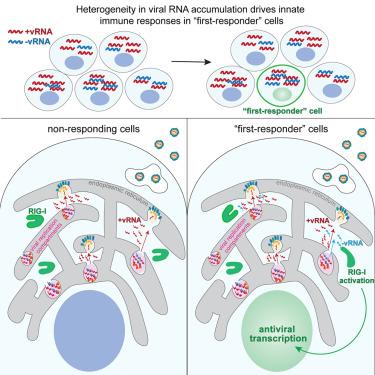
For many RNA viruses, immunity is triggered when RIG-I-like receptors (RLRs) detect viral RNA. However, only a minority of infected cells undergo innate immune activation. By examining these “first-responder” cells during West Nile virus infection, we found that specific accumulation of antigenomic negative-sense viral RNA (−vRNA) underlies innate immune activation and that RIG-I preferentially interacts with −vRNA. However, flaviviruses sequester −vRNA into membrane-bound replication compartments away from cytosolic sensors. We found that single-stranded −vRNA accumulates outside of replication compartments in first-responder cells, rendering it accessible to RLRs. Exposure of this −vRNA occurs at late time points of infection, is linked to viral assembly, and depends on the expression of viral structural proteins. These findings reveal that, although most infected cells replicate high levels of vRNA, release of −vRNA from replication compartments during assembly occurs at low frequency and is critical for initiation of innate immunity during flavivirus infection.
期刊介绍:
Molecular Cell is a companion to Cell, the leading journal of biology and the highest-impact journal in the world. Launched in December 1997 and published monthly. Molecular Cell is dedicated to publishing cutting-edge research in molecular biology, focusing on fundamental cellular processes. The journal encompasses a wide range of topics, including DNA replication, recombination, and repair; Chromatin biology and genome organization; Transcription; RNA processing and decay; Non-coding RNA function; Translation; Protein folding, modification, and quality control; Signal transduction pathways; Cell cycle and checkpoints; Cell death; Autophagy; Metabolism.



 京公网安备 11010802042870号
京ICP备2023020795号-1
京公网安备 11010802042870号
京ICP备2023020795号-1

 分享
分享
 求助内容:
求助内容: 应助结果提醒方式:
 扫码关注我们
