Chase C. Suiter, Diego Calderon, David S. Lee, Melodie Chiu, Shruti Jain, Florence M. Chardon, Choli Lee, Riza M. Daza, Cole Trapnell, Ning Zheng, Jay Shendure
{"title":"E3泛素连接酶与靶底物的组合作图","authors":"Chase C. Suiter, Diego Calderon, David S. Lee, Melodie Chiu, Shruti Jain, Florence M. Chardon, Choli Lee, Riza M. Daza, Cole Trapnell, Ning Zheng, Jay Shendure","doi":"10.1016/j.molcel.2025.01.016","DOIUrl":null,"url":null,"abstract":"E3 ubiquitin ligases (E3s) confer specificity of protein degradation through ubiquitination of substrate proteins. Yet, the vast majority of the >600 human E3s have no known substrates. To identify proteolytic E3-substrate pairs at scale, we developed combinatorial mapping of E3 targets (COMET), a framework for testing the role of many E3s in degrading many candidate substrates within a single experiment. We applied COMET to SCF ubiquitin ligase subunits that mediate degradation of target substrates (6,716 F-box-ORF [open reading frame] combinations) and E3s that degrade short-lived transcription factors (TFs) (26,028 E3-TF combinations). Our data suggest that many E3-substrate relationships are complex rather than 1:1 associations. Finally, we leverage deep learning to predict the structural basis of E3-substrate interactions and probe the strengths and limits of such models. Looking forward, we consider the practicality of transposing this framework, i.e., computational structural prediction of all possible E3-substrate interactions, followed by multiplex experimental validation.","PeriodicalId":18950,"journal":{"name":"Molecular Cell","volume":"15 1","pages":""},"PeriodicalIF":16.0000,"publicationDate":"2025-02-06","publicationTypes":"Journal Article","fieldsOfStudy":null,"isOpenAccess":false,"openAccessPdf":"","citationCount":"0","resultStr":"{\"title\":\"Combinatorial mapping of E3 ubiquitin ligases to their target substrates\",\"authors\":\"Chase C. Suiter, Diego Calderon, David S. Lee, Melodie Chiu, Shruti Jain, Florence M. Chardon, Choli Lee, Riza M. Daza, Cole Trapnell, Ning Zheng, Jay Shendure\",\"doi\":\"10.1016/j.molcel.2025.01.016\",\"DOIUrl\":null,\"url\":null,\"abstract\":\"E3 ubiquitin ligases (E3s) confer specificity of protein degradation through ubiquitination of substrate proteins. Yet, the vast majority of the >600 human E3s have no known substrates. To identify proteolytic E3-substrate pairs at scale, we developed combinatorial mapping of E3 targets (COMET), a framework for testing the role of many E3s in degrading many candidate substrates within a single experiment. We applied COMET to SCF ubiquitin ligase subunits that mediate degradation of target substrates (6,716 F-box-ORF [open reading frame] combinations) and E3s that degrade short-lived transcription factors (TFs) (26,028 E3-TF combinations). Our data suggest that many E3-substrate relationships are complex rather than 1:1 associations. Finally, we leverage deep learning to predict the structural basis of E3-substrate interactions and probe the strengths and limits of such models. Looking forward, we consider the practicality of transposing this framework, i.e., computational structural prediction of all possible E3-substrate interactions, followed by multiplex experimental validation.\",\"PeriodicalId\":18950,\"journal\":{\"name\":\"Molecular Cell\",\"volume\":\"15 1\",\"pages\":\"\"},\"PeriodicalIF\":16.0000,\"publicationDate\":\"2025-02-06\",\"publicationTypes\":\"Journal Article\",\"fieldsOfStudy\":null,\"isOpenAccess\":false,\"openAccessPdf\":\"\",\"citationCount\":\"0\",\"resultStr\":null,\"platform\":\"Semanticscholar\",\"paperid\":null,\"PeriodicalName\":\"Molecular Cell\",\"FirstCategoryId\":\"99\",\"ListUrlMain\":\"https://doi.org/10.1016/j.molcel.2025.01.016\",\"RegionNum\":1,\"RegionCategory\":\"生物学\",\"ArticlePicture\":[],\"TitleCN\":null,\"AbstractTextCN\":null,\"PMCID\":null,\"EPubDate\":\"\",\"PubModel\":\"\",\"JCR\":\"Q1\",\"JCRName\":\"BIOCHEMISTRY & MOLECULAR BIOLOGY\",\"Score\":null,\"Total\":0}","platform":"Semanticscholar","paperid":null,"PeriodicalName":"Molecular Cell","FirstCategoryId":"99","ListUrlMain":"https://doi.org/10.1016/j.molcel.2025.01.016","RegionNum":1,"RegionCategory":"生物学","ArticlePicture":[],"TitleCN":null,"AbstractTextCN":null,"PMCID":null,"EPubDate":"","PubModel":"","JCR":"Q1","JCRName":"BIOCHEMISTRY & MOLECULAR BIOLOGY","Score":null,"Total":0}
Combinatorial mapping of E3 ubiquitin ligases to their target substrates
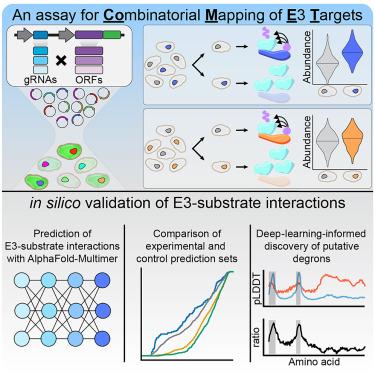
E3 ubiquitin ligases (E3s) confer specificity of protein degradation through ubiquitination of substrate proteins. Yet, the vast majority of the >600 human E3s have no known substrates. To identify proteolytic E3-substrate pairs at scale, we developed combinatorial mapping of E3 targets (COMET), a framework for testing the role of many E3s in degrading many candidate substrates within a single experiment. We applied COMET to SCF ubiquitin ligase subunits that mediate degradation of target substrates (6,716 F-box-ORF [open reading frame] combinations) and E3s that degrade short-lived transcription factors (TFs) (26,028 E3-TF combinations). Our data suggest that many E3-substrate relationships are complex rather than 1:1 associations. Finally, we leverage deep learning to predict the structural basis of E3-substrate interactions and probe the strengths and limits of such models. Looking forward, we consider the practicality of transposing this framework, i.e., computational structural prediction of all possible E3-substrate interactions, followed by multiplex experimental validation.
期刊介绍:
Molecular Cell is a companion to Cell, the leading journal of biology and the highest-impact journal in the world. Launched in December 1997 and published monthly. Molecular Cell is dedicated to publishing cutting-edge research in molecular biology, focusing on fundamental cellular processes. The journal encompasses a wide range of topics, including DNA replication, recombination, and repair; Chromatin biology and genome organization; Transcription; RNA processing and decay; Non-coding RNA function; Translation; Protein folding, modification, and quality control; Signal transduction pathways; Cell cycle and checkpoints; Cell death; Autophagy; Metabolism.




 京公网安备 11010802042870号
京ICP备2023020795号-1
京公网安备 11010802042870号
京ICP备2023020795号-1

 分享
分享
 求助内容:
求助内容: 应助结果提醒方式:
 扫码关注我们
