Adrien Gregorj , Zeynep Yücel , Francesco Zanlungo , Takayuki Kanda
{"title":"生态数据揭示了由于两个人的社会互动而导致的人与人之间避碰的不平衡","authors":"Adrien Gregorj , Zeynep Yücel , Francesco Zanlungo , Takayuki Kanda","doi":"10.1016/j.trf.2025.01.039","DOIUrl":null,"url":null,"abstract":"<div><div>Humans navigate public spaces safely and smoothly using complex collision avoidance strategies. Traditional models of human–human collision avoidance often draw from physics, relying on repulsive forces, but the effect of social factors on these strategies is not well understood. This study examines frontal encounters between single pedestrians and two-person groups (dyads), investigating the contributions of each party to collision avoidance and the impact of social interaction within the group. Using an ecological dataset of pedestrian trajectories, we measured deviations from a straight path as a proxy for collision avoidance. Our findings reveal a systematic imbalance and significant effects of social interaction on collision avoidance. Single pedestrians tend to prioritise trajectory efficiency in undisturbed situations and are the primary contributors to avoidance during encounters, adjusting their paths according to the dyad's interaction level. For dyads, social interaction correlates with lower efficiency in undisturbed cases and reduced responsiveness during encounters. An analysis of the impact parameter further shows that collision risk influences path deviations: individuals demonstrate larger deviations in response to highly interactive dyads, both in high-risk and less critical encounters. For dyads, the difference in deviation between low and high interaction levels is most pronounced when the single pedestrian is on a near-collision course. These results deepen our understanding of human pedestrian navigation, illustrating dynamical and social implications of group dynamics.</div></div>","PeriodicalId":48355,"journal":{"name":"Transportation Research Part F-Traffic Psychology and Behaviour","volume":"109 ","pages":"Pages 1313-1333"},"PeriodicalIF":4.4000,"publicationDate":"2025-02-01","publicationTypes":"Journal Article","fieldsOfStudy":null,"isOpenAccess":false,"openAccessPdf":"","citationCount":"0","resultStr":"{\"title\":\"Ecological data reveal imbalances in human–human collision avoidance due to dyads' social interaction\",\"authors\":\"Adrien Gregorj , Zeynep Yücel , Francesco Zanlungo , Takayuki Kanda\",\"doi\":\"10.1016/j.trf.2025.01.039\",\"DOIUrl\":null,\"url\":null,\"abstract\":\"<div><div>Humans navigate public spaces safely and smoothly using complex collision avoidance strategies. Traditional models of human–human collision avoidance often draw from physics, relying on repulsive forces, but the effect of social factors on these strategies is not well understood. This study examines frontal encounters between single pedestrians and two-person groups (dyads), investigating the contributions of each party to collision avoidance and the impact of social interaction within the group. Using an ecological dataset of pedestrian trajectories, we measured deviations from a straight path as a proxy for collision avoidance. Our findings reveal a systematic imbalance and significant effects of social interaction on collision avoidance. Single pedestrians tend to prioritise trajectory efficiency in undisturbed situations and are the primary contributors to avoidance during encounters, adjusting their paths according to the dyad's interaction level. For dyads, social interaction correlates with lower efficiency in undisturbed cases and reduced responsiveness during encounters. An analysis of the impact parameter further shows that collision risk influences path deviations: individuals demonstrate larger deviations in response to highly interactive dyads, both in high-risk and less critical encounters. For dyads, the difference in deviation between low and high interaction levels is most pronounced when the single pedestrian is on a near-collision course. These results deepen our understanding of human pedestrian navigation, illustrating dynamical and social implications of group dynamics.</div></div>\",\"PeriodicalId\":48355,\"journal\":{\"name\":\"Transportation Research Part F-Traffic Psychology and Behaviour\",\"volume\":\"109 \",\"pages\":\"Pages 1313-1333\"},\"PeriodicalIF\":4.4000,\"publicationDate\":\"2025-02-01\",\"publicationTypes\":\"Journal Article\",\"fieldsOfStudy\":null,\"isOpenAccess\":false,\"openAccessPdf\":\"\",\"citationCount\":\"0\",\"resultStr\":null,\"platform\":\"Semanticscholar\",\"paperid\":null,\"PeriodicalName\":\"Transportation Research Part F-Traffic Psychology and Behaviour\",\"FirstCategoryId\":\"5\",\"ListUrlMain\":\"https://www.sciencedirect.com/science/article/pii/S1369847825000373\",\"RegionNum\":2,\"RegionCategory\":\"工程技术\",\"ArticlePicture\":[],\"TitleCN\":null,\"AbstractTextCN\":null,\"PMCID\":null,\"EPubDate\":\"2025/2/6 0:00:00\",\"PubModel\":\"Epub\",\"JCR\":\"Q1\",\"JCRName\":\"PSYCHOLOGY, APPLIED\",\"Score\":null,\"Total\":0}","platform":"Semanticscholar","paperid":null,"PeriodicalName":"Transportation Research Part F-Traffic Psychology and Behaviour","FirstCategoryId":"5","ListUrlMain":"https://www.sciencedirect.com/science/article/pii/S1369847825000373","RegionNum":2,"RegionCategory":"工程技术","ArticlePicture":[],"TitleCN":null,"AbstractTextCN":null,"PMCID":null,"EPubDate":"2025/2/6 0:00:00","PubModel":"Epub","JCR":"Q1","JCRName":"PSYCHOLOGY, APPLIED","Score":null,"Total":0}
Ecological data reveal imbalances in human–human collision avoidance due to dyads' social interaction
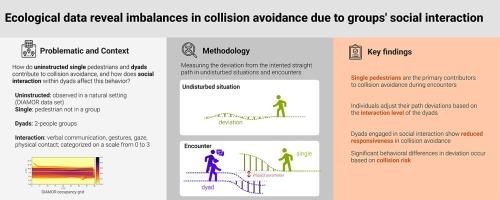
Humans navigate public spaces safely and smoothly using complex collision avoidance strategies. Traditional models of human–human collision avoidance often draw from physics, relying on repulsive forces, but the effect of social factors on these strategies is not well understood. This study examines frontal encounters between single pedestrians and two-person groups (dyads), investigating the contributions of each party to collision avoidance and the impact of social interaction within the group. Using an ecological dataset of pedestrian trajectories, we measured deviations from a straight path as a proxy for collision avoidance. Our findings reveal a systematic imbalance and significant effects of social interaction on collision avoidance. Single pedestrians tend to prioritise trajectory efficiency in undisturbed situations and are the primary contributors to avoidance during encounters, adjusting their paths according to the dyad's interaction level. For dyads, social interaction correlates with lower efficiency in undisturbed cases and reduced responsiveness during encounters. An analysis of the impact parameter further shows that collision risk influences path deviations: individuals demonstrate larger deviations in response to highly interactive dyads, both in high-risk and less critical encounters. For dyads, the difference in deviation between low and high interaction levels is most pronounced when the single pedestrian is on a near-collision course. These results deepen our understanding of human pedestrian navigation, illustrating dynamical and social implications of group dynamics.
期刊介绍:
Transportation Research Part F: Traffic Psychology and Behaviour focuses on the behavioural and psychological aspects of traffic and transport. The aim of the journal is to enhance theory development, improve the quality of empirical studies and to stimulate the application of research findings in practice. TRF provides a focus and a means of communication for the considerable amount of research activities that are now being carried out in this field. The journal provides a forum for transportation researchers, psychologists, ergonomists, engineers and policy-makers with an interest in traffic and transport psychology.




 京公网安备 11010802042870号
京ICP备2023020795号-1
京公网安备 11010802042870号
京ICP备2023020795号-1

 分享
分享
 求助内容:
求助内容: 应助结果提醒方式:
 扫码关注我们
