{"title":"位错对纳米结构金刚石和立方氮化硼复合材料异质界面强化的影响","authors":"Hanqing Wei , Haifei Zhan , Dominik Legut , Shihao Zhang","doi":"10.1016/j.carbon.2025.120079","DOIUrl":null,"url":null,"abstract":"<div><div>The nanometer-scale diamond/cBN (C/BN) heterointerface is believed to significantly enhance the mechanical properties of diamond-cBN nanocomposites, however, the underlying mechanisms remain largely unexplored and poorly understood. In this study, we conduct a comprehensive investigation of the dislocation slip resistance at perfect C/BN heterointerfaces and their corresponding nanotwinned and stacking-faulted structures, utilizing the ab initio-informed Peierls-Nabarro model. Our findings show that the nanotwinned defects at the heterointerface, characterized by negative formation energy, are more thermodynamically stable than those in the cBN and diamond bulk. Stacking faults tend to favor the cBN side over the diamond side at the heterointerface, which is consistent with experimental observations. The perfect C/BN heterointerface exhibits notably lower slip resistance to parallel dislocation than bulk diamond and cBN due to shear-induced Friedel oscillation. Conversely, a much higher dislocation slip resistance is observed at the nanotwinned and stacking-faulted C/BN heterointerfaces than that of bulk cBN, suggesting that the mirror symmetry presented across the nanotwinned and stacking-faulted heterointerfaces offers an effective strategy for strengthening. These insights not only offer a novel perspective on the ubiquitous heterointerfacial strengthening in diamond-cBN nanocomposites, but also underscore the pivotal role of atomic-scale interfaces in designing superhard nanostructures.</div></div>","PeriodicalId":262,"journal":{"name":"Carbon","volume":"235 ","pages":"Article 120079"},"PeriodicalIF":12.7000,"publicationDate":"2025-03-10","publicationTypes":"Journal Article","fieldsOfStudy":null,"isOpenAccess":false,"openAccessPdf":"","citationCount":"0","resultStr":"{\"title\":\"A dislocation perspective on heterointerfacial strengthening in nanostructured diamond and cubic boron nitride composites\",\"authors\":\"Hanqing Wei , Haifei Zhan , Dominik Legut , Shihao Zhang\",\"doi\":\"10.1016/j.carbon.2025.120079\",\"DOIUrl\":null,\"url\":null,\"abstract\":\"<div><div>The nanometer-scale diamond/cBN (C/BN) heterointerface is believed to significantly enhance the mechanical properties of diamond-cBN nanocomposites, however, the underlying mechanisms remain largely unexplored and poorly understood. In this study, we conduct a comprehensive investigation of the dislocation slip resistance at perfect C/BN heterointerfaces and their corresponding nanotwinned and stacking-faulted structures, utilizing the ab initio-informed Peierls-Nabarro model. Our findings show that the nanotwinned defects at the heterointerface, characterized by negative formation energy, are more thermodynamically stable than those in the cBN and diamond bulk. Stacking faults tend to favor the cBN side over the diamond side at the heterointerface, which is consistent with experimental observations. The perfect C/BN heterointerface exhibits notably lower slip resistance to parallel dislocation than bulk diamond and cBN due to shear-induced Friedel oscillation. Conversely, a much higher dislocation slip resistance is observed at the nanotwinned and stacking-faulted C/BN heterointerfaces than that of bulk cBN, suggesting that the mirror symmetry presented across the nanotwinned and stacking-faulted heterointerfaces offers an effective strategy for strengthening. These insights not only offer a novel perspective on the ubiquitous heterointerfacial strengthening in diamond-cBN nanocomposites, but also underscore the pivotal role of atomic-scale interfaces in designing superhard nanostructures.</div></div>\",\"PeriodicalId\":262,\"journal\":{\"name\":\"Carbon\",\"volume\":\"235 \",\"pages\":\"Article 120079\"},\"PeriodicalIF\":12.7000,\"publicationDate\":\"2025-03-10\",\"publicationTypes\":\"Journal Article\",\"fieldsOfStudy\":null,\"isOpenAccess\":false,\"openAccessPdf\":\"\",\"citationCount\":\"0\",\"resultStr\":null,\"platform\":\"Semanticscholar\",\"paperid\":null,\"PeriodicalName\":\"Carbon\",\"FirstCategoryId\":\"88\",\"ListUrlMain\":\"https://www.sciencedirect.com/science/article/pii/S0008622325000958\",\"RegionNum\":2,\"RegionCategory\":\"材料科学\",\"ArticlePicture\":[],\"TitleCN\":null,\"AbstractTextCN\":null,\"PMCID\":null,\"EPubDate\":\"2025/2/1 0:00:00\",\"PubModel\":\"Epub\",\"JCR\":\"Q1\",\"JCRName\":\"CHEMISTRY, PHYSICAL\",\"Score\":null,\"Total\":0}","platform":"Semanticscholar","paperid":null,"PeriodicalName":"Carbon","FirstCategoryId":"88","ListUrlMain":"https://www.sciencedirect.com/science/article/pii/S0008622325000958","RegionNum":2,"RegionCategory":"材料科学","ArticlePicture":[],"TitleCN":null,"AbstractTextCN":null,"PMCID":null,"EPubDate":"2025/2/1 0:00:00","PubModel":"Epub","JCR":"Q1","JCRName":"CHEMISTRY, PHYSICAL","Score":null,"Total":0}
A dislocation perspective on heterointerfacial strengthening in nanostructured diamond and cubic boron nitride composites
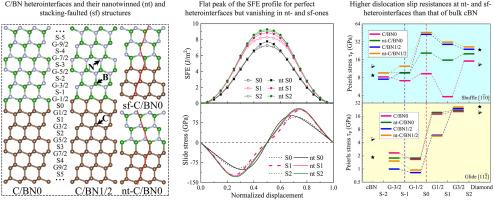
The nanometer-scale diamond/cBN (C/BN) heterointerface is believed to significantly enhance the mechanical properties of diamond-cBN nanocomposites, however, the underlying mechanisms remain largely unexplored and poorly understood. In this study, we conduct a comprehensive investigation of the dislocation slip resistance at perfect C/BN heterointerfaces and their corresponding nanotwinned and stacking-faulted structures, utilizing the ab initio-informed Peierls-Nabarro model. Our findings show that the nanotwinned defects at the heterointerface, characterized by negative formation energy, are more thermodynamically stable than those in the cBN and diamond bulk. Stacking faults tend to favor the cBN side over the diamond side at the heterointerface, which is consistent with experimental observations. The perfect C/BN heterointerface exhibits notably lower slip resistance to parallel dislocation than bulk diamond and cBN due to shear-induced Friedel oscillation. Conversely, a much higher dislocation slip resistance is observed at the nanotwinned and stacking-faulted C/BN heterointerfaces than that of bulk cBN, suggesting that the mirror symmetry presented across the nanotwinned and stacking-faulted heterointerfaces offers an effective strategy for strengthening. These insights not only offer a novel perspective on the ubiquitous heterointerfacial strengthening in diamond-cBN nanocomposites, but also underscore the pivotal role of atomic-scale interfaces in designing superhard nanostructures.
期刊介绍:
The journal Carbon is an international multidisciplinary forum for communicating scientific advances in the field of carbon materials. It reports new findings related to the formation, structure, properties, behaviors, and technological applications of carbons. Carbons are a broad class of ordered or disordered solid phases composed primarily of elemental carbon, including but not limited to carbon black, carbon fibers and filaments, carbon nanotubes, diamond and diamond-like carbon, fullerenes, glassy carbon, graphite, graphene, graphene-oxide, porous carbons, pyrolytic carbon, and other sp2 and non-sp2 hybridized carbon systems. Carbon is the companion title to the open access journal Carbon Trends. Relevant application areas for carbon materials include biology and medicine, catalysis, electronic, optoelectronic, spintronic, high-frequency, and photonic devices, energy storage and conversion systems, environmental applications and water treatment, smart materials and systems, and structural and thermal applications.




 京公网安备 11010802042870号
京ICP备2023020795号-1
京公网安备 11010802042870号
京ICP备2023020795号-1

 分享
分享
 求助内容:
求助内容: 应助结果提醒方式:
 扫码关注我们
