Jake Von Hintze, Ville Ponkilainen, Annette W-Dahl, Nils P Hailer, Ove Furnes, Anne M Fenstad, Mona Badawy, Alma B Pedersen, Martin Lindberg-Larsen, Mika J Niemeläinen, Keijo Mäkelä, Antti Eskelinen
{"title":"来自北欧关节成形术登记协会(NARA)的一项基于登记的研究:约束髁和铰接膝关节植入物的发生率和中长期生存率。","authors":"Jake Von Hintze, Ville Ponkilainen, Annette W-Dahl, Nils P Hailer, Ove Furnes, Anne M Fenstad, Mona Badawy, Alma B Pedersen, Martin Lindberg-Larsen, Mika J Niemeläinen, Keijo Mäkelä, Antti Eskelinen","doi":"10.2340/17453674.2025.42999","DOIUrl":null,"url":null,"abstract":"<p><strong>Background and purpose: </strong>In complex primary total knee arthroplasty (TKA), constrained condylar knee (CCK) or rotating hinge knee (RHK) designs may be required to provide stability or address bony deficiencies. We analyzed trends in incidence of these designs in primary TKA and evaluated the mid- to long-term survivorship of CCK and RHK in 4 Nordic countries.</p><p><strong>Methods: </strong>From 2000 to 2017, 5,134 CCK and 2,515 RHK primary TKAs were identified from the NARA database. Kaplan-Meier (K-M) survival and flexible parametric survival model (FPSM) analyses were performed to estimate revision risk, expressed as hazard ratio (HR) with 95% confidence intervals (CI), with minimally stabilized (MS) TKA acting as the control group (n = 456,137).</p><p><strong>Results: </strong>The incidence of CCK and RHK implants increased significantly in Finland, while it was moderate in Denmark, Norway, and Sweden. With revision for any reason as the endpoint the 15-year K-M cumulative revision risk for RHK was 13.6% (CI 10.4-16.7) and for CCK it was 11.3% (CI 9.1-13.5). Compared with MS TKA, the hazard ratio for revision was 2.1 (CI 1.8-2.3) for CCK and 2.5 (CI 2.1-2.8) for RHK. Periprosthetic joint infection (PJI) was the most common reason for revision, accounting for 44% of CCK and 47% of RHK cases. After excluding revisions for PJI, the hazard ratio remained high for both designs, at 1.5 (CI 1.3-1.7) for CCK and 1.6 (CI 1.3-2.0) for RHK compared with MS.</p><p><strong>Conclusion: </strong>The incidence of CCK and RHK increased during the study period. Both designs showed consistent 15-year revision risks of 11-14%, with no major differences between them. The higher revision risk compared with MS TKAs may reflect the complexity of the surgeries.</p>","PeriodicalId":6916,"journal":{"name":"Acta Orthopaedica","volume":"96 ","pages":"142-150"},"PeriodicalIF":2.4000,"publicationDate":"2025-02-06","publicationTypes":"Journal Article","fieldsOfStudy":null,"isOpenAccess":false,"openAccessPdf":"https://www.ncbi.nlm.nih.gov/pmc/articles/PMC11806214/pdf/","citationCount":"0","resultStr":"{\"title\":\"Incidence of constrained condylar and hinged knee implants and mid- to long-term survivorship: a register-based study from the Nordic Arthroplasty Register Association (NARA).\",\"authors\":\"Jake Von Hintze, Ville Ponkilainen, Annette W-Dahl, Nils P Hailer, Ove Furnes, Anne M Fenstad, Mona Badawy, Alma B Pedersen, Martin Lindberg-Larsen, Mika J Niemeläinen, Keijo Mäkelä, Antti Eskelinen\",\"doi\":\"10.2340/17453674.2025.42999\",\"DOIUrl\":null,\"url\":null,\"abstract\":\"<p><strong>Background and purpose: </strong>In complex primary total knee arthroplasty (TKA), constrained condylar knee (CCK) or rotating hinge knee (RHK) designs may be required to provide stability or address bony deficiencies. We analyzed trends in incidence of these designs in primary TKA and evaluated the mid- to long-term survivorship of CCK and RHK in 4 Nordic countries.</p><p><strong>Methods: </strong>From 2000 to 2017, 5,134 CCK and 2,515 RHK primary TKAs were identified from the NARA database. Kaplan-Meier (K-M) survival and flexible parametric survival model (FPSM) analyses were performed to estimate revision risk, expressed as hazard ratio (HR) with 95% confidence intervals (CI), with minimally stabilized (MS) TKA acting as the control group (n = 456,137).</p><p><strong>Results: </strong>The incidence of CCK and RHK implants increased significantly in Finland, while it was moderate in Denmark, Norway, and Sweden. With revision for any reason as the endpoint the 15-year K-M cumulative revision risk for RHK was 13.6% (CI 10.4-16.7) and for CCK it was 11.3% (CI 9.1-13.5). Compared with MS TKA, the hazard ratio for revision was 2.1 (CI 1.8-2.3) for CCK and 2.5 (CI 2.1-2.8) for RHK. Periprosthetic joint infection (PJI) was the most common reason for revision, accounting for 44% of CCK and 47% of RHK cases. After excluding revisions for PJI, the hazard ratio remained high for both designs, at 1.5 (CI 1.3-1.7) for CCK and 1.6 (CI 1.3-2.0) for RHK compared with MS.</p><p><strong>Conclusion: </strong>The incidence of CCK and RHK increased during the study period. Both designs showed consistent 15-year revision risks of 11-14%, with no major differences between them. The higher revision risk compared with MS TKAs may reflect the complexity of the surgeries.</p>\",\"PeriodicalId\":6916,\"journal\":{\"name\":\"Acta Orthopaedica\",\"volume\":\"96 \",\"pages\":\"142-150\"},\"PeriodicalIF\":2.4000,\"publicationDate\":\"2025-02-06\",\"publicationTypes\":\"Journal Article\",\"fieldsOfStudy\":null,\"isOpenAccess\":false,\"openAccessPdf\":\"https://www.ncbi.nlm.nih.gov/pmc/articles/PMC11806214/pdf/\",\"citationCount\":\"0\",\"resultStr\":null,\"platform\":\"Semanticscholar\",\"paperid\":null,\"PeriodicalName\":\"Acta Orthopaedica\",\"FirstCategoryId\":\"3\",\"ListUrlMain\":\"https://doi.org/10.2340/17453674.2025.42999\",\"RegionNum\":2,\"RegionCategory\":\"医学\",\"ArticlePicture\":[],\"TitleCN\":null,\"AbstractTextCN\":null,\"PMCID\":null,\"EPubDate\":\"\",\"PubModel\":\"\",\"JCR\":\"Q1\",\"JCRName\":\"ORTHOPEDICS\",\"Score\":null,\"Total\":0}","platform":"Semanticscholar","paperid":null,"PeriodicalName":"Acta Orthopaedica","FirstCategoryId":"3","ListUrlMain":"https://doi.org/10.2340/17453674.2025.42999","RegionNum":2,"RegionCategory":"医学","ArticlePicture":[],"TitleCN":null,"AbstractTextCN":null,"PMCID":null,"EPubDate":"","PubModel":"","JCR":"Q1","JCRName":"ORTHOPEDICS","Score":null,"Total":0}
Incidence of constrained condylar and hinged knee implants and mid- to long-term survivorship: a register-based study from the Nordic Arthroplasty Register Association (NARA).
Background and purpose: In complex primary total knee arthroplasty (TKA), constrained condylar knee (CCK) or rotating hinge knee (RHK) designs may be required to provide stability or address bony deficiencies. We analyzed trends in incidence of these designs in primary TKA and evaluated the mid- to long-term survivorship of CCK and RHK in 4 Nordic countries.
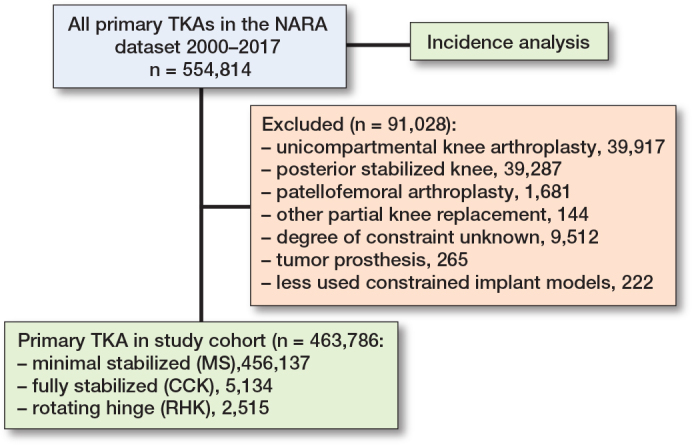
Methods: From 2000 to 2017, 5,134 CCK and 2,515 RHK primary TKAs were identified from the NARA database. Kaplan-Meier (K-M) survival and flexible parametric survival model (FPSM) analyses were performed to estimate revision risk, expressed as hazard ratio (HR) with 95% confidence intervals (CI), with minimally stabilized (MS) TKA acting as the control group (n = 456,137).
Results: The incidence of CCK and RHK implants increased significantly in Finland, while it was moderate in Denmark, Norway, and Sweden. With revision for any reason as the endpoint the 15-year K-M cumulative revision risk for RHK was 13.6% (CI 10.4-16.7) and for CCK it was 11.3% (CI 9.1-13.5). Compared with MS TKA, the hazard ratio for revision was 2.1 (CI 1.8-2.3) for CCK and 2.5 (CI 2.1-2.8) for RHK. Periprosthetic joint infection (PJI) was the most common reason for revision, accounting for 44% of CCK and 47% of RHK cases. After excluding revisions for PJI, the hazard ratio remained high for both designs, at 1.5 (CI 1.3-1.7) for CCK and 1.6 (CI 1.3-2.0) for RHK compared with MS.
Conclusion: The incidence of CCK and RHK increased during the study period. Both designs showed consistent 15-year revision risks of 11-14%, with no major differences between them. The higher revision risk compared with MS TKAs may reflect the complexity of the surgeries.
期刊介绍:
Acta Orthopaedica (previously Acta Orthopaedica Scandinavica) presents original articles of basic research interest, as well as clinical studies in the field of orthopedics and related sub disciplines. Ever since the journal was founded in 1930, by a group of Scandinavian orthopedic surgeons, the journal has been published for an international audience. Acta Orthopaedica is owned by the Nordic Orthopaedic Federation and is the official publication of this federation.




 京公网安备 11010802042870号
京ICP备2023020795号-1
京公网安备 11010802042870号
京ICP备2023020795号-1

 分享
分享
 求助内容:
求助内容: 应助结果提醒方式:
 扫码关注我们
