Giovanni Vivenzio, Sikabwe Noki, Amit Chakraborty, John Lopez, Beatriz G de la Torre, Fernando Albericio
{"title":"甲烷磺酸(MSA)在固相肽合成中作为全局脱保护绿酸的应用范围和局限性","authors":"Giovanni Vivenzio, Sikabwe Noki, Amit Chakraborty, John Lopez, Beatriz G de la Torre, Fernando Albericio","doi":"10.1002/cssc.202402752","DOIUrl":null,"url":null,"abstract":"<p>N,N-dimethylformamide (DMF) and trifluoroacetic acid (TFA) are the two solvents/reagents most widely used in solid-phase peptide synthesis (SPPS). While DMF is already regulated in Europe, TFA – a member of the polyfluoroalkyl substances (PFAS) family – is expected to face similar restrictions soon. These compounds break down slowly and pose risks to human health and the environment. Herein, the use of the so-called “green acid par excellence”, methanesulfonic acid (MSA), in substitution of TFA is discussed. As MSA is stronger than TFA, it is diluted with a solvent for use. The effectivity of MSA depends on the solvents used. When dichloromethane (DCM) is used, 1.5 % MSA removes all side-chain protecting groups, except the trityl (Trt) group of His. In the presence of acetic acid (AcOH) and dimethylcarbonate (DMC), more concentrated solutions of MSA (8–16 %) are required. The removal of the Trt group of Asn/Gln continues to be a challenge even with these solutions, and aspartimide formation can occur in Asp-containing peptides.</p>","PeriodicalId":149,"journal":{"name":"ChemSusChem","volume":"18 11","pages":""},"PeriodicalIF":5.9000,"publicationDate":"2025-02-06","publicationTypes":"Journal Article","fieldsOfStudy":null,"isOpenAccess":false,"openAccessPdf":"https://onlinelibrary.wiley.com/doi/epdf/10.1002/cssc.202402752","citationCount":"0","resultStr":"{\"title\":\"Scope and Limitations of the Use of Methanesulfonic Acid (MSA) as a Green Acid for Global Deprotection in Solid-Phase Peptide Synthesis\",\"authors\":\"Giovanni Vivenzio, Sikabwe Noki, Amit Chakraborty, John Lopez, Beatriz G de la Torre, Fernando Albericio\",\"doi\":\"10.1002/cssc.202402752\",\"DOIUrl\":null,\"url\":null,\"abstract\":\"<p>N,N-dimethylformamide (DMF) and trifluoroacetic acid (TFA) are the two solvents/reagents most widely used in solid-phase peptide synthesis (SPPS). While DMF is already regulated in Europe, TFA – a member of the polyfluoroalkyl substances (PFAS) family – is expected to face similar restrictions soon. These compounds break down slowly and pose risks to human health and the environment. Herein, the use of the so-called “green acid par excellence”, methanesulfonic acid (MSA), in substitution of TFA is discussed. As MSA is stronger than TFA, it is diluted with a solvent for use. The effectivity of MSA depends on the solvents used. When dichloromethane (DCM) is used, 1.5 % MSA removes all side-chain protecting groups, except the trityl (Trt) group of His. In the presence of acetic acid (AcOH) and dimethylcarbonate (DMC), more concentrated solutions of MSA (8–16 %) are required. The removal of the Trt group of Asn/Gln continues to be a challenge even with these solutions, and aspartimide formation can occur in Asp-containing peptides.</p>\",\"PeriodicalId\":149,\"journal\":{\"name\":\"ChemSusChem\",\"volume\":\"18 11\",\"pages\":\"\"},\"PeriodicalIF\":5.9000,\"publicationDate\":\"2025-02-06\",\"publicationTypes\":\"Journal Article\",\"fieldsOfStudy\":null,\"isOpenAccess\":false,\"openAccessPdf\":\"https://onlinelibrary.wiley.com/doi/epdf/10.1002/cssc.202402752\",\"citationCount\":\"0\",\"resultStr\":null,\"platform\":\"Semanticscholar\",\"paperid\":null,\"PeriodicalName\":\"ChemSusChem\",\"FirstCategoryId\":\"92\",\"ListUrlMain\":\"https://chemistry-europe.onlinelibrary.wiley.com/doi/10.1002/cssc.202402752\",\"RegionNum\":2,\"RegionCategory\":\"化学\",\"ArticlePicture\":[],\"TitleCN\":null,\"AbstractTextCN\":null,\"PMCID\":null,\"EPubDate\":\"\",\"PubModel\":\"\",\"JCR\":\"Q1\",\"JCRName\":\"CHEMISTRY, MULTIDISCIPLINARY\",\"Score\":null,\"Total\":0}","platform":"Semanticscholar","paperid":null,"PeriodicalName":"ChemSusChem","FirstCategoryId":"92","ListUrlMain":"https://chemistry-europe.onlinelibrary.wiley.com/doi/10.1002/cssc.202402752","RegionNum":2,"RegionCategory":"化学","ArticlePicture":[],"TitleCN":null,"AbstractTextCN":null,"PMCID":null,"EPubDate":"","PubModel":"","JCR":"Q1","JCRName":"CHEMISTRY, MULTIDISCIPLINARY","Score":null,"Total":0}
Scope and Limitations of the Use of Methanesulfonic Acid (MSA) as a Green Acid for Global Deprotection in Solid-Phase Peptide Synthesis
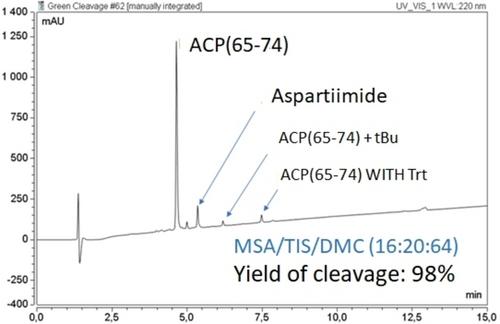
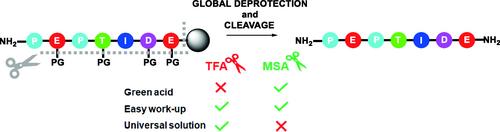
N,N-dimethylformamide (DMF) and trifluoroacetic acid (TFA) are the two solvents/reagents most widely used in solid-phase peptide synthesis (SPPS). While DMF is already regulated in Europe, TFA – a member of the polyfluoroalkyl substances (PFAS) family – is expected to face similar restrictions soon. These compounds break down slowly and pose risks to human health and the environment. Herein, the use of the so-called “green acid par excellence”, methanesulfonic acid (MSA), in substitution of TFA is discussed. As MSA is stronger than TFA, it is diluted with a solvent for use. The effectivity of MSA depends on the solvents used. When dichloromethane (DCM) is used, 1.5 % MSA removes all side-chain protecting groups, except the trityl (Trt) group of His. In the presence of acetic acid (AcOH) and dimethylcarbonate (DMC), more concentrated solutions of MSA (8–16 %) are required. The removal of the Trt group of Asn/Gln continues to be a challenge even with these solutions, and aspartimide formation can occur in Asp-containing peptides.
期刊介绍:
ChemSusChem
Impact Factor (2016): 7.226
Scope:
Interdisciplinary journal
Focuses on research at the interface of chemistry and sustainability
Features the best research on sustainability and energy
Areas Covered:
Chemistry
Materials Science
Chemical Engineering
Biotechnology





 京公网安备 11010802042870号
京ICP备2023020795号-1
京公网安备 11010802042870号
京ICP备2023020795号-1

 分享
分享
 求助内容:
求助内容: 应助结果提醒方式:
 扫码关注我们
