Sarah Weigl, Johanna Dabernig-Heinz, Fabian Granitz, Michaela Lipp, Laura Ostermann, Dag Harmsen, Thanh Trung Trinh, Ivo Steinmetz, Gabriel E Wagner, Sabine Lichtenegger
{"title":"改进基于纳米孔测序的核心基因组MLST用于全球感染控制:一种针对富含gc的病原体(如假杆菌)的策略。","authors":"Sarah Weigl, Johanna Dabernig-Heinz, Fabian Granitz, Michaela Lipp, Laura Ostermann, Dag Harmsen, Thanh Trung Trinh, Ivo Steinmetz, Gabriel E Wagner, Sabine Lichtenegger","doi":"10.1128/jcm.01569-24","DOIUrl":null,"url":null,"abstract":"<p><p>Genomic surveillance of pathogens is essential to trace infections and analyze resistance markers. Core genome multilocus sequence typing (cgMLST) facilitates genomic surveillance by simplified analysis and standardization. However, its application is limited by the poor cost-efficiency of short-read (SR) sequencing. Oxford Nanopore long-read sequencing (ONT-LR), which allows fast on-site analysis with comparatively low costs, could provide an alternative. Despite ONT-LR raw read accuracy improvement, evidence for methylation-based errors accumulates. PCR-based library preparation, suggested as a solution, presumably poses difficulties for GC-rich bacteria. We challenged ONT-LR-based cgMLST using the highly GC-rich pathogen <i>Burkholderia pseudomallei</i> to develop a clinically applicable workflow. Our <i>B. pseudomallei</i> cgMLST scheme was applied to ONT-LR data, and the results were validated against SR data. Native, rapid, and PCR-based library preparation was performed and combined with different basecalling models (SUP@bacterial-methylation, SUP@v4.2, SUP@v4.3, and SUP@v5.0) and polishing strategies (medaka_consensus, medaka_variant, r103_min_high_g360). To ensure reliability across genotypes, we included 14 sequence types and 27 genotypes. The recommended ONT-LR workflow at study initiation (SUP@v4.2, medaka_consensus) showed nearly 200 allele differences compared with the reference for specific strains. PCR-based library preparation resulted in missing targets and typing errors of up to 21 alleles. Native barcoding with SUP@v5.0 basecalling and r103_min_high_g360 polishing outperformed the PCR-based approach in all parameters reducing the error rate to a maximum of two allele differences. The optimized ONT-LR-based cgMLST workflow for <i>B. pseudomallei</i> integrates high resolution and ease of implementation with enhanced cost-efficiency for rapid diagnostics. The developed protocol might serve as a guideline for other GC-rich pathogens.</p><p><strong>Importance: </strong>This study highlights a significant advancement in genomic surveillance of bacterial pathogens, specifically addressing the challenges posed by the GC-rich species <i>Burkholderia pseudomallei</i>. Core genome multilocus sequence typing (cgMLST) is widely used for bacterial typing as it combines high resolution with simple implementation and standardization. To improve cost efficiency and thus accessibility, we changed the sequencing approach from Illumina short-read (SR) to Oxford Nanopore long-read sequencing (ONT-LR). ONT-LR-based cgMLST showed a very high error rate compared with SR-based cgMLST, most likely due to methylation-associated errors. PCR-based library preparation, which is proposed to correct these errors, did not achieve the required accuracy. In contrast, native barcoding with advanced basecalling and polishing strategies massively reduces allelic differences. This optimized ONT-LR cgMLST workflow provides a transformative solution for cost-efficient, high-resolution typing of <i>B. pseudomallei</i>. Furthermore, this study can serve as a guide for similarly challenging bacteria.</p>","PeriodicalId":15511,"journal":{"name":"Journal of Clinical Microbiology","volume":" ","pages":"e0156924"},"PeriodicalIF":5.9000,"publicationDate":"2025-03-12","publicationTypes":"Journal Article","fieldsOfStudy":null,"isOpenAccess":false,"openAccessPdf":"https://www.ncbi.nlm.nih.gov/pmc/articles/PMC11898673/pdf/","citationCount":"0","resultStr":"{\"title\":\"Improving Nanopore sequencing-based core genome MLST for global infection control: a strategy for GC-rich pathogens like <i>Burkholderia pseudomallei</i>.\",\"authors\":\"Sarah Weigl, Johanna Dabernig-Heinz, Fabian Granitz, Michaela Lipp, Laura Ostermann, Dag Harmsen, Thanh Trung Trinh, Ivo Steinmetz, Gabriel E Wagner, Sabine Lichtenegger\",\"doi\":\"10.1128/jcm.01569-24\",\"DOIUrl\":null,\"url\":null,\"abstract\":\"<p><p>Genomic surveillance of pathogens is essential to trace infections and analyze resistance markers. Core genome multilocus sequence typing (cgMLST) facilitates genomic surveillance by simplified analysis and standardization. However, its application is limited by the poor cost-efficiency of short-read (SR) sequencing. Oxford Nanopore long-read sequencing (ONT-LR), which allows fast on-site analysis with comparatively low costs, could provide an alternative. Despite ONT-LR raw read accuracy improvement, evidence for methylation-based errors accumulates. PCR-based library preparation, suggested as a solution, presumably poses difficulties for GC-rich bacteria. We challenged ONT-LR-based cgMLST using the highly GC-rich pathogen <i>Burkholderia pseudomallei</i> to develop a clinically applicable workflow. Our <i>B. pseudomallei</i> cgMLST scheme was applied to ONT-LR data, and the results were validated against SR data. Native, rapid, and PCR-based library preparation was performed and combined with different basecalling models (SUP@bacterial-methylation, SUP@v4.2, SUP@v4.3, and SUP@v5.0) and polishing strategies (medaka_consensus, medaka_variant, r103_min_high_g360). To ensure reliability across genotypes, we included 14 sequence types and 27 genotypes. The recommended ONT-LR workflow at study initiation (SUP@v4.2, medaka_consensus) showed nearly 200 allele differences compared with the reference for specific strains. PCR-based library preparation resulted in missing targets and typing errors of up to 21 alleles. Native barcoding with SUP@v5.0 basecalling and r103_min_high_g360 polishing outperformed the PCR-based approach in all parameters reducing the error rate to a maximum of two allele differences. The optimized ONT-LR-based cgMLST workflow for <i>B. pseudomallei</i> integrates high resolution and ease of implementation with enhanced cost-efficiency for rapid diagnostics. The developed protocol might serve as a guideline for other GC-rich pathogens.</p><p><strong>Importance: </strong>This study highlights a significant advancement in genomic surveillance of bacterial pathogens, specifically addressing the challenges posed by the GC-rich species <i>Burkholderia pseudomallei</i>. Core genome multilocus sequence typing (cgMLST) is widely used for bacterial typing as it combines high resolution with simple implementation and standardization. To improve cost efficiency and thus accessibility, we changed the sequencing approach from Illumina short-read (SR) to Oxford Nanopore long-read sequencing (ONT-LR). ONT-LR-based cgMLST showed a very high error rate compared with SR-based cgMLST, most likely due to methylation-associated errors. PCR-based library preparation, which is proposed to correct these errors, did not achieve the required accuracy. In contrast, native barcoding with advanced basecalling and polishing strategies massively reduces allelic differences. This optimized ONT-LR cgMLST workflow provides a transformative solution for cost-efficient, high-resolution typing of <i>B. pseudomallei</i>. Furthermore, this study can serve as a guide for similarly challenging bacteria.</p>\",\"PeriodicalId\":15511,\"journal\":{\"name\":\"Journal of Clinical Microbiology\",\"volume\":\" \",\"pages\":\"e0156924\"},\"PeriodicalIF\":5.9000,\"publicationDate\":\"2025-03-12\",\"publicationTypes\":\"Journal Article\",\"fieldsOfStudy\":null,\"isOpenAccess\":false,\"openAccessPdf\":\"https://www.ncbi.nlm.nih.gov/pmc/articles/PMC11898673/pdf/\",\"citationCount\":\"0\",\"resultStr\":null,\"platform\":\"Semanticscholar\",\"paperid\":null,\"PeriodicalName\":\"Journal of Clinical Microbiology\",\"FirstCategoryId\":\"3\",\"ListUrlMain\":\"https://doi.org/10.1128/jcm.01569-24\",\"RegionNum\":2,\"RegionCategory\":\"医学\",\"ArticlePicture\":[],\"TitleCN\":null,\"AbstractTextCN\":null,\"PMCID\":null,\"EPubDate\":\"2025/2/6 0:00:00\",\"PubModel\":\"Epub\",\"JCR\":\"Q1\",\"JCRName\":\"MICROBIOLOGY\",\"Score\":null,\"Total\":0}","platform":"Semanticscholar","paperid":null,"PeriodicalName":"Journal of Clinical Microbiology","FirstCategoryId":"3","ListUrlMain":"https://doi.org/10.1128/jcm.01569-24","RegionNum":2,"RegionCategory":"医学","ArticlePicture":[],"TitleCN":null,"AbstractTextCN":null,"PMCID":null,"EPubDate":"2025/2/6 0:00:00","PubModel":"Epub","JCR":"Q1","JCRName":"MICROBIOLOGY","Score":null,"Total":0}
Improving Nanopore sequencing-based core genome MLST for global infection control: a strategy for GC-rich pathogens like Burkholderia pseudomallei.
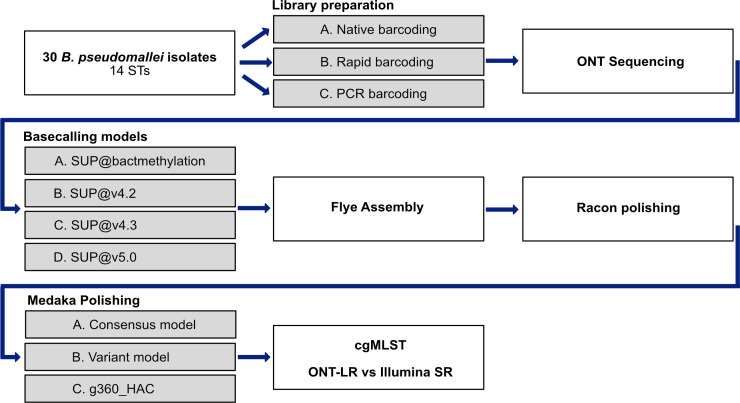
Genomic surveillance of pathogens is essential to trace infections and analyze resistance markers. Core genome multilocus sequence typing (cgMLST) facilitates genomic surveillance by simplified analysis and standardization. However, its application is limited by the poor cost-efficiency of short-read (SR) sequencing. Oxford Nanopore long-read sequencing (ONT-LR), which allows fast on-site analysis with comparatively low costs, could provide an alternative. Despite ONT-LR raw read accuracy improvement, evidence for methylation-based errors accumulates. PCR-based library preparation, suggested as a solution, presumably poses difficulties for GC-rich bacteria. We challenged ONT-LR-based cgMLST using the highly GC-rich pathogen Burkholderia pseudomallei to develop a clinically applicable workflow. Our B. pseudomallei cgMLST scheme was applied to ONT-LR data, and the results were validated against SR data. Native, rapid, and PCR-based library preparation was performed and combined with different basecalling models (SUP@bacterial-methylation, SUP@v4.2, SUP@v4.3, and SUP@v5.0) and polishing strategies (medaka_consensus, medaka_variant, r103_min_high_g360). To ensure reliability across genotypes, we included 14 sequence types and 27 genotypes. The recommended ONT-LR workflow at study initiation (SUP@v4.2, medaka_consensus) showed nearly 200 allele differences compared with the reference for specific strains. PCR-based library preparation resulted in missing targets and typing errors of up to 21 alleles. Native barcoding with SUP@v5.0 basecalling and r103_min_high_g360 polishing outperformed the PCR-based approach in all parameters reducing the error rate to a maximum of two allele differences. The optimized ONT-LR-based cgMLST workflow for B. pseudomallei integrates high resolution and ease of implementation with enhanced cost-efficiency for rapid diagnostics. The developed protocol might serve as a guideline for other GC-rich pathogens.
Importance: This study highlights a significant advancement in genomic surveillance of bacterial pathogens, specifically addressing the challenges posed by the GC-rich species Burkholderia pseudomallei. Core genome multilocus sequence typing (cgMLST) is widely used for bacterial typing as it combines high resolution with simple implementation and standardization. To improve cost efficiency and thus accessibility, we changed the sequencing approach from Illumina short-read (SR) to Oxford Nanopore long-read sequencing (ONT-LR). ONT-LR-based cgMLST showed a very high error rate compared with SR-based cgMLST, most likely due to methylation-associated errors. PCR-based library preparation, which is proposed to correct these errors, did not achieve the required accuracy. In contrast, native barcoding with advanced basecalling and polishing strategies massively reduces allelic differences. This optimized ONT-LR cgMLST workflow provides a transformative solution for cost-efficient, high-resolution typing of B. pseudomallei. Furthermore, this study can serve as a guide for similarly challenging bacteria.
期刊介绍:
The Journal of Clinical Microbiology® disseminates the latest research concerning the laboratory diagnosis of human and animal infections, along with the laboratory's role in epidemiology and the management of infectious diseases.






 京公网安备 11010802042870号
京ICP备2023020795号-1
京公网安备 11010802042870号
京ICP备2023020795号-1

 分享
分享
 求助内容:
求助内容: 应助结果提醒方式:
 扫码关注我们
