{"title":"肌肉减少症与妊娠期糖尿病的因果关系。","authors":"Yihong Huang, Shanshan Zhao, Jiajun Hong, Lixia Shen, Zilian Wang, Dongyu Wang","doi":"10.2147/IJWH.S494910","DOIUrl":null,"url":null,"abstract":"<p><strong>Introduction: </strong>Sarcopenia may affect the onset of gestational diabetes mellitus (GDM). However, the causal relationship between sarcopenia and GDM remains unclear. In this study, we used a bi-directional Mendelian randomization (MR) approach to explore this intricate relationship.</p><p><strong>Methods: </strong>This study utilized data from FinnGen datasets and genome-wide association studies. A bi-directional MR study was conducted. First, a forward MR analysis evaluated the causality of sarcopenia on GDM risk, with sarcopenia-related traits as exposures and GDM as the outcome. Second, in the reverse MR analysis, we assessed whether GDM influenced sarcopenia-related traits. Finally, sensitivity analysis was conducted to assess the robustness of the MR analysis.</p><p><strong>Results: </strong>Forward MR analysis revealed that appendicular lean mass (odds ratio [OR] = 1.2182, 95% confidence interval [CI]: 1.1397-1.3021, P < 0.0001), right-hand grip strength (OR= 1.4194, 95% CI: 1.0773-1.8701, P= 0.0128), left-hand grip strength (OR= 1.6064, 95% CI: 1.2829-2.0115, P < 0.0001), and usual walking pace (OR= 3.3676, 95% CI: 1.8769-6.0423, P < 0.0001) were associated with an increased risk of GDM. However, according to the reverse MR results, GDM had no causal effect on sarcopenia. No pleiotropy was observed.</p><p><strong>Conclusion: </strong>In summary, sarcopenia had a significant causal influence on GDM, while GDM did not causally affect sarcopenia.</p>","PeriodicalId":14356,"journal":{"name":"International Journal of Women's Health","volume":"17 ","pages":"259-269"},"PeriodicalIF":2.6000,"publicationDate":"2025-02-01","publicationTypes":"Journal Article","fieldsOfStudy":null,"isOpenAccess":false,"openAccessPdf":"https://www.ncbi.nlm.nih.gov/pmc/articles/PMC11796450/pdf/","citationCount":"0","resultStr":"{\"title\":\"Causal Associations Between Sarcopenia and Gestational Diabetes Mellitus.\",\"authors\":\"Yihong Huang, Shanshan Zhao, Jiajun Hong, Lixia Shen, Zilian Wang, Dongyu Wang\",\"doi\":\"10.2147/IJWH.S494910\",\"DOIUrl\":null,\"url\":null,\"abstract\":\"<p><strong>Introduction: </strong>Sarcopenia may affect the onset of gestational diabetes mellitus (GDM). However, the causal relationship between sarcopenia and GDM remains unclear. In this study, we used a bi-directional Mendelian randomization (MR) approach to explore this intricate relationship.</p><p><strong>Methods: </strong>This study utilized data from FinnGen datasets and genome-wide association studies. A bi-directional MR study was conducted. First, a forward MR analysis evaluated the causality of sarcopenia on GDM risk, with sarcopenia-related traits as exposures and GDM as the outcome. Second, in the reverse MR analysis, we assessed whether GDM influenced sarcopenia-related traits. Finally, sensitivity analysis was conducted to assess the robustness of the MR analysis.</p><p><strong>Results: </strong>Forward MR analysis revealed that appendicular lean mass (odds ratio [OR] = 1.2182, 95% confidence interval [CI]: 1.1397-1.3021, P < 0.0001), right-hand grip strength (OR= 1.4194, 95% CI: 1.0773-1.8701, P= 0.0128), left-hand grip strength (OR= 1.6064, 95% CI: 1.2829-2.0115, P < 0.0001), and usual walking pace (OR= 3.3676, 95% CI: 1.8769-6.0423, P < 0.0001) were associated with an increased risk of GDM. However, according to the reverse MR results, GDM had no causal effect on sarcopenia. No pleiotropy was observed.</p><p><strong>Conclusion: </strong>In summary, sarcopenia had a significant causal influence on GDM, while GDM did not causally affect sarcopenia.</p>\",\"PeriodicalId\":14356,\"journal\":{\"name\":\"International Journal of Women's Health\",\"volume\":\"17 \",\"pages\":\"259-269\"},\"PeriodicalIF\":2.6000,\"publicationDate\":\"2025-02-01\",\"publicationTypes\":\"Journal Article\",\"fieldsOfStudy\":null,\"isOpenAccess\":false,\"openAccessPdf\":\"https://www.ncbi.nlm.nih.gov/pmc/articles/PMC11796450/pdf/\",\"citationCount\":\"0\",\"resultStr\":null,\"platform\":\"Semanticscholar\",\"paperid\":null,\"PeriodicalName\":\"International Journal of Women's Health\",\"FirstCategoryId\":\"3\",\"ListUrlMain\":\"https://doi.org/10.2147/IJWH.S494910\",\"RegionNum\":4,\"RegionCategory\":\"医学\",\"ArticlePicture\":[],\"TitleCN\":null,\"AbstractTextCN\":null,\"PMCID\":null,\"EPubDate\":\"2025/1/1 0:00:00\",\"PubModel\":\"eCollection\",\"JCR\":\"Q2\",\"JCRName\":\"OBSTETRICS & GYNECOLOGY\",\"Score\":null,\"Total\":0}","platform":"Semanticscholar","paperid":null,"PeriodicalName":"International Journal of Women's Health","FirstCategoryId":"3","ListUrlMain":"https://doi.org/10.2147/IJWH.S494910","RegionNum":4,"RegionCategory":"医学","ArticlePicture":[],"TitleCN":null,"AbstractTextCN":null,"PMCID":null,"EPubDate":"2025/1/1 0:00:00","PubModel":"eCollection","JCR":"Q2","JCRName":"OBSTETRICS & GYNECOLOGY","Score":null,"Total":0}
引用次数: 0
摘要
前言:肌少症可能影响妊娠期糖尿病(GDM)的发病。然而,肌少症与GDM之间的因果关系尚不清楚。在这项研究中,我们使用双向孟德尔随机化(MR)方法来探索这种复杂的关系。方法:本研究利用FinnGen数据集和全基因组关联研究的数据。进行了双向磁共振研究。首先,前瞻性磁共振分析评估了肌少症与GDM风险的因果关系,以肌少症相关特征为暴露,以GDM为结果。其次,在反向MR分析中,我们评估了GDM是否影响肌肉减少症相关特征。最后,进行敏感性分析以评估MR分析的稳健性。结果:前向磁共振分析显示,阑尾瘦质量(优势比[OR] = 1.2182, 95%可信区间[CI]: 1.1397-1.3021, P < 0.0001)、右手握力(OR= 1.4194, 95% CI: 1.0773-1.8701, P= 0.0128)、左手握力(OR= 1.6064, 95% CI: 1.2829-2.0115, P < 0.0001)和正常步行速度(OR= 3.3676, 95% CI: 1.8769-6.0423, P < 0.0001)与GDM风险增加相关。然而,根据相反的MR结果,GDM对肌肉减少症没有因果影响。未观察到多效性。结论:综上所述,肌少症对GDM有显著的因果影响,而GDM对肌少症无因果影响。
Causal Associations Between Sarcopenia and Gestational Diabetes Mellitus.
Introduction: Sarcopenia may affect the onset of gestational diabetes mellitus (GDM). However, the causal relationship between sarcopenia and GDM remains unclear. In this study, we used a bi-directional Mendelian randomization (MR) approach to explore this intricate relationship.
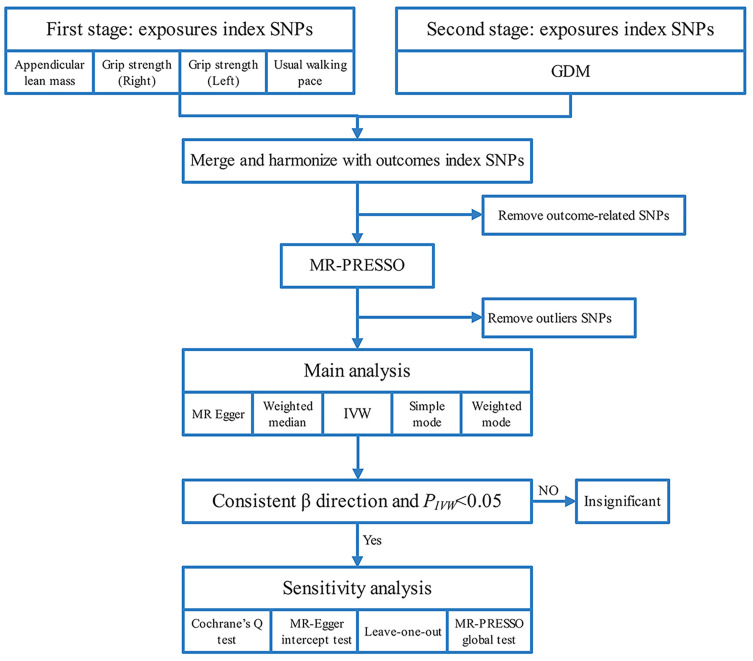
Methods: This study utilized data from FinnGen datasets and genome-wide association studies. A bi-directional MR study was conducted. First, a forward MR analysis evaluated the causality of sarcopenia on GDM risk, with sarcopenia-related traits as exposures and GDM as the outcome. Second, in the reverse MR analysis, we assessed whether GDM influenced sarcopenia-related traits. Finally, sensitivity analysis was conducted to assess the robustness of the MR analysis.
Results: Forward MR analysis revealed that appendicular lean mass (odds ratio [OR] = 1.2182, 95% confidence interval [CI]: 1.1397-1.3021, P < 0.0001), right-hand grip strength (OR= 1.4194, 95% CI: 1.0773-1.8701, P= 0.0128), left-hand grip strength (OR= 1.6064, 95% CI: 1.2829-2.0115, P < 0.0001), and usual walking pace (OR= 3.3676, 95% CI: 1.8769-6.0423, P < 0.0001) were associated with an increased risk of GDM. However, according to the reverse MR results, GDM had no causal effect on sarcopenia. No pleiotropy was observed.
Conclusion: In summary, sarcopenia had a significant causal influence on GDM, while GDM did not causally affect sarcopenia.
期刊介绍:
International Journal of Women''s Health is an international, peer-reviewed, open access, online journal. Publishing original research, reports, editorials, reviews and commentaries on all aspects of women''s healthcare including gynecology, obstetrics, and breast cancer. Subject areas include: Chronic conditions including cancers of various organs specific and not specific to women Migraine, headaches, arthritis, osteoporosis Endocrine and autoimmune syndromes - asthma, multiple sclerosis, lupus, diabetes Sexual and reproductive health including fertility patterns and emerging technologies to address infertility Infectious disease with chronic sequelae including HIV/AIDS, HPV, PID, and other STDs Psychological and psychosocial conditions - depression across the life span, substance abuse, domestic violence Health maintenance among aging females - factors affecting the quality of life including physical, social and mental issues Avenues for health promotion and disease prevention across the life span Male vs female incidence comparisons for conditions that affect both genders.






 京公网安备 11010802042870号
京ICP备2023020795号-1
京公网安备 11010802042870号
京ICP备2023020795号-1

 分享
分享
 求助内容:
求助内容: 应助结果提醒方式:
 扫码关注我们
