Vivens Mubonanyikuzo, Hongjie Yan, Temitope Emmanuel Komolafe, Liang Zhou, Tao Wu, Nizhuan Wang
{"title":"使用视觉变形检测神经图像中的阿尔茨海默病:系统回顾和荟萃分析。","authors":"Vivens Mubonanyikuzo, Hongjie Yan, Temitope Emmanuel Komolafe, Liang Zhou, Tao Wu, Nizhuan Wang","doi":"10.2196/62647","DOIUrl":null,"url":null,"abstract":"<p><strong>Background: </strong>Alzheimer disease (AD) is a progressive condition characterized by cognitive decline and memory loss. Vision transformers (ViTs) are emerging as promising deep learning models in medical imaging, with potential applications in the detection and diagnosis of AD.</p><p><strong>Objective: </strong>This review systematically examines recent studies on the application of ViTs in detecting AD, evaluating the diagnostic accuracy and impact of network architecture on model performance.</p><p><strong>Methods: </strong>We conducted a systematic search across major medical databases, including China National Knowledge Infrastructure, CENTRAL (Cochrane Central Register of Controlled Trials), ScienceDirect, PubMed, Web of Science, and Scopus, covering publications from January 1, 2020, to March 1, 2024. A manual search was also performed to include relevant gray literature. The included papers used ViT models for AD detection versus healthy controls based on neuroimaging data, and the included studies used magnetic resonance imaging and positron emission tomography. Pooled diagnostic accuracy estimates, including sensitivity, specificity, likelihood ratios, and diagnostic odds ratios, were derived using random-effects models. Subgroup analyses comparing the diagnostic performance of different ViT network architectures were performed.</p><p><strong>Results: </strong>The meta-analysis, encompassing 11 studies with 95% CIs and P values, demonstrated pooled diagnostic accuracy: sensitivity 0.925 (95% CI 0.892-0.959; P<.01), specificity 0.957 (95% CI 0.932-0.981; P<.01), positive likelihood ratio 21.84 (95% CI 12.26-38.91; P<.01), and negative likelihood ratio 0.08 (95% CI 0.05-0.14; P<.01). The area under the curve was notably high at 0.924. The findings highlight the potential of ViTs as effective tools for early and accurate AD diagnosis, offering insights for future neuroimaging-based diagnostic approaches.</p><p><strong>Conclusions: </strong>This systematic review provides valuable evidence for the utility of ViT models in distinguishing patients with AD from healthy controls, thereby contributing to advancements in neuroimaging-based diagnostic methodologies.</p><p><strong>Trial registration: </strong>PROSPERO CRD42024584347; https://www.crd.york.ac.uk/prospero/display_record.php?RecordID=584347.</p>","PeriodicalId":16337,"journal":{"name":"Journal of Medical Internet Research","volume":"27 ","pages":"e62647"},"PeriodicalIF":6.0000,"publicationDate":"2025-02-05","publicationTypes":"Journal Article","fieldsOfStudy":null,"isOpenAccess":false,"openAccessPdf":"https://www.ncbi.nlm.nih.gov/pmc/articles/PMC11840381/pdf/","citationCount":"0","resultStr":"{\"title\":\"Detection of Alzheimer Disease in Neuroimages Using Vision Transformers: Systematic Review and Meta-Analysis.\",\"authors\":\"Vivens Mubonanyikuzo, Hongjie Yan, Temitope Emmanuel Komolafe, Liang Zhou, Tao Wu, Nizhuan Wang\",\"doi\":\"10.2196/62647\",\"DOIUrl\":null,\"url\":null,\"abstract\":\"<p><strong>Background: </strong>Alzheimer disease (AD) is a progressive condition characterized by cognitive decline and memory loss. Vision transformers (ViTs) are emerging as promising deep learning models in medical imaging, with potential applications in the detection and diagnosis of AD.</p><p><strong>Objective: </strong>This review systematically examines recent studies on the application of ViTs in detecting AD, evaluating the diagnostic accuracy and impact of network architecture on model performance.</p><p><strong>Methods: </strong>We conducted a systematic search across major medical databases, including China National Knowledge Infrastructure, CENTRAL (Cochrane Central Register of Controlled Trials), ScienceDirect, PubMed, Web of Science, and Scopus, covering publications from January 1, 2020, to March 1, 2024. A manual search was also performed to include relevant gray literature. The included papers used ViT models for AD detection versus healthy controls based on neuroimaging data, and the included studies used magnetic resonance imaging and positron emission tomography. Pooled diagnostic accuracy estimates, including sensitivity, specificity, likelihood ratios, and diagnostic odds ratios, were derived using random-effects models. Subgroup analyses comparing the diagnostic performance of different ViT network architectures were performed.</p><p><strong>Results: </strong>The meta-analysis, encompassing 11 studies with 95% CIs and P values, demonstrated pooled diagnostic accuracy: sensitivity 0.925 (95% CI 0.892-0.959; P<.01), specificity 0.957 (95% CI 0.932-0.981; P<.01), positive likelihood ratio 21.84 (95% CI 12.26-38.91; P<.01), and negative likelihood ratio 0.08 (95% CI 0.05-0.14; P<.01). The area under the curve was notably high at 0.924. The findings highlight the potential of ViTs as effective tools for early and accurate AD diagnosis, offering insights for future neuroimaging-based diagnostic approaches.</p><p><strong>Conclusions: </strong>This systematic review provides valuable evidence for the utility of ViT models in distinguishing patients with AD from healthy controls, thereby contributing to advancements in neuroimaging-based diagnostic methodologies.</p><p><strong>Trial registration: </strong>PROSPERO CRD42024584347; https://www.crd.york.ac.uk/prospero/display_record.php?RecordID=584347.</p>\",\"PeriodicalId\":16337,\"journal\":{\"name\":\"Journal of Medical Internet Research\",\"volume\":\"27 \",\"pages\":\"e62647\"},\"PeriodicalIF\":6.0000,\"publicationDate\":\"2025-02-05\",\"publicationTypes\":\"Journal Article\",\"fieldsOfStudy\":null,\"isOpenAccess\":false,\"openAccessPdf\":\"https://www.ncbi.nlm.nih.gov/pmc/articles/PMC11840381/pdf/\",\"citationCount\":\"0\",\"resultStr\":null,\"platform\":\"Semanticscholar\",\"paperid\":null,\"PeriodicalName\":\"Journal of Medical Internet Research\",\"FirstCategoryId\":\"3\",\"ListUrlMain\":\"https://doi.org/10.2196/62647\",\"RegionNum\":2,\"RegionCategory\":\"医学\",\"ArticlePicture\":[],\"TitleCN\":null,\"AbstractTextCN\":null,\"PMCID\":null,\"EPubDate\":\"\",\"PubModel\":\"\",\"JCR\":\"Q1\",\"JCRName\":\"HEALTH CARE SCIENCES & SERVICES\",\"Score\":null,\"Total\":0}","platform":"Semanticscholar","paperid":null,"PeriodicalName":"Journal of Medical Internet Research","FirstCategoryId":"3","ListUrlMain":"https://doi.org/10.2196/62647","RegionNum":2,"RegionCategory":"医学","ArticlePicture":[],"TitleCN":null,"AbstractTextCN":null,"PMCID":null,"EPubDate":"","PubModel":"","JCR":"Q1","JCRName":"HEALTH CARE SCIENCES & SERVICES","Score":null,"Total":0}
引用次数: 0
摘要
背景:阿尔茨海默病(AD)是一种以认知能力下降和记忆丧失为特征的进行性疾病。视觉变压器(ViTs)正在成为医学成像中有前途的深度学习模型,在AD的检测和诊断中具有潜在的应用前景。目的:本文系统回顾了近年来ViTs在AD检测中的应用研究,评估了网络结构对模型性能的诊断准确性和影响。方法:我们对主要医学数据库进行了系统检索,包括中国国家知识基础设施、中央(Cochrane中央对照试验注册中心)、ScienceDirect、PubMed、Web of Science和Scopus,涵盖了2020年1月1日至2024年3月1日的出版物。还进行了手工检索,以包括相关的灰色文献。纳入的论文使用ViT模型与基于神经影像学数据的健康对照进行AD检测,纳入的研究使用磁共振成像和正电子发射断层扫描。使用随机效应模型得出诊断准确性估计,包括敏感性、特异性、似然比和诊断优势比。进行亚组分析,比较不同ViT网络架构的诊断性能。结果:荟萃分析包括11项研究,95% CI和P值,显示合并诊断准确性:敏感性0.925 (95% CI 0.892-0.959;结论:本系统综述为ViT模型在区分AD患者和健康对照中的应用提供了有价值的证据,从而促进了基于神经影像学的诊断方法的进步。试验注册:PROSPERO CRD42024584347;https://www.crd.york.ac.uk/prospero/display_record.php?RecordID=584347。
Detection of Alzheimer Disease in Neuroimages Using Vision Transformers: Systematic Review and Meta-Analysis.
Background: Alzheimer disease (AD) is a progressive condition characterized by cognitive decline and memory loss. Vision transformers (ViTs) are emerging as promising deep learning models in medical imaging, with potential applications in the detection and diagnosis of AD.
Objective: This review systematically examines recent studies on the application of ViTs in detecting AD, evaluating the diagnostic accuracy and impact of network architecture on model performance.
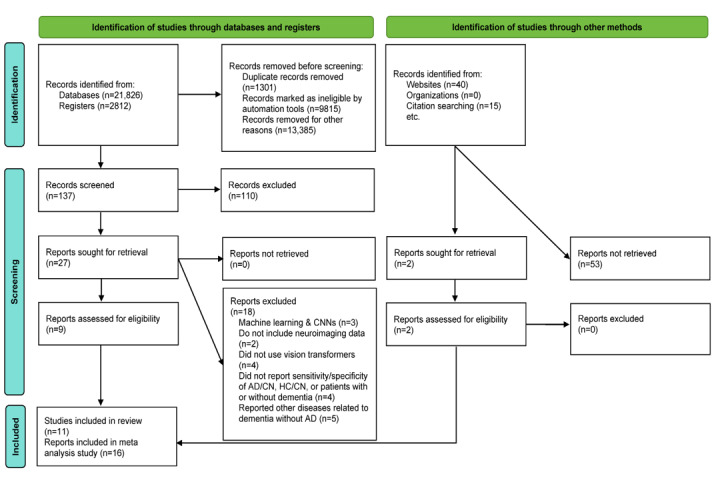
Methods: We conducted a systematic search across major medical databases, including China National Knowledge Infrastructure, CENTRAL (Cochrane Central Register of Controlled Trials), ScienceDirect, PubMed, Web of Science, and Scopus, covering publications from January 1, 2020, to March 1, 2024. A manual search was also performed to include relevant gray literature. The included papers used ViT models for AD detection versus healthy controls based on neuroimaging data, and the included studies used magnetic resonance imaging and positron emission tomography. Pooled diagnostic accuracy estimates, including sensitivity, specificity, likelihood ratios, and diagnostic odds ratios, were derived using random-effects models. Subgroup analyses comparing the diagnostic performance of different ViT network architectures were performed.
Results: The meta-analysis, encompassing 11 studies with 95% CIs and P values, demonstrated pooled diagnostic accuracy: sensitivity 0.925 (95% CI 0.892-0.959; P<.01), specificity 0.957 (95% CI 0.932-0.981; P<.01), positive likelihood ratio 21.84 (95% CI 12.26-38.91; P<.01), and negative likelihood ratio 0.08 (95% CI 0.05-0.14; P<.01). The area under the curve was notably high at 0.924. The findings highlight the potential of ViTs as effective tools for early and accurate AD diagnosis, offering insights for future neuroimaging-based diagnostic approaches.
Conclusions: This systematic review provides valuable evidence for the utility of ViT models in distinguishing patients with AD from healthy controls, thereby contributing to advancements in neuroimaging-based diagnostic methodologies.
期刊介绍:
The Journal of Medical Internet Research (JMIR) is a highly respected publication in the field of health informatics and health services. With a founding date in 1999, JMIR has been a pioneer in the field for over two decades.
As a leader in the industry, the journal focuses on digital health, data science, health informatics, and emerging technologies for health, medicine, and biomedical research. It is recognized as a top publication in these disciplines, ranking in the first quartile (Q1) by Impact Factor.
Notably, JMIR holds the prestigious position of being ranked #1 on Google Scholar within the "Medical Informatics" discipline.






 京公网安备 11010802042870号
京ICP备2023020795号-1
京公网安备 11010802042870号
京ICP备2023020795号-1

 分享
分享

 求助内容:
求助内容: 应助结果提醒方式:
 扫码关注我们
