{"title":"非侵入性脑刺激干预对认知障碍的疗效:随机对照试验荟萃分析综述。","authors":"Minmin Wu, Wenjing Song, Xue Wang, Lili Teng, Jinting Li, Jiongliang Zhang, Xinyue Li, Donghui Yu, Huanhuan Jia, Binhan Wang, Qiang Tang, Luwen Zhu","doi":"10.1186/s12984-025-01566-3","DOIUrl":null,"url":null,"abstract":"<p><strong>Background: </strong>The impact of noninvasive brain stimulation (NIBS) on cognitive and mental outcomes in Alzheimer's disease (AD) and mild cognitive impairment (MCI) remains under debate due to contradictory findings from systematic reviews and meta-analyses (SRMAs). To synthesize evidence from SRMAs assessing the effectiveness of NIBS techniques on cognitive and mental outcomes in AD and MCI populations. By comparing our findings to recent reviews and clinical guidelines, we highlight how this study addresses current limitations in the literature, provides a more holistic perspective on NIBS interventions, and guides future research and clinical practice.</p><p><strong>Methods: </strong>We searched four databases from inception to May 15, 2024, reviewing SRMAs that analyzed the effects of NIBS. Effect sizes, 95% confidence intervals (CIs), and prediction intervals were computed for each meta-analysis. The methodological quality of the SRMAs was evaluated using the Measurement Tool to Assess Systematic Reviews 2, and the quality of evidence was assessed through the Grading of Recommendations, Assessment, Development, and Evaluation criteria.</p><p><strong>Findings: </strong>Ten SRMAs detailing 22 associations were analyzed, focusing on two NIBS techniques across 12 unique outcomes. Significant improvements were observed in global cognition, language, executive function, and memory. Repetitive transcranial magnetic stimulation (rTMS) significantly enhanced short-term global cognition (standardized mean difference [SMD], 0.44; 95% CI 0.02-0.86), language (SMD, 1.64; 95% CI 1.22-2.06), executive function (SMD, 1.64; 95% CI 0.18-0.83), and long-term global cognition (SMD, 0.29; 95% CI 0.07-0.50). Transcranial direct current stimulation (tDCS) was effective in improving memory (SMD, 0.60; 95% CI 0.32-0.89) and executive function (SMD, 0.39; 95% CI 0.08-0.71). NIBS interventions showed no significant correlation with neuropsychiatric symptoms but demonstrated good tolerability in terms of safety and acceptability.</p><p><strong>Interpretation: </strong>This umbrella review indicates that NIBS techniques, particularly rTMS and tDCS, can significantly improve cognitive functions such as global cognition, language, executive functions, and memory in patients with AD and MCI. Despite potential benefits, results should be interpreted cautiously due to study heterogeneity and methodological limitations. Future studies should investigate their long-term effects and applicability across dementia types.</p>","PeriodicalId":16384,"journal":{"name":"Journal of NeuroEngineering and Rehabilitation","volume":"22 1","pages":"22"},"PeriodicalIF":5.2000,"publicationDate":"2025-02-05","publicationTypes":"Journal Article","fieldsOfStudy":null,"isOpenAccess":false,"openAccessPdf":"https://www.ncbi.nlm.nih.gov/pmc/articles/PMC11796046/pdf/","citationCount":"0","resultStr":"{\"title\":\"Efficacy of non-invasive brain stimulation interventions on cognitive impairment: an umbrella review of meta-analyses of randomized controlled trials.\",\"authors\":\"Minmin Wu, Wenjing Song, Xue Wang, Lili Teng, Jinting Li, Jiongliang Zhang, Xinyue Li, Donghui Yu, Huanhuan Jia, Binhan Wang, Qiang Tang, Luwen Zhu\",\"doi\":\"10.1186/s12984-025-01566-3\",\"DOIUrl\":null,\"url\":null,\"abstract\":\"<p><strong>Background: </strong>The impact of noninvasive brain stimulation (NIBS) on cognitive and mental outcomes in Alzheimer's disease (AD) and mild cognitive impairment (MCI) remains under debate due to contradictory findings from systematic reviews and meta-analyses (SRMAs). To synthesize evidence from SRMAs assessing the effectiveness of NIBS techniques on cognitive and mental outcomes in AD and MCI populations. By comparing our findings to recent reviews and clinical guidelines, we highlight how this study addresses current limitations in the literature, provides a more holistic perspective on NIBS interventions, and guides future research and clinical practice.</p><p><strong>Methods: </strong>We searched four databases from inception to May 15, 2024, reviewing SRMAs that analyzed the effects of NIBS. Effect sizes, 95% confidence intervals (CIs), and prediction intervals were computed for each meta-analysis. The methodological quality of the SRMAs was evaluated using the Measurement Tool to Assess Systematic Reviews 2, and the quality of evidence was assessed through the Grading of Recommendations, Assessment, Development, and Evaluation criteria.</p><p><strong>Findings: </strong>Ten SRMAs detailing 22 associations were analyzed, focusing on two NIBS techniques across 12 unique outcomes. Significant improvements were observed in global cognition, language, executive function, and memory. Repetitive transcranial magnetic stimulation (rTMS) significantly enhanced short-term global cognition (standardized mean difference [SMD], 0.44; 95% CI 0.02-0.86), language (SMD, 1.64; 95% CI 1.22-2.06), executive function (SMD, 1.64; 95% CI 0.18-0.83), and long-term global cognition (SMD, 0.29; 95% CI 0.07-0.50). Transcranial direct current stimulation (tDCS) was effective in improving memory (SMD, 0.60; 95% CI 0.32-0.89) and executive function (SMD, 0.39; 95% CI 0.08-0.71). NIBS interventions showed no significant correlation with neuropsychiatric symptoms but demonstrated good tolerability in terms of safety and acceptability.</p><p><strong>Interpretation: </strong>This umbrella review indicates that NIBS techniques, particularly rTMS and tDCS, can significantly improve cognitive functions such as global cognition, language, executive functions, and memory in patients with AD and MCI. Despite potential benefits, results should be interpreted cautiously due to study heterogeneity and methodological limitations. Future studies should investigate their long-term effects and applicability across dementia types.</p>\",\"PeriodicalId\":16384,\"journal\":{\"name\":\"Journal of NeuroEngineering and Rehabilitation\",\"volume\":\"22 1\",\"pages\":\"22\"},\"PeriodicalIF\":5.2000,\"publicationDate\":\"2025-02-05\",\"publicationTypes\":\"Journal Article\",\"fieldsOfStudy\":null,\"isOpenAccess\":false,\"openAccessPdf\":\"https://www.ncbi.nlm.nih.gov/pmc/articles/PMC11796046/pdf/\",\"citationCount\":\"0\",\"resultStr\":null,\"platform\":\"Semanticscholar\",\"paperid\":null,\"PeriodicalName\":\"Journal of NeuroEngineering and Rehabilitation\",\"FirstCategoryId\":\"5\",\"ListUrlMain\":\"https://doi.org/10.1186/s12984-025-01566-3\",\"RegionNum\":2,\"RegionCategory\":\"医学\",\"ArticlePicture\":[],\"TitleCN\":null,\"AbstractTextCN\":null,\"PMCID\":null,\"EPubDate\":\"\",\"PubModel\":\"\",\"JCR\":\"Q1\",\"JCRName\":\"ENGINEERING, BIOMEDICAL\",\"Score\":null,\"Total\":0}","platform":"Semanticscholar","paperid":null,"PeriodicalName":"Journal of NeuroEngineering and Rehabilitation","FirstCategoryId":"5","ListUrlMain":"https://doi.org/10.1186/s12984-025-01566-3","RegionNum":2,"RegionCategory":"医学","ArticlePicture":[],"TitleCN":null,"AbstractTextCN":null,"PMCID":null,"EPubDate":"","PubModel":"","JCR":"Q1","JCRName":"ENGINEERING, BIOMEDICAL","Score":null,"Total":0}
引用次数: 0
摘要
背景:无创脑刺激(NIBS)对阿尔茨海默病(AD)和轻度认知障碍(MCI)患者认知和精神结局的影响,由于系统综述和荟萃分析(SRMAs)的结果相互矛盾,仍然存在争议。综合来自srma的证据,评估NIBS技术对AD和MCI人群认知和精神结局的有效性。通过将我们的研究结果与最近的综述和临床指南进行比较,我们强调了本研究如何解决当前文献中的局限性,为NIBS干预提供了更全面的视角,并指导了未来的研究和临床实践。方法:我们检索了四个数据库,从成立到2024年5月15日,回顾了分析NIBS效果的srma。计算每个meta分析的效应量、95%置信区间(ci)和预测区间。srma的方法学质量使用评估系统评价的测量工具2进行评估,证据质量通过建议分级、评估、发展和评估标准进行评估。研究结果:分析了10个srma,详细分析了22种关联,重点研究了两种NIBS技术在12种独特结果中的应用。在整体认知、语言、执行功能和记忆方面观察到显著的改善。重复经颅磁刺激(rTMS)显著增强短期全局认知(标准化平均差[SMD], 0.44;95% CI 0.02-0.86),语言(SMD, 1.64;95% CI 1.22-2.06),执行功能(SMD, 1.64;95% CI 0.18-0.83)和长期全局认知(SMD, 0.29;95% ci 0.07-0.50)。经颅直流电刺激(tDCS)能有效改善记忆(SMD, 0.60;95% CI 0.32-0.89)和执行功能(SMD, 0.39;95% ci 0.08-0.71)。NIBS干预与神经精神症状无显著相关性,但在安全性和可接受性方面表现出良好的耐受性。该综述表明,NIBS技术,特别是rTMS和tDCS,可以显著改善AD和MCI患者的认知功能,如全局认知、语言、执行功能和记忆。尽管有潜在的益处,但由于研究的异质性和方法的局限性,结果应谨慎解释。未来的研究应该调查它们对痴呆类型的长期影响和适用性。
Efficacy of non-invasive brain stimulation interventions on cognitive impairment: an umbrella review of meta-analyses of randomized controlled trials.
Background: The impact of noninvasive brain stimulation (NIBS) on cognitive and mental outcomes in Alzheimer's disease (AD) and mild cognitive impairment (MCI) remains under debate due to contradictory findings from systematic reviews and meta-analyses (SRMAs). To synthesize evidence from SRMAs assessing the effectiveness of NIBS techniques on cognitive and mental outcomes in AD and MCI populations. By comparing our findings to recent reviews and clinical guidelines, we highlight how this study addresses current limitations in the literature, provides a more holistic perspective on NIBS interventions, and guides future research and clinical practice.
Methods: We searched four databases from inception to May 15, 2024, reviewing SRMAs that analyzed the effects of NIBS. Effect sizes, 95% confidence intervals (CIs), and prediction intervals were computed for each meta-analysis. The methodological quality of the SRMAs was evaluated using the Measurement Tool to Assess Systematic Reviews 2, and the quality of evidence was assessed through the Grading of Recommendations, Assessment, Development, and Evaluation criteria.
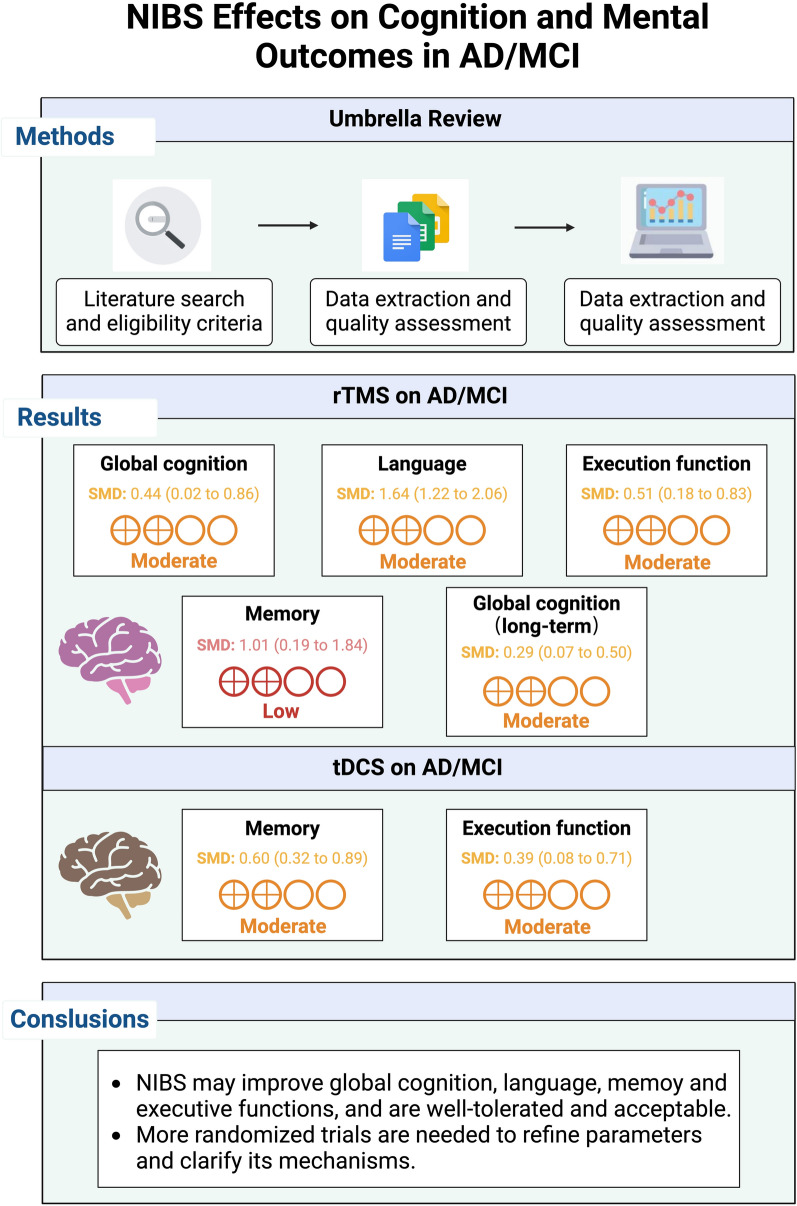
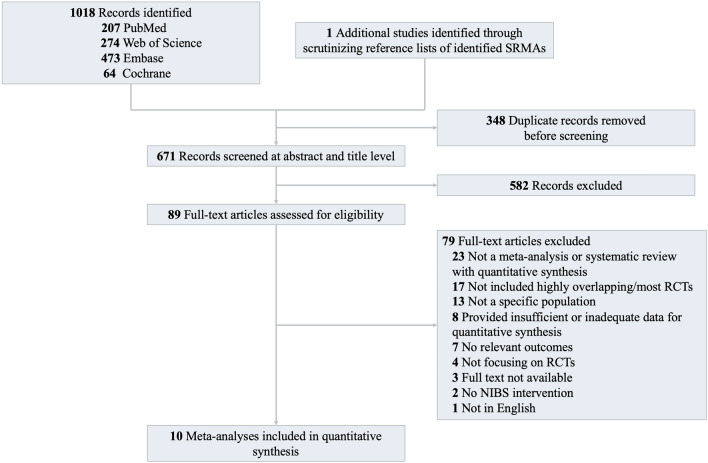
Findings: Ten SRMAs detailing 22 associations were analyzed, focusing on two NIBS techniques across 12 unique outcomes. Significant improvements were observed in global cognition, language, executive function, and memory. Repetitive transcranial magnetic stimulation (rTMS) significantly enhanced short-term global cognition (standardized mean difference [SMD], 0.44; 95% CI 0.02-0.86), language (SMD, 1.64; 95% CI 1.22-2.06), executive function (SMD, 1.64; 95% CI 0.18-0.83), and long-term global cognition (SMD, 0.29; 95% CI 0.07-0.50). Transcranial direct current stimulation (tDCS) was effective in improving memory (SMD, 0.60; 95% CI 0.32-0.89) and executive function (SMD, 0.39; 95% CI 0.08-0.71). NIBS interventions showed no significant correlation with neuropsychiatric symptoms but demonstrated good tolerability in terms of safety and acceptability.
Interpretation: This umbrella review indicates that NIBS techniques, particularly rTMS and tDCS, can significantly improve cognitive functions such as global cognition, language, executive functions, and memory in patients with AD and MCI. Despite potential benefits, results should be interpreted cautiously due to study heterogeneity and methodological limitations. Future studies should investigate their long-term effects and applicability across dementia types.
期刊介绍:
Journal of NeuroEngineering and Rehabilitation considers manuscripts on all aspects of research that result from cross-fertilization of the fields of neuroscience, biomedical engineering, and physical medicine & rehabilitation.




 京公网安备 11010802042870号
京ICP备2023020795号-1
京公网安备 11010802042870号
京ICP备2023020795号-1

 分享
分享
 求助内容:
求助内容: 应助结果提醒方式:
 扫码关注我们
