Hege Kristin Gravdahl Garelius, Timothy Bagguley, Adele Taylor, Pierre Fenaux, David Bowen, Argiris Symeonidis, Moshe Mittelmann, Reinhard Stauder, Jaroslav Čermák, Guillermo Sanz, Saskia Langemeijer, Luca Malcovati, Ulrich Germing, Laurence Sanhes, Maud d'Aveni, Dominic Culligan, Ioannis Kotsianidis, Karin A Koinig, Corine van Marrewijk, Simon Crouch, Theo deWitte, Alexandra Smith, Eva Hellström-Lindberg
{"title":"低风险骨髓增生异常综合征暴露于促红细胞生成药物的患者的生存和生活质量:一项观察性队列研究","authors":"Hege Kristin Gravdahl Garelius, Timothy Bagguley, Adele Taylor, Pierre Fenaux, David Bowen, Argiris Symeonidis, Moshe Mittelmann, Reinhard Stauder, Jaroslav Čermák, Guillermo Sanz, Saskia Langemeijer, Luca Malcovati, Ulrich Germing, Laurence Sanhes, Maud d'Aveni, Dominic Culligan, Ioannis Kotsianidis, Karin A Koinig, Corine van Marrewijk, Simon Crouch, Theo deWitte, Alexandra Smith, Eva Hellström-Lindberg","doi":"10.1016/S2352-3026(24)00350-8","DOIUrl":null,"url":null,"abstract":"<p><strong>Background: </strong>In our previous study on erythropoiesis-stimulating agent (ESA) treatment in lower risk myelodysplastic syndromes from the European MDS (EUMDS) Registry, we showed that patients treated with ESAs had longer survival compared with patients who receive red blood cell transfusion (RBCT). In this study, with a longer follow up time and more patients included, we aimed to assess long-term effects on survival and health-related quality of life (HRQoL) of exposure to ESAs with or without RBCT in patients with lower risk myelodysplastic syndromes.</p><p><strong>Methods: </strong>The EUMDS Registry is a non-interventional, longitudinal, real-world registry prospectively enrolling newly diagnosed patients older than 18 years with lower risk (International Prognostic Scoring System low or intermediate-1) myelodysplastic syndromes from 16 European countries and Israel. The analysis was restricted to patients with haemoglobin concentrations less than 100 g/L enrolled between Jan 1, 2008, and July 1, 2019, with last censoring of data on Dec 31, 2021. Patient management was recorded every 6 months, including treatment, transfusions, and HRQoL. ESA treatment followed local guidelines. The patients were separated into four groups at each study visit: no ESA or RBCT, ESA only, ESA plus RBCT, and RBCT only. The data were analysed longitudinally over time according to ESA and RBCT status during each 6-month interval, using propensity score matching. The main outcomes were median overall survival and leukaemia-free survival, and HRQoL. This study is registered with ClinicalTrials.gov, NCT00600860, as is ongoing.</p><p><strong>Findings: </strong>2448 patients (the ESA-unexposed group [n=1265] and ESA-exposed group [n=1183]) were diagnosed before July 1, 2019; 1520 (62·1%) were male and 928 (37·9%) were female. Median follow-up time was 3·9 years (IQR 1·6-6·5). After applying eligibility criteria and propensity matching, there were 426 patients in the ESA-unexposed group and 744 patients in the ESA-exposed group. Median overall survival in the ESA exposed group was 44·9 months (95% CI 40·2-50·5) compared with 34·8 months (28·6-39·2) in the ESA unexposed group; the absolute difference was 10·1 months (95% CI 2·2-18·0; hazard ratio [HR] 0·70 [95% CI 0·59-0·83]; p<0·0001). Patients without RBCT in the presence or absence of ESA exposure maintained significantly better HRQoL than those with RBCT, irrespective of ESA exposure (linear mixed effect model of EQ-5d-3L index score, RBCT coefficient -0·04 [95% CI -0·06 to 0·03], p<0·0001; linear mixed effect model of VAS, -4·57 [-6·02 to -3·13], p<0·0001).</p><p><strong>Interpretation: </strong>ESA treatment in patients with lower risk myelodysplastic syndromes significantly improves overall survival when started before or early after the onset of regular transfusion therapy. Avoiding RBCT is associated with significantly better HRQoL.</p><p><strong>Funding: </strong>H2020 European Research Council, Novartis Pharmacy B V Oncology Europe, Amgen, BMS/Celgene International, Janssen Pharmaceutica, Takeda Pharmaceuticals International, and Gilead Sciences.</p>","PeriodicalId":48726,"journal":{"name":"Lancet Haematology","volume":"12 2","pages":"e128-e137"},"PeriodicalIF":20.4000,"publicationDate":"2025-02-01","publicationTypes":"Journal Article","fieldsOfStudy":null,"isOpenAccess":false,"openAccessPdf":"https://www.ncbi.nlm.nih.gov/pmc/articles/PMC11803517/pdf/","citationCount":"0","resultStr":"{\"title\":\"Survival and quality of life in patients with lower risk myelodysplastic syndromes exposed to erythropoiesis-stimulating agents: an observational cohort study.\",\"authors\":\"Hege Kristin Gravdahl Garelius, Timothy Bagguley, Adele Taylor, Pierre Fenaux, David Bowen, Argiris Symeonidis, Moshe Mittelmann, Reinhard Stauder, Jaroslav Čermák, Guillermo Sanz, Saskia Langemeijer, Luca Malcovati, Ulrich Germing, Laurence Sanhes, Maud d'Aveni, Dominic Culligan, Ioannis Kotsianidis, Karin A Koinig, Corine van Marrewijk, Simon Crouch, Theo deWitte, Alexandra Smith, Eva Hellström-Lindberg\",\"doi\":\"10.1016/S2352-3026(24)00350-8\",\"DOIUrl\":null,\"url\":null,\"abstract\":\"<p><strong>Background: </strong>In our previous study on erythropoiesis-stimulating agent (ESA) treatment in lower risk myelodysplastic syndromes from the European MDS (EUMDS) Registry, we showed that patients treated with ESAs had longer survival compared with patients who receive red blood cell transfusion (RBCT). In this study, with a longer follow up time and more patients included, we aimed to assess long-term effects on survival and health-related quality of life (HRQoL) of exposure to ESAs with or without RBCT in patients with lower risk myelodysplastic syndromes.</p><p><strong>Methods: </strong>The EUMDS Registry is a non-interventional, longitudinal, real-world registry prospectively enrolling newly diagnosed patients older than 18 years with lower risk (International Prognostic Scoring System low or intermediate-1) myelodysplastic syndromes from 16 European countries and Israel. The analysis was restricted to patients with haemoglobin concentrations less than 100 g/L enrolled between Jan 1, 2008, and July 1, 2019, with last censoring of data on Dec 31, 2021. Patient management was recorded every 6 months, including treatment, transfusions, and HRQoL. ESA treatment followed local guidelines. The patients were separated into four groups at each study visit: no ESA or RBCT, ESA only, ESA plus RBCT, and RBCT only. The data were analysed longitudinally over time according to ESA and RBCT status during each 6-month interval, using propensity score matching. The main outcomes were median overall survival and leukaemia-free survival, and HRQoL. This study is registered with ClinicalTrials.gov, NCT00600860, as is ongoing.</p><p><strong>Findings: </strong>2448 patients (the ESA-unexposed group [n=1265] and ESA-exposed group [n=1183]) were diagnosed before July 1, 2019; 1520 (62·1%) were male and 928 (37·9%) were female. Median follow-up time was 3·9 years (IQR 1·6-6·5). After applying eligibility criteria and propensity matching, there were 426 patients in the ESA-unexposed group and 744 patients in the ESA-exposed group. Median overall survival in the ESA exposed group was 44·9 months (95% CI 40·2-50·5) compared with 34·8 months (28·6-39·2) in the ESA unexposed group; the absolute difference was 10·1 months (95% CI 2·2-18·0; hazard ratio [HR] 0·70 [95% CI 0·59-0·83]; p<0·0001). Patients without RBCT in the presence or absence of ESA exposure maintained significantly better HRQoL than those with RBCT, irrespective of ESA exposure (linear mixed effect model of EQ-5d-3L index score, RBCT coefficient -0·04 [95% CI -0·06 to 0·03], p<0·0001; linear mixed effect model of VAS, -4·57 [-6·02 to -3·13], p<0·0001).</p><p><strong>Interpretation: </strong>ESA treatment in patients with lower risk myelodysplastic syndromes significantly improves overall survival when started before or early after the onset of regular transfusion therapy. Avoiding RBCT is associated with significantly better HRQoL.</p><p><strong>Funding: </strong>H2020 European Research Council, Novartis Pharmacy B V Oncology Europe, Amgen, BMS/Celgene International, Janssen Pharmaceutica, Takeda Pharmaceuticals International, and Gilead Sciences.</p>\",\"PeriodicalId\":48726,\"journal\":{\"name\":\"Lancet Haematology\",\"volume\":\"12 2\",\"pages\":\"e128-e137\"},\"PeriodicalIF\":20.4000,\"publicationDate\":\"2025-02-01\",\"publicationTypes\":\"Journal Article\",\"fieldsOfStudy\":null,\"isOpenAccess\":false,\"openAccessPdf\":\"https://www.ncbi.nlm.nih.gov/pmc/articles/PMC11803517/pdf/\",\"citationCount\":\"0\",\"resultStr\":null,\"platform\":\"Semanticscholar\",\"paperid\":null,\"PeriodicalName\":\"Lancet Haematology\",\"FirstCategoryId\":\"3\",\"ListUrlMain\":\"https://doi.org/10.1016/S2352-3026(24)00350-8\",\"RegionNum\":1,\"RegionCategory\":\"医学\",\"ArticlePicture\":[],\"TitleCN\":null,\"AbstractTextCN\":null,\"PMCID\":null,\"EPubDate\":\"\",\"PubModel\":\"\",\"JCR\":\"Q1\",\"JCRName\":\"HEMATOLOGY\",\"Score\":null,\"Total\":0}","platform":"Semanticscholar","paperid":null,"PeriodicalName":"Lancet Haematology","FirstCategoryId":"3","ListUrlMain":"https://doi.org/10.1016/S2352-3026(24)00350-8","RegionNum":1,"RegionCategory":"医学","ArticlePicture":[],"TitleCN":null,"AbstractTextCN":null,"PMCID":null,"EPubDate":"","PubModel":"","JCR":"Q1","JCRName":"HEMATOLOGY","Score":null,"Total":0}
引用次数: 0
摘要
背景:在我们之前对欧洲MDS (EUMDS)登记处的低风险骨髓增生异常综合征的促红细胞生成剂(ESA)治疗的研究中,我们发现与接受红细胞输血(RBCT)的患者相比,接受ESA治疗的患者生存时间更长。在这项研究中,随访时间更长,纳入的患者更多,我们的目的是评估低风险骨髓增生异常综合征患者接受或不接受RBCT的esa对生存和健康相关生活质量(HRQoL)的长期影响。方法:EUMDS注册是一项非干预性的、纵向的、真实世界的注册,前瞻性地纳入了来自16个欧洲国家和以色列的18岁以上、低风险(国际预后评分系统低或中1)骨髓增生异常综合征的新诊断患者。该分析仅限于2008年1月1日至2019年7月1日期间入组的血红蛋白浓度低于100 g/L的患者,最后一次数据审查是在2021年12月31日。每6个月记录一次患者管理情况,包括治疗、输血和HRQoL。欧空局的治疗遵循当地的指导方针。在每次研究访问时,将患者分为四组:不进行ESA或RBCT、仅进行ESA、ESA加RBCT和仅进行RBCT。根据每6个月的ESA和RBCT状态,使用倾向评分匹配方法对数据进行纵向分析。主要结局是中位总生存期、无白血病生存期和HRQoL。该研究已在ClinicalTrials.gov注册,编号NCT00600860,目前正在进行中。结果:2019年7月1日前确诊2448例患者(未暴露组[n=1265]和暴露组[n=1183]);男性1520例(62.1%),女性928例(37.9%)。中位随访时间为3.9年(IQR为1.6 ~ 6.5)。应用资格标准和倾向匹配后,未暴露组有426例,暴露组有744例。ESA暴露组的中位总生存期为44.9个月(95% CI 40.2 - 50.5),而未暴露组的中位总生存期为34.8个月(28.6 - 39.2);绝对差异为10.1个月(95% CI 2 ~ 18.0;风险比[HR] 0.70 [95% CI 0.59 ~ 0.83];结论:低风险骨髓增生异常综合征患者在接受常规输血治疗之前或之后早期接受ESA治疗可显著提高总生存率。避免RBCT与更好的HRQoL显著相关。资助:H2020欧洲研究理事会,诺华制药B V肿瘤学欧洲,安进,BMS/Celgene国际,杨森制药,武田制药国际和吉利德科学。
Survival and quality of life in patients with lower risk myelodysplastic syndromes exposed to erythropoiesis-stimulating agents: an observational cohort study.
Background: In our previous study on erythropoiesis-stimulating agent (ESA) treatment in lower risk myelodysplastic syndromes from the European MDS (EUMDS) Registry, we showed that patients treated with ESAs had longer survival compared with patients who receive red blood cell transfusion (RBCT). In this study, with a longer follow up time and more patients included, we aimed to assess long-term effects on survival and health-related quality of life (HRQoL) of exposure to ESAs with or without RBCT in patients with lower risk myelodysplastic syndromes.
Methods: The EUMDS Registry is a non-interventional, longitudinal, real-world registry prospectively enrolling newly diagnosed patients older than 18 years with lower risk (International Prognostic Scoring System low or intermediate-1) myelodysplastic syndromes from 16 European countries and Israel. The analysis was restricted to patients with haemoglobin concentrations less than 100 g/L enrolled between Jan 1, 2008, and July 1, 2019, with last censoring of data on Dec 31, 2021. Patient management was recorded every 6 months, including treatment, transfusions, and HRQoL. ESA treatment followed local guidelines. The patients were separated into four groups at each study visit: no ESA or RBCT, ESA only, ESA plus RBCT, and RBCT only. The data were analysed longitudinally over time according to ESA and RBCT status during each 6-month interval, using propensity score matching. The main outcomes were median overall survival and leukaemia-free survival, and HRQoL. This study is registered with ClinicalTrials.gov, NCT00600860, as is ongoing.
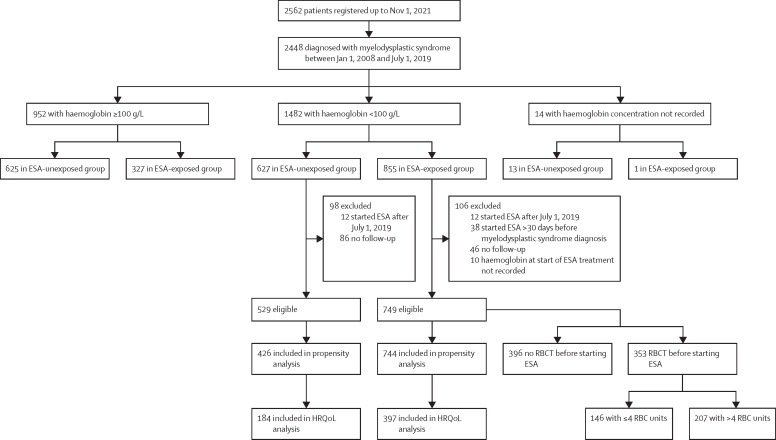
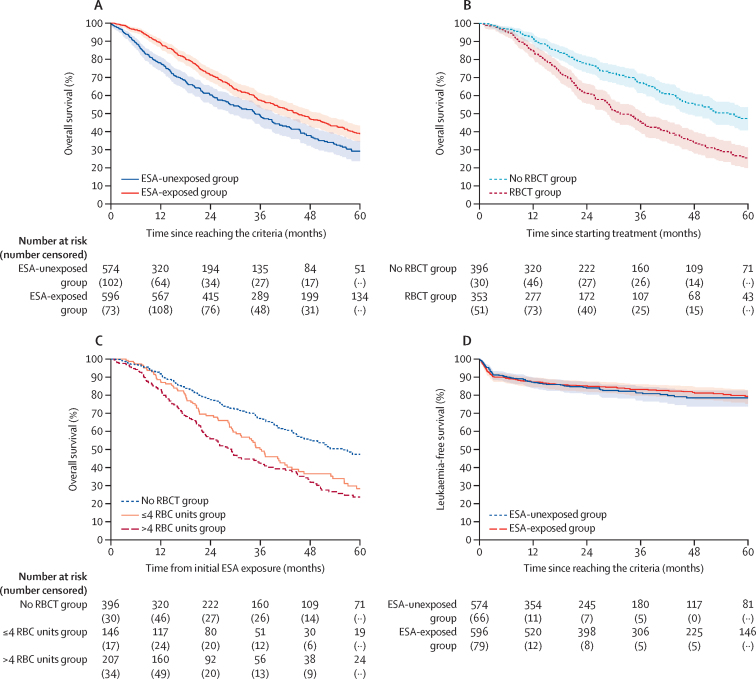
Findings: 2448 patients (the ESA-unexposed group [n=1265] and ESA-exposed group [n=1183]) were diagnosed before July 1, 2019; 1520 (62·1%) were male and 928 (37·9%) were female. Median follow-up time was 3·9 years (IQR 1·6-6·5). After applying eligibility criteria and propensity matching, there were 426 patients in the ESA-unexposed group and 744 patients in the ESA-exposed group. Median overall survival in the ESA exposed group was 44·9 months (95% CI 40·2-50·5) compared with 34·8 months (28·6-39·2) in the ESA unexposed group; the absolute difference was 10·1 months (95% CI 2·2-18·0; hazard ratio [HR] 0·70 [95% CI 0·59-0·83]; p<0·0001). Patients without RBCT in the presence or absence of ESA exposure maintained significantly better HRQoL than those with RBCT, irrespective of ESA exposure (linear mixed effect model of EQ-5d-3L index score, RBCT coefficient -0·04 [95% CI -0·06 to 0·03], p<0·0001; linear mixed effect model of VAS, -4·57 [-6·02 to -3·13], p<0·0001).
Interpretation: ESA treatment in patients with lower risk myelodysplastic syndromes significantly improves overall survival when started before or early after the onset of regular transfusion therapy. Avoiding RBCT is associated with significantly better HRQoL.
Funding: H2020 European Research Council, Novartis Pharmacy B V Oncology Europe, Amgen, BMS/Celgene International, Janssen Pharmaceutica, Takeda Pharmaceuticals International, and Gilead Sciences.
期刊介绍:
Launched in autumn 2014, The Lancet Haematology is part of the Lancet specialty journals, exclusively available online. This monthly journal is committed to publishing original research that not only sheds light on haematological clinical practice but also advocates for change within the field. Aligned with the Lancet journals' tradition of high-impact research, The Lancet Haematology aspires to achieve a similar standing and reputation within its discipline. It upholds the rigorous reporting standards characteristic of all Lancet titles, ensuring a consistent commitment to quality in its contributions to the field of haematology.





 京公网安备 11010802042870号
京ICP备2023020795号-1
京公网安备 11010802042870号
京ICP备2023020795号-1

 分享
分享
 求助内容:
求助内容: 应助结果提醒方式:
 扫码关注我们
