Ziyi Shui, Huiying Tian, Hang Mu, Liuyun Xu, Xiaoming Gao and Xi Chen
{"title":"Mn掺杂调控Co3O4电子结构构建氧电催化双活性位点","authors":"Ziyi Shui, Huiying Tian, Hang Mu, Liuyun Xu, Xiaoming Gao and Xi Chen","doi":"10.1039/D4QI03005B","DOIUrl":null,"url":null,"abstract":"<p >Efficient bifunctional catalysts for the oxygen reduction reaction (ORR) and the oxygen evolution reaction (OER) are crucial for rechargeable Zn–air batteries (ZABs). However, these catalysts often suffer from poor O<small><sub>2</sub></small> conversion efficiency and a lack of dual active sites for oxygen reactions. Regulating the electronic structure through elemental doping is an efficient strategy for constructing dual active sites of catalysts. Nevertheless, the mechanisms of O<small><sub>2</sub></small> adsorption/activation, the nature of the reaction active sites, and the associated energy barriers remain poorly understood. Herein, we report a Mn-doped Co<small><sub>3</sub></small>O<small><sub>4</sub></small> (MnCo<small><sub>2</sub></small>O<small><sub>4</sub></small>) bimetallic oxide. The impact of Mn doping on the ORR/OER performance of Co<small><sub>3</sub></small>O<small><sub>4</sub></small> is investigated using both density functional theory (DFT) calculations and experimental methods. The DFT findings indicate that Mn doping modifies the electronic structure, activates Co sites in Co<small><sub>3</sub></small>O<small><sub>4</sub></small>, and introduces new Mn active sites, resulting in dual active sites for the OER/ORR. As predicted, MnCo<small><sub>2</sub></small>O<small><sub>4</sub></small> exhibits remarkable ORR/OER performance, with a potential difference (Δ<em>E</em>) as low as 0.87 V, which is 0.11 V smaller than that of Co<small><sub>3</sub></small>O<small><sub>4</sub></small>. Furthermore, a rechargeable ZAB delivers a narrow discharge–charge voltage gap (0.76 V), high cycling stability over long periods (90 h), and a peak power density of up to 97 mW cm<small><sup>−2</sup></small> in a liquid system. Such excellent results demonstrate that Mn–Co bimetallic synergistic catalysis is an effective strategy for improving ORR/OER selectivity.</p>","PeriodicalId":79,"journal":{"name":"Inorganic Chemistry Frontiers","volume":" 7","pages":" 2783-2791"},"PeriodicalIF":6.4000,"publicationDate":"2025-02-07","publicationTypes":"Journal Article","fieldsOfStudy":null,"isOpenAccess":false,"openAccessPdf":"","citationCount":"0","resultStr":"{\"title\":\"Mn doping for regulating the electronic structure of Co3O4 to construct dual active sites for oxygen electrocatalysis†\",\"authors\":\"Ziyi Shui, Huiying Tian, Hang Mu, Liuyun Xu, Xiaoming Gao and Xi Chen\",\"doi\":\"10.1039/D4QI03005B\",\"DOIUrl\":null,\"url\":null,\"abstract\":\"<p >Efficient bifunctional catalysts for the oxygen reduction reaction (ORR) and the oxygen evolution reaction (OER) are crucial for rechargeable Zn–air batteries (ZABs). However, these catalysts often suffer from poor O<small><sub>2</sub></small> conversion efficiency and a lack of dual active sites for oxygen reactions. Regulating the electronic structure through elemental doping is an efficient strategy for constructing dual active sites of catalysts. Nevertheless, the mechanisms of O<small><sub>2</sub></small> adsorption/activation, the nature of the reaction active sites, and the associated energy barriers remain poorly understood. Herein, we report a Mn-doped Co<small><sub>3</sub></small>O<small><sub>4</sub></small> (MnCo<small><sub>2</sub></small>O<small><sub>4</sub></small>) bimetallic oxide. The impact of Mn doping on the ORR/OER performance of Co<small><sub>3</sub></small>O<small><sub>4</sub></small> is investigated using both density functional theory (DFT) calculations and experimental methods. The DFT findings indicate that Mn doping modifies the electronic structure, activates Co sites in Co<small><sub>3</sub></small>O<small><sub>4</sub></small>, and introduces new Mn active sites, resulting in dual active sites for the OER/ORR. As predicted, MnCo<small><sub>2</sub></small>O<small><sub>4</sub></small> exhibits remarkable ORR/OER performance, with a potential difference (Δ<em>E</em>) as low as 0.87 V, which is 0.11 V smaller than that of Co<small><sub>3</sub></small>O<small><sub>4</sub></small>. Furthermore, a rechargeable ZAB delivers a narrow discharge–charge voltage gap (0.76 V), high cycling stability over long periods (90 h), and a peak power density of up to 97 mW cm<small><sup>−2</sup></small> in a liquid system. Such excellent results demonstrate that Mn–Co bimetallic synergistic catalysis is an effective strategy for improving ORR/OER selectivity.</p>\",\"PeriodicalId\":79,\"journal\":{\"name\":\"Inorganic Chemistry Frontiers\",\"volume\":\" 7\",\"pages\":\" 2783-2791\"},\"PeriodicalIF\":6.4000,\"publicationDate\":\"2025-02-07\",\"publicationTypes\":\"Journal Article\",\"fieldsOfStudy\":null,\"isOpenAccess\":false,\"openAccessPdf\":\"\",\"citationCount\":\"0\",\"resultStr\":null,\"platform\":\"Semanticscholar\",\"paperid\":null,\"PeriodicalName\":\"Inorganic Chemistry Frontiers\",\"FirstCategoryId\":\"92\",\"ListUrlMain\":\"https://pubs.rsc.org/en/content/articlelanding/2025/qi/d4qi03005b\",\"RegionNum\":1,\"RegionCategory\":\"化学\",\"ArticlePicture\":[],\"TitleCN\":null,\"AbstractTextCN\":null,\"PMCID\":null,\"EPubDate\":\"\",\"PubModel\":\"\",\"JCR\":\"Q1\",\"JCRName\":\"CHEMISTRY, INORGANIC & NUCLEAR\",\"Score\":null,\"Total\":0}","platform":"Semanticscholar","paperid":null,"PeriodicalName":"Inorganic Chemistry Frontiers","FirstCategoryId":"92","ListUrlMain":"https://pubs.rsc.org/en/content/articlelanding/2025/qi/d4qi03005b","RegionNum":1,"RegionCategory":"化学","ArticlePicture":[],"TitleCN":null,"AbstractTextCN":null,"PMCID":null,"EPubDate":"","PubModel":"","JCR":"Q1","JCRName":"CHEMISTRY, INORGANIC & NUCLEAR","Score":null,"Total":0}
Mn doping for regulating the electronic structure of Co3O4 to construct dual active sites for oxygen electrocatalysis†
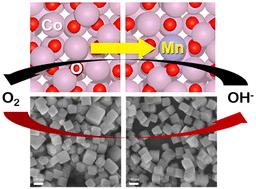
Efficient bifunctional catalysts for the oxygen reduction reaction (ORR) and the oxygen evolution reaction (OER) are crucial for rechargeable Zn–air batteries (ZABs). However, these catalysts often suffer from poor O2 conversion efficiency and a lack of dual active sites for oxygen reactions. Regulating the electronic structure through elemental doping is an efficient strategy for constructing dual active sites of catalysts. Nevertheless, the mechanisms of O2 adsorption/activation, the nature of the reaction active sites, and the associated energy barriers remain poorly understood. Herein, we report a Mn-doped Co3O4 (MnCo2O4) bimetallic oxide. The impact of Mn doping on the ORR/OER performance of Co3O4 is investigated using both density functional theory (DFT) calculations and experimental methods. The DFT findings indicate that Mn doping modifies the electronic structure, activates Co sites in Co3O4, and introduces new Mn active sites, resulting in dual active sites for the OER/ORR. As predicted, MnCo2O4 exhibits remarkable ORR/OER performance, with a potential difference (ΔE) as low as 0.87 V, which is 0.11 V smaller than that of Co3O4. Furthermore, a rechargeable ZAB delivers a narrow discharge–charge voltage gap (0.76 V), high cycling stability over long periods (90 h), and a peak power density of up to 97 mW cm−2 in a liquid system. Such excellent results demonstrate that Mn–Co bimetallic synergistic catalysis is an effective strategy for improving ORR/OER selectivity.





 京公网安备 11010802042870号
京ICP备2023020795号-1
京公网安备 11010802042870号
京ICP备2023020795号-1

 分享
分享
 求助内容:
求助内容: 应助结果提醒方式:
 扫码关注我们
