Bernard Pereda, Nathaniel Caluda-Perdue, Samuel Levy, Lillianna Zhang, Craig R. Colder
{"title":"经父母允许的青少年饮酒年龄及其对成年后饮酒和酒精危害的影响:一项纵向研究","authors":"Bernard Pereda, Nathaniel Caluda-Perdue, Samuel Levy, Lillianna Zhang, Craig R. Colder","doi":"10.1016/j.addbeh.2025.108271","DOIUrl":null,"url":null,"abstract":"<div><div>Parental permission to use alcohol is common in adolescence, and many parents believe it to be an effective harm reduction strategy because it provides an opportunity to supervise drinking. Contrary to this belief, prior research has consistently linked parental provision of alcohol and permission to drink to increases in future alcohol-related harms. Whether the age of onset of parental permission to use alcohol influences these outcomes is poorly understood. This study is the first to investigate the impact of age of onset of parental permission to use alcohol on later drinking outcomes, utilizing a longitudinal US community sample of adolescents (n = 387). The analysis included nine annual waves of data and accounted for risk and protective factors at the individual, peer, and family levels. Consistent with prior research, a robust relationship was found between parental permission to use alcohol during adolescence and increased alcohol use frequency and quantity, alcohol use disorder symptoms, and alcohol-related harms in young adulthood. Age of onset of parental permission was not associated with later alcohol use outcomes, suggesting a uniform risk effect of parental permission to drink. Public health messaging to parents should seek to correct perceptions of supervised alcohol use as a harm reduction strategy and emphasize the harm of parental permission to use alcohol, regardless of age.</div></div>","PeriodicalId":7155,"journal":{"name":"Addictive behaviors","volume":"164 ","pages":"Article 108271"},"PeriodicalIF":3.6000,"publicationDate":"2025-05-01","publicationTypes":"Journal Article","fieldsOfStudy":null,"isOpenAccess":false,"openAccessPdf":"","citationCount":"0","resultStr":"{\"title\":\"Age of onset of adolescent alcohol use with parental permission and its impact on drinking and alcohol-harms in young adulthood: A longitudinal study\",\"authors\":\"Bernard Pereda, Nathaniel Caluda-Perdue, Samuel Levy, Lillianna Zhang, Craig R. Colder\",\"doi\":\"10.1016/j.addbeh.2025.108271\",\"DOIUrl\":null,\"url\":null,\"abstract\":\"<div><div>Parental permission to use alcohol is common in adolescence, and many parents believe it to be an effective harm reduction strategy because it provides an opportunity to supervise drinking. Contrary to this belief, prior research has consistently linked parental provision of alcohol and permission to drink to increases in future alcohol-related harms. Whether the age of onset of parental permission to use alcohol influences these outcomes is poorly understood. This study is the first to investigate the impact of age of onset of parental permission to use alcohol on later drinking outcomes, utilizing a longitudinal US community sample of adolescents (n = 387). The analysis included nine annual waves of data and accounted for risk and protective factors at the individual, peer, and family levels. Consistent with prior research, a robust relationship was found between parental permission to use alcohol during adolescence and increased alcohol use frequency and quantity, alcohol use disorder symptoms, and alcohol-related harms in young adulthood. Age of onset of parental permission was not associated with later alcohol use outcomes, suggesting a uniform risk effect of parental permission to drink. Public health messaging to parents should seek to correct perceptions of supervised alcohol use as a harm reduction strategy and emphasize the harm of parental permission to use alcohol, regardless of age.</div></div>\",\"PeriodicalId\":7155,\"journal\":{\"name\":\"Addictive behaviors\",\"volume\":\"164 \",\"pages\":\"Article 108271\"},\"PeriodicalIF\":3.6000,\"publicationDate\":\"2025-05-01\",\"publicationTypes\":\"Journal Article\",\"fieldsOfStudy\":null,\"isOpenAccess\":false,\"openAccessPdf\":\"\",\"citationCount\":\"0\",\"resultStr\":null,\"platform\":\"Semanticscholar\",\"paperid\":null,\"PeriodicalName\":\"Addictive behaviors\",\"FirstCategoryId\":\"3\",\"ListUrlMain\":\"https://www.sciencedirect.com/science/article/pii/S0306460325000267\",\"RegionNum\":2,\"RegionCategory\":\"医学\",\"ArticlePicture\":[],\"TitleCN\":null,\"AbstractTextCN\":null,\"PMCID\":null,\"EPubDate\":\"2025/2/2 0:00:00\",\"PubModel\":\"Epub\",\"JCR\":\"Q1\",\"JCRName\":\"PSYCHOLOGY, CLINICAL\",\"Score\":null,\"Total\":0}","platform":"Semanticscholar","paperid":null,"PeriodicalName":"Addictive behaviors","FirstCategoryId":"3","ListUrlMain":"https://www.sciencedirect.com/science/article/pii/S0306460325000267","RegionNum":2,"RegionCategory":"医学","ArticlePicture":[],"TitleCN":null,"AbstractTextCN":null,"PMCID":null,"EPubDate":"2025/2/2 0:00:00","PubModel":"Epub","JCR":"Q1","JCRName":"PSYCHOLOGY, CLINICAL","Score":null,"Total":0}
Age of onset of adolescent alcohol use with parental permission and its impact on drinking and alcohol-harms in young adulthood: A longitudinal study
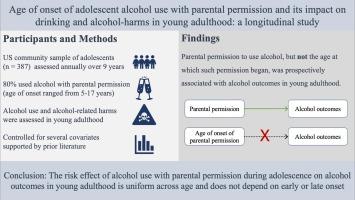
Parental permission to use alcohol is common in adolescence, and many parents believe it to be an effective harm reduction strategy because it provides an opportunity to supervise drinking. Contrary to this belief, prior research has consistently linked parental provision of alcohol and permission to drink to increases in future alcohol-related harms. Whether the age of onset of parental permission to use alcohol influences these outcomes is poorly understood. This study is the first to investigate the impact of age of onset of parental permission to use alcohol on later drinking outcomes, utilizing a longitudinal US community sample of adolescents (n = 387). The analysis included nine annual waves of data and accounted for risk and protective factors at the individual, peer, and family levels. Consistent with prior research, a robust relationship was found between parental permission to use alcohol during adolescence and increased alcohol use frequency and quantity, alcohol use disorder symptoms, and alcohol-related harms in young adulthood. Age of onset of parental permission was not associated with later alcohol use outcomes, suggesting a uniform risk effect of parental permission to drink. Public health messaging to parents should seek to correct perceptions of supervised alcohol use as a harm reduction strategy and emphasize the harm of parental permission to use alcohol, regardless of age.
期刊介绍:
Addictive Behaviors is an international peer-reviewed journal publishing high quality human research on addictive behaviors and disorders since 1975. The journal accepts submissions of full-length papers and short communications on substance-related addictions such as the abuse of alcohol, drugs and nicotine, and behavioral addictions involving gambling and technology. We primarily publish behavioral and psychosocial research but our articles span the fields of psychology, sociology, psychiatry, epidemiology, social policy, medicine, pharmacology and neuroscience. While theoretical orientations are diverse, the emphasis of the journal is primarily empirical. That is, sound experimental design combined with valid, reliable assessment and evaluation procedures are a requisite for acceptance. However, innovative and empirically oriented case studies that might encourage new lines of inquiry are accepted as well. Studies that clearly contribute to current knowledge of etiology, prevention, social policy or treatment are given priority. Scholarly commentaries on topical issues, systematic reviews, and mini reviews are encouraged. We especially welcome multimedia papers that incorporate video or audio components to better display methodology or findings.
Studies can also be submitted to Addictive Behaviors? companion title, the open access journal Addictive Behaviors Reports, which has a particular interest in ''non-traditional'', innovative and empirically-oriented research such as negative/null data papers, replication studies, case reports on novel treatments, and cross-cultural research.




 京公网安备 11010802042870号
京ICP备2023020795号-1
京公网安备 11010802042870号
京ICP备2023020795号-1

 分享
分享
 求助内容:
求助内容: 应助结果提醒方式:
 扫码关注我们
