{"title":"基于深度学习的无花果副产物化学分类与价值评估","authors":"Fekhreddine Chekkal , Ilhem Chachoua , Samir Hameurlaine , Samira Karoune , Abdelhamid Foughalia , Samir Boudibi , Ali Hachemi , Saliha Benaoune","doi":"10.1016/j.sajb.2025.01.044","DOIUrl":null,"url":null,"abstract":"<div><div>This study aimed to characterize the chemical composition of by-products from <em>Opuntia ficus-indica</em> (cladodes, peels, and seed cakes) using gas chromatography-mass spectrometry (GC–MS) to explore their valorization potential. The by-products were subjected to extraction and transesterification before analysis. A deep learning approach, NPClassifier (Natural Products Classifier), was applied to categorize volatile organic compounds (VOCs) by metabolic pathways, superclasses, and classes, facilitating detailed comparisons across the three plant parts. The innovative aspect of this study lies in the application of deep learning-derived classes to construct the molecular network. The analysis revealed a diverse range of VOCs, including fatty acids, terpenes, and alkaloids, with peels exhibiting the highest functional diversity. Specifically, fatty acids dominated in cladodes (91.06 %), terpenoids and steroids were prominent in peels (48.91 % and 29.91 %, respectively), and nitrogenous compounds characterized seed cakes. Diversity indices confirmed significant differences among samples, with peels showing the highest Shannon index (<em>H</em> = 3.26) and Simpson index (0.94), while cladodes had the lowest (<em>H</em> = 2.68, Simpson = 0.87). Multivariate statistical methods, such as Kruskal-Wallis tests and similarity analyses (Bray-Curtis and Jaccard), revealed that peels and cladodes were the most dissimilar at the class level (Jaccard = 1.59; Bray-Curtis = 1.74), while cladodes and seed cakes exhibited the highest similarity at the pathway level (Bray-Curtis = 0.17). These findings highlight the potential of <em>Opuntia ficus-indica</em> by-products, especially peels, for sustainable bio-industrial applications in cosmetics, pharmaceuticals, and agriculture.</div></div>","PeriodicalId":21919,"journal":{"name":"South African Journal of Botany","volume":"178 ","pages":"Pages 411-423"},"PeriodicalIF":2.7000,"publicationDate":"2025-03-01","publicationTypes":"Journal Article","fieldsOfStudy":null,"isOpenAccess":false,"openAccessPdf":"","citationCount":"0","resultStr":"{\"title\":\"Deep learning for chemical classification and valorization of Opuntia ficus-indica by-products\",\"authors\":\"Fekhreddine Chekkal , Ilhem Chachoua , Samir Hameurlaine , Samira Karoune , Abdelhamid Foughalia , Samir Boudibi , Ali Hachemi , Saliha Benaoune\",\"doi\":\"10.1016/j.sajb.2025.01.044\",\"DOIUrl\":null,\"url\":null,\"abstract\":\"<div><div>This study aimed to characterize the chemical composition of by-products from <em>Opuntia ficus-indica</em> (cladodes, peels, and seed cakes) using gas chromatography-mass spectrometry (GC–MS) to explore their valorization potential. The by-products were subjected to extraction and transesterification before analysis. A deep learning approach, NPClassifier (Natural Products Classifier), was applied to categorize volatile organic compounds (VOCs) by metabolic pathways, superclasses, and classes, facilitating detailed comparisons across the three plant parts. The innovative aspect of this study lies in the application of deep learning-derived classes to construct the molecular network. The analysis revealed a diverse range of VOCs, including fatty acids, terpenes, and alkaloids, with peels exhibiting the highest functional diversity. Specifically, fatty acids dominated in cladodes (91.06 %), terpenoids and steroids were prominent in peels (48.91 % and 29.91 %, respectively), and nitrogenous compounds characterized seed cakes. Diversity indices confirmed significant differences among samples, with peels showing the highest Shannon index (<em>H</em> = 3.26) and Simpson index (0.94), while cladodes had the lowest (<em>H</em> = 2.68, Simpson = 0.87). Multivariate statistical methods, such as Kruskal-Wallis tests and similarity analyses (Bray-Curtis and Jaccard), revealed that peels and cladodes were the most dissimilar at the class level (Jaccard = 1.59; Bray-Curtis = 1.74), while cladodes and seed cakes exhibited the highest similarity at the pathway level (Bray-Curtis = 0.17). These findings highlight the potential of <em>Opuntia ficus-indica</em> by-products, especially peels, for sustainable bio-industrial applications in cosmetics, pharmaceuticals, and agriculture.</div></div>\",\"PeriodicalId\":21919,\"journal\":{\"name\":\"South African Journal of Botany\",\"volume\":\"178 \",\"pages\":\"Pages 411-423\"},\"PeriodicalIF\":2.7000,\"publicationDate\":\"2025-03-01\",\"publicationTypes\":\"Journal Article\",\"fieldsOfStudy\":null,\"isOpenAccess\":false,\"openAccessPdf\":\"\",\"citationCount\":\"0\",\"resultStr\":null,\"platform\":\"Semanticscholar\",\"paperid\":null,\"PeriodicalName\":\"South African Journal of Botany\",\"FirstCategoryId\":\"99\",\"ListUrlMain\":\"https://www.sciencedirect.com/science/article/pii/S0254629925000572\",\"RegionNum\":3,\"RegionCategory\":\"生物学\",\"ArticlePicture\":[],\"TitleCN\":null,\"AbstractTextCN\":null,\"PMCID\":null,\"EPubDate\":\"2025/2/7 0:00:00\",\"PubModel\":\"Epub\",\"JCR\":\"Q2\",\"JCRName\":\"PLANT SCIENCES\",\"Score\":null,\"Total\":0}","platform":"Semanticscholar","paperid":null,"PeriodicalName":"South African Journal of Botany","FirstCategoryId":"99","ListUrlMain":"https://www.sciencedirect.com/science/article/pii/S0254629925000572","RegionNum":3,"RegionCategory":"生物学","ArticlePicture":[],"TitleCN":null,"AbstractTextCN":null,"PMCID":null,"EPubDate":"2025/2/7 0:00:00","PubModel":"Epub","JCR":"Q2","JCRName":"PLANT SCIENCES","Score":null,"Total":0}
Deep learning for chemical classification and valorization of Opuntia ficus-indica by-products
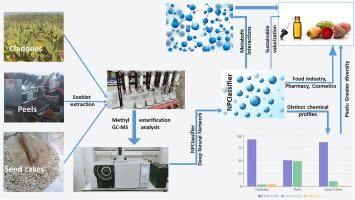
This study aimed to characterize the chemical composition of by-products from Opuntia ficus-indica (cladodes, peels, and seed cakes) using gas chromatography-mass spectrometry (GC–MS) to explore their valorization potential. The by-products were subjected to extraction and transesterification before analysis. A deep learning approach, NPClassifier (Natural Products Classifier), was applied to categorize volatile organic compounds (VOCs) by metabolic pathways, superclasses, and classes, facilitating detailed comparisons across the three plant parts. The innovative aspect of this study lies in the application of deep learning-derived classes to construct the molecular network. The analysis revealed a diverse range of VOCs, including fatty acids, terpenes, and alkaloids, with peels exhibiting the highest functional diversity. Specifically, fatty acids dominated in cladodes (91.06 %), terpenoids and steroids were prominent in peels (48.91 % and 29.91 %, respectively), and nitrogenous compounds characterized seed cakes. Diversity indices confirmed significant differences among samples, with peels showing the highest Shannon index (H = 3.26) and Simpson index (0.94), while cladodes had the lowest (H = 2.68, Simpson = 0.87). Multivariate statistical methods, such as Kruskal-Wallis tests and similarity analyses (Bray-Curtis and Jaccard), revealed that peels and cladodes were the most dissimilar at the class level (Jaccard = 1.59; Bray-Curtis = 1.74), while cladodes and seed cakes exhibited the highest similarity at the pathway level (Bray-Curtis = 0.17). These findings highlight the potential of Opuntia ficus-indica by-products, especially peels, for sustainable bio-industrial applications in cosmetics, pharmaceuticals, and agriculture.
期刊介绍:
The South African Journal of Botany publishes original papers that deal with the classification, biodiversity, morphology, physiology, molecular biology, ecology, biotechnology, ethnobotany and other botanically related aspects of species that are of importance to southern Africa. Manuscripts dealing with significant new findings on other species of the world and general botanical principles will also be considered and are encouraged.




 京公网安备 11010802042870号
京ICP备2023020795号-1
京公网安备 11010802042870号
京ICP备2023020795号-1

 分享
分享
 求助内容:
求助内容: 应助结果提醒方式:
 扫码关注我们
