Yiwen Zhang , Jiaqi Wen , Zhong Wu , Zhenbo Qin , Huiming Ji , Xinjun Liu , Wenbin Hu
{"title":"FeCo-金刚石类碳纳米复合膜的室温负磁阻,具有较高的耐腐蚀和抗菌性","authors":"Yiwen Zhang , Jiaqi Wen , Zhong Wu , Zhenbo Qin , Huiming Ji , Xinjun Liu , Wenbin Hu","doi":"10.1016/j.carbon.2025.120090","DOIUrl":null,"url":null,"abstract":"<div><div>Magnetic metal (Co, Fe, etc.)-diamond like carbon (DLC) nanocomposite film is promising for implantable magnetoresistance biosensor material, which requires room temperature (RT) tunneling magnetoresistance (TMR), high anticorrosion and antibiosis, simultaneously. However, carbonization of magnetic metals reduces saturation magnetization of films, which is a critical problem for realizing RT-TMR. In this study, introduction of FeCo alloy can effectively inhibit formation of Co carbides, which makes FeCo-DLC film has high saturation magnetization from 0.125 to 0.284 T, as FeCo content increasing from 45 to 64 at.%. Moreover, tunneling conduction paths of uniformly distributed FeCo particles have been obtained by sputtering-pressure controlling. Consequently, RT-TMR of -0.01% is innovatively realized in FeCo-DLC nanocomposite films. For anticorrosion, the microporous is the main cause of low corrosion resistance. Owing to microporous blocking effect of <em>sp</em><sup><em>2</em></sup> cluster enhanced by FeCo alloy, corrosion resistance of FeCo-DLC film reaches 2.5×10<sup>5</sup> Ω⋅cm<sup>2</sup>, which is 10 times higher than that of Co-DLC films. Meanwhile, as FeCo content increasing, higher <em>sp</em><sup><em>2</em></sup><em>/sp</em><sup><em>3</em></sup> ratio can reduce surface energy, and enhance hydrophobicity to prevent bacteria adsorption. Antibacterial rate exhibits significant increase from 59 to 92%. Integration of the multiple properties is realized in FeCo-DLC nanocomposite film for biosensor material.</div></div>","PeriodicalId":262,"journal":{"name":"Carbon","volume":"235 ","pages":"Article 120090"},"PeriodicalIF":11.6000,"publicationDate":"2025-02-04","publicationTypes":"Journal Article","fieldsOfStudy":null,"isOpenAccess":false,"openAccessPdf":"","citationCount":"0","resultStr":"{\"title\":\"Room-temperature negative magnetoresistance of FeCo- diamond like carbon nanocomposite film with high anticorrosion and antibiosis\",\"authors\":\"Yiwen Zhang , Jiaqi Wen , Zhong Wu , Zhenbo Qin , Huiming Ji , Xinjun Liu , Wenbin Hu\",\"doi\":\"10.1016/j.carbon.2025.120090\",\"DOIUrl\":null,\"url\":null,\"abstract\":\"<div><div>Magnetic metal (Co, Fe, etc.)-diamond like carbon (DLC) nanocomposite film is promising for implantable magnetoresistance biosensor material, which requires room temperature (RT) tunneling magnetoresistance (TMR), high anticorrosion and antibiosis, simultaneously. However, carbonization of magnetic metals reduces saturation magnetization of films, which is a critical problem for realizing RT-TMR. In this study, introduction of FeCo alloy can effectively inhibit formation of Co carbides, which makes FeCo-DLC film has high saturation magnetization from 0.125 to 0.284 T, as FeCo content increasing from 45 to 64 at.%. Moreover, tunneling conduction paths of uniformly distributed FeCo particles have been obtained by sputtering-pressure controlling. Consequently, RT-TMR of -0.01% is innovatively realized in FeCo-DLC nanocomposite films. For anticorrosion, the microporous is the main cause of low corrosion resistance. Owing to microporous blocking effect of <em>sp</em><sup><em>2</em></sup> cluster enhanced by FeCo alloy, corrosion resistance of FeCo-DLC film reaches 2.5×10<sup>5</sup> Ω⋅cm<sup>2</sup>, which is 10 times higher than that of Co-DLC films. Meanwhile, as FeCo content increasing, higher <em>sp</em><sup><em>2</em></sup><em>/sp</em><sup><em>3</em></sup> ratio can reduce surface energy, and enhance hydrophobicity to prevent bacteria adsorption. Antibacterial rate exhibits significant increase from 59 to 92%. Integration of the multiple properties is realized in FeCo-DLC nanocomposite film for biosensor material.</div></div>\",\"PeriodicalId\":262,\"journal\":{\"name\":\"Carbon\",\"volume\":\"235 \",\"pages\":\"Article 120090\"},\"PeriodicalIF\":11.6000,\"publicationDate\":\"2025-02-04\",\"publicationTypes\":\"Journal Article\",\"fieldsOfStudy\":null,\"isOpenAccess\":false,\"openAccessPdf\":\"\",\"citationCount\":\"0\",\"resultStr\":null,\"platform\":\"Semanticscholar\",\"paperid\":null,\"PeriodicalName\":\"Carbon\",\"FirstCategoryId\":\"88\",\"ListUrlMain\":\"https://www.sciencedirect.com/science/article/pii/S000862232500106X\",\"RegionNum\":2,\"RegionCategory\":\"材料科学\",\"ArticlePicture\":[],\"TitleCN\":null,\"AbstractTextCN\":null,\"PMCID\":null,\"EPubDate\":\"\",\"PubModel\":\"\",\"JCR\":\"Q1\",\"JCRName\":\"CHEMISTRY, PHYSICAL\",\"Score\":null,\"Total\":0}","platform":"Semanticscholar","paperid":null,"PeriodicalName":"Carbon","FirstCategoryId":"88","ListUrlMain":"https://www.sciencedirect.com/science/article/pii/S000862232500106X","RegionNum":2,"RegionCategory":"材料科学","ArticlePicture":[],"TitleCN":null,"AbstractTextCN":null,"PMCID":null,"EPubDate":"","PubModel":"","JCR":"Q1","JCRName":"CHEMISTRY, PHYSICAL","Score":null,"Total":0}
Room-temperature negative magnetoresistance of FeCo- diamond like carbon nanocomposite film with high anticorrosion and antibiosis
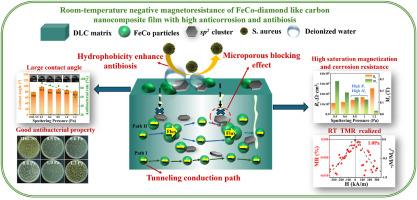
Magnetic metal (Co, Fe, etc.)-diamond like carbon (DLC) nanocomposite film is promising for implantable magnetoresistance biosensor material, which requires room temperature (RT) tunneling magnetoresistance (TMR), high anticorrosion and antibiosis, simultaneously. However, carbonization of magnetic metals reduces saturation magnetization of films, which is a critical problem for realizing RT-TMR. In this study, introduction of FeCo alloy can effectively inhibit formation of Co carbides, which makes FeCo-DLC film has high saturation magnetization from 0.125 to 0.284 T, as FeCo content increasing from 45 to 64 at.%. Moreover, tunneling conduction paths of uniformly distributed FeCo particles have been obtained by sputtering-pressure controlling. Consequently, RT-TMR of -0.01% is innovatively realized in FeCo-DLC nanocomposite films. For anticorrosion, the microporous is the main cause of low corrosion resistance. Owing to microporous blocking effect of sp2 cluster enhanced by FeCo alloy, corrosion resistance of FeCo-DLC film reaches 2.5×10⁵ Ω⋅cm2, which is 10 times higher than that of Co-DLC films. Meanwhile, as FeCo content increasing, higher sp2/sp3 ratio can reduce surface energy, and enhance hydrophobicity to prevent bacteria adsorption. Antibacterial rate exhibits significant increase from 59 to 92%. Integration of the multiple properties is realized in FeCo-DLC nanocomposite film for biosensor material.
期刊介绍:
The journal Carbon is an international multidisciplinary forum for communicating scientific advances in the field of carbon materials. It reports new findings related to the formation, structure, properties, behaviors, and technological applications of carbons. Carbons are a broad class of ordered or disordered solid phases composed primarily of elemental carbon, including but not limited to carbon black, carbon fibers and filaments, carbon nanotubes, diamond and diamond-like carbon, fullerenes, glassy carbon, graphite, graphene, graphene-oxide, porous carbons, pyrolytic carbon, and other sp2 and non-sp2 hybridized carbon systems. Carbon is the companion title to the open access journal Carbon Trends. Relevant application areas for carbon materials include biology and medicine, catalysis, electronic, optoelectronic, spintronic, high-frequency, and photonic devices, energy storage and conversion systems, environmental applications and water treatment, smart materials and systems, and structural and thermal applications.




 京公网安备 11010802042870号
京ICP备2023020795号-1
京公网安备 11010802042870号
京ICP备2023020795号-1

 分享
分享
 求助内容:
求助内容: 应助结果提醒方式:
 扫码关注我们
