Zunaira Shafiq , Mudassir Hussain Tahir , Syed Shoaib Ahmad Shah , Khalid M. Elhindi , Munaza Shah Din , Nadia Akram , Muhammad Ramzan Saeed Ashraf Janjua
{"title":"机器学习辅助设计具有多终端缺电子基团的小分子受体和下一代光伏电池的性能预测","authors":"Zunaira Shafiq , Mudassir Hussain Tahir , Syed Shoaib Ahmad Shah , Khalid M. Elhindi , Munaza Shah Din , Nadia Akram , Muhammad Ramzan Saeed Ashraf Janjua","doi":"10.1016/j.jssc.2025.125240","DOIUrl":null,"url":null,"abstract":"<div><div>Small molecule acceptors (SMAs) are extensively used in organic photovoltaics (OPVs) because of their capacity to efficiently receive electrons and enable charge separation. The performance of organic photovoltaic (OPV) devices can be enhanced by designing SMAs with several terminal electron-deficient groups, which will increase their electron-accepting capacity. However, it takes a lot of effort and time to rationally build such complicated molecules. In this work, a strategy for designing novel SMAs with numerous terminal electron-deficient groups is introduced. In order to predict the performance of newly designed SMAs, ML models have been employed that have been trained. Data on the power conversion efficiency (PCE) of 124 solar cell devices is collected. PCE's maximum value is taken into account. To compute molecular descriptors, utilize RDkit. A library of about 200 descriptors has been generated. The chemical similarity of the designed SMAs is studied using cluster plot and heatmap. For this purpose, chemical fingerprints are used. Using this method, thirty SMAs with highest PCE (%) ranges from 9.99 to 9.65 % have been selected.</div></div>","PeriodicalId":378,"journal":{"name":"Journal of Solid State Chemistry","volume":"345 ","pages":"Article 125240"},"PeriodicalIF":3.5000,"publicationDate":"2025-05-01","publicationTypes":"Journal Article","fieldsOfStudy":null,"isOpenAccess":false,"openAccessPdf":"","citationCount":"0","resultStr":"{\"title\":\"Machine learning assisted designing of small molecule acceptors with multiple terminal electron-deficient groups and performance prediction for next-generation photovoltaics\",\"authors\":\"Zunaira Shafiq , Mudassir Hussain Tahir , Syed Shoaib Ahmad Shah , Khalid M. Elhindi , Munaza Shah Din , Nadia Akram , Muhammad Ramzan Saeed Ashraf Janjua\",\"doi\":\"10.1016/j.jssc.2025.125240\",\"DOIUrl\":null,\"url\":null,\"abstract\":\"<div><div>Small molecule acceptors (SMAs) are extensively used in organic photovoltaics (OPVs) because of their capacity to efficiently receive electrons and enable charge separation. The performance of organic photovoltaic (OPV) devices can be enhanced by designing SMAs with several terminal electron-deficient groups, which will increase their electron-accepting capacity. However, it takes a lot of effort and time to rationally build such complicated molecules. In this work, a strategy for designing novel SMAs with numerous terminal electron-deficient groups is introduced. In order to predict the performance of newly designed SMAs, ML models have been employed that have been trained. Data on the power conversion efficiency (PCE) of 124 solar cell devices is collected. PCE's maximum value is taken into account. To compute molecular descriptors, utilize RDkit. A library of about 200 descriptors has been generated. The chemical similarity of the designed SMAs is studied using cluster plot and heatmap. For this purpose, chemical fingerprints are used. Using this method, thirty SMAs with highest PCE (%) ranges from 9.99 to 9.65 % have been selected.</div></div>\",\"PeriodicalId\":378,\"journal\":{\"name\":\"Journal of Solid State Chemistry\",\"volume\":\"345 \",\"pages\":\"Article 125240\"},\"PeriodicalIF\":3.5000,\"publicationDate\":\"2025-05-01\",\"publicationTypes\":\"Journal Article\",\"fieldsOfStudy\":null,\"isOpenAccess\":false,\"openAccessPdf\":\"\",\"citationCount\":\"0\",\"resultStr\":null,\"platform\":\"Semanticscholar\",\"paperid\":null,\"PeriodicalName\":\"Journal of Solid State Chemistry\",\"FirstCategoryId\":\"92\",\"ListUrlMain\":\"https://www.sciencedirect.com/science/article/pii/S0022459625000635\",\"RegionNum\":3,\"RegionCategory\":\"化学\",\"ArticlePicture\":[],\"TitleCN\":null,\"AbstractTextCN\":null,\"PMCID\":null,\"EPubDate\":\"2025/2/6 0:00:00\",\"PubModel\":\"Epub\",\"JCR\":\"Q2\",\"JCRName\":\"CHEMISTRY, INORGANIC & NUCLEAR\",\"Score\":null,\"Total\":0}","platform":"Semanticscholar","paperid":null,"PeriodicalName":"Journal of Solid State Chemistry","FirstCategoryId":"92","ListUrlMain":"https://www.sciencedirect.com/science/article/pii/S0022459625000635","RegionNum":3,"RegionCategory":"化学","ArticlePicture":[],"TitleCN":null,"AbstractTextCN":null,"PMCID":null,"EPubDate":"2025/2/6 0:00:00","PubModel":"Epub","JCR":"Q2","JCRName":"CHEMISTRY, INORGANIC & NUCLEAR","Score":null,"Total":0}
Machine learning assisted designing of small molecule acceptors with multiple terminal electron-deficient groups and performance prediction for next-generation photovoltaics
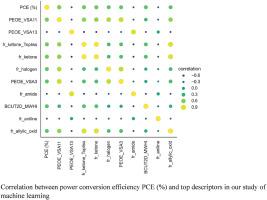
Small molecule acceptors (SMAs) are extensively used in organic photovoltaics (OPVs) because of their capacity to efficiently receive electrons and enable charge separation. The performance of organic photovoltaic (OPV) devices can be enhanced by designing SMAs with several terminal electron-deficient groups, which will increase their electron-accepting capacity. However, it takes a lot of effort and time to rationally build such complicated molecules. In this work, a strategy for designing novel SMAs with numerous terminal electron-deficient groups is introduced. In order to predict the performance of newly designed SMAs, ML models have been employed that have been trained. Data on the power conversion efficiency (PCE) of 124 solar cell devices is collected. PCE's maximum value is taken into account. To compute molecular descriptors, utilize RDkit. A library of about 200 descriptors has been generated. The chemical similarity of the designed SMAs is studied using cluster plot and heatmap. For this purpose, chemical fingerprints are used. Using this method, thirty SMAs with highest PCE (%) ranges from 9.99 to 9.65 % have been selected.
期刊介绍:
Covering major developments in the field of solid state chemistry and related areas such as ceramics and amorphous materials, the Journal of Solid State Chemistry features studies of chemical, structural, thermodynamic, electronic, magnetic, and optical properties and processes in solids.




 京公网安备 11010802042870号
京ICP备2023020795号-1
京公网安备 11010802042870号
京ICP备2023020795号-1

 分享
分享
 求助内容:
求助内容: 应助结果提醒方式:
 扫码关注我们
