{"title":"具有高爬坡能力的差动轮式移动机器人机构","authors":"Woojae Lee;Taehyun Kim;Jeongeun Kim;TaeWon Seo","doi":"10.1109/LRA.2025.3534681","DOIUrl":null,"url":null,"abstract":"Differential-driven wheeled mobile robots, such as logistics robots and mobile manipulators, are used for various tasks on flat ground. These differential-driven wheeled mobile robots are highly environmentally constrained when driven on flat ground. This study proposes a differential-driven wheeled mobile mechanism of the robot with high step-climbing ability and the capability to navigate narrow paths. This work shows that the novel wheel and differential-driven module improve the ability to climb stairs through the transfer of center of mass (C.O.M). A sub-wheel connected to the passive joint of the wheel is used to convert the drive into a vertical force to improve the mobile robot's ability to climb high stairs. By pitching the body of the wheel-powered robot through the advanced reaction force, the ability to climb stairs in reverse using the reaction force of the wall is improved. Furthermore, the proposed mechanism enables precise control of the robot's path, allowing it to effectively navigate narrow spaces. The prototype robot was tested for climbing stairs and high steps, as well as climbing a deformable slope while climbing obstacles. Even if the center of mass is located in the driving direction, this result uses a novel wheel to overcome the step in the front wheel and improve the overcoming performance of the rear wheel owing to the center-of-mass position in the driving direction. We expect that this method will be applicable to various differential-driven wheeled mobile robot mechanisms, especially for environments with confined spaces.","PeriodicalId":13241,"journal":{"name":"IEEE Robotics and Automation Letters","volume":"10 3","pages":"2702-2709"},"PeriodicalIF":5.3000,"publicationDate":"2025-01-29","publicationTypes":"Journal Article","fieldsOfStudy":null,"isOpenAccess":false,"openAccessPdf":"","citationCount":"0","resultStr":"{\"title\":\"Differential-Driven Wheeled Mobile Robot Mechanism With High Step-Climbing Ability\",\"authors\":\"Woojae Lee;Taehyun Kim;Jeongeun Kim;TaeWon Seo\",\"doi\":\"10.1109/LRA.2025.3534681\",\"DOIUrl\":null,\"url\":null,\"abstract\":\"Differential-driven wheeled mobile robots, such as logistics robots and mobile manipulators, are used for various tasks on flat ground. These differential-driven wheeled mobile robots are highly environmentally constrained when driven on flat ground. This study proposes a differential-driven wheeled mobile mechanism of the robot with high step-climbing ability and the capability to navigate narrow paths. This work shows that the novel wheel and differential-driven module improve the ability to climb stairs through the transfer of center of mass (C.O.M). A sub-wheel connected to the passive joint of the wheel is used to convert the drive into a vertical force to improve the mobile robot's ability to climb high stairs. By pitching the body of the wheel-powered robot through the advanced reaction force, the ability to climb stairs in reverse using the reaction force of the wall is improved. Furthermore, the proposed mechanism enables precise control of the robot's path, allowing it to effectively navigate narrow spaces. The prototype robot was tested for climbing stairs and high steps, as well as climbing a deformable slope while climbing obstacles. Even if the center of mass is located in the driving direction, this result uses a novel wheel to overcome the step in the front wheel and improve the overcoming performance of the rear wheel owing to the center-of-mass position in the driving direction. We expect that this method will be applicable to various differential-driven wheeled mobile robot mechanisms, especially for environments with confined spaces.\",\"PeriodicalId\":13241,\"journal\":{\"name\":\"IEEE Robotics and Automation Letters\",\"volume\":\"10 3\",\"pages\":\"2702-2709\"},\"PeriodicalIF\":5.3000,\"publicationDate\":\"2025-01-29\",\"publicationTypes\":\"Journal Article\",\"fieldsOfStudy\":null,\"isOpenAccess\":false,\"openAccessPdf\":\"\",\"citationCount\":\"0\",\"resultStr\":null,\"platform\":\"Semanticscholar\",\"paperid\":null,\"PeriodicalName\":\"IEEE Robotics and Automation Letters\",\"FirstCategoryId\":\"94\",\"ListUrlMain\":\"https://ieeexplore.ieee.org/document/10856826/\",\"RegionNum\":2,\"RegionCategory\":\"计算机科学\",\"ArticlePicture\":[],\"TitleCN\":null,\"AbstractTextCN\":null,\"PMCID\":null,\"EPubDate\":\"\",\"PubModel\":\"\",\"JCR\":\"Q2\",\"JCRName\":\"ROBOTICS\",\"Score\":null,\"Total\":0}","platform":"Semanticscholar","paperid":null,"PeriodicalName":"IEEE Robotics and Automation Letters","FirstCategoryId":"94","ListUrlMain":"https://ieeexplore.ieee.org/document/10856826/","RegionNum":2,"RegionCategory":"计算机科学","ArticlePicture":[],"TitleCN":null,"AbstractTextCN":null,"PMCID":null,"EPubDate":"","PubModel":"","JCR":"Q2","JCRName":"ROBOTICS","Score":null,"Total":0}
Differential-Driven Wheeled Mobile Robot Mechanism With High Step-Climbing Ability
Differential-driven wheeled mobile robots, such as logistics robots and mobile manipulators, are used for various tasks on flat ground. These differential-driven wheeled mobile robots are highly environmentally constrained when driven on flat ground. This study proposes a differential-driven wheeled mobile mechanism of the robot with high step-climbing ability and the capability to navigate narrow paths. This work shows that the novel wheel and differential-driven module improve the ability to climb stairs through the transfer of center of mass (C.O.M). A sub-wheel connected to the passive joint of the wheel is used to convert the drive into a vertical force to improve the mobile robot's ability to climb high stairs. By pitching the body of the wheel-powered robot through the advanced reaction force, the ability to climb stairs in reverse using the reaction force of the wall is improved. Furthermore, the proposed mechanism enables precise control of the robot's path, allowing it to effectively navigate narrow spaces. The prototype robot was tested for climbing stairs and high steps, as well as climbing a deformable slope while climbing obstacles. Even if the center of mass is located in the driving direction, this result uses a novel wheel to overcome the step in the front wheel and improve the overcoming performance of the rear wheel owing to the center-of-mass position in the driving direction. We expect that this method will be applicable to various differential-driven wheeled mobile robot mechanisms, especially for environments with confined spaces.
期刊介绍:
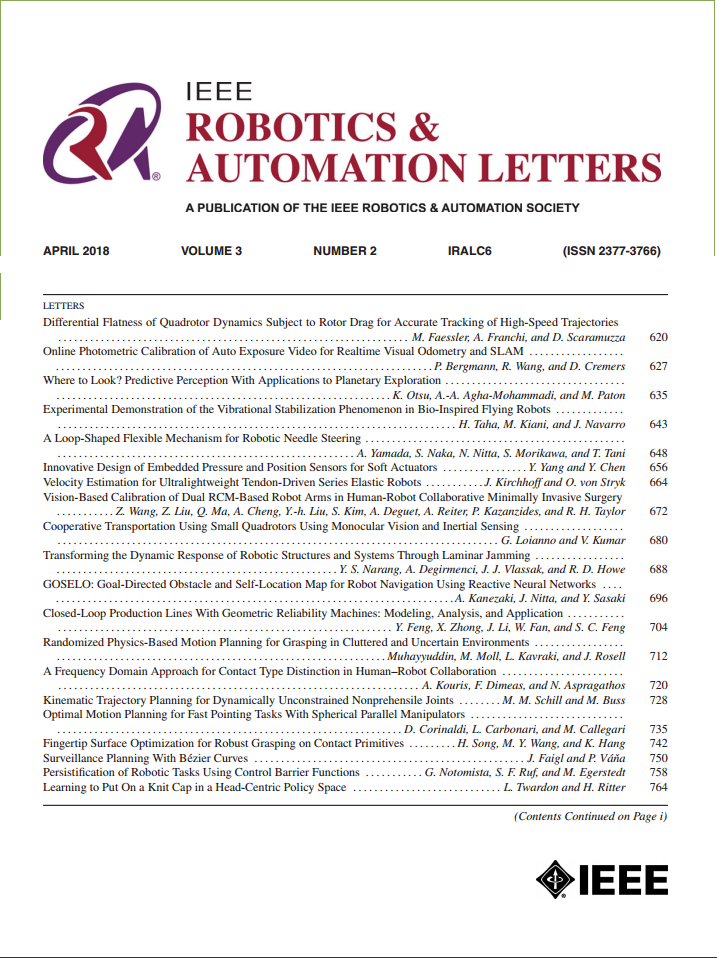
The scope of this journal is to publish peer-reviewed articles that provide a timely and concise account of innovative research ideas and application results, reporting significant theoretical findings and application case studies in areas of robotics and automation.




 京公网安备 11010802042870号
京ICP备2023020795号-1
京公网安备 11010802042870号
京ICP备2023020795号-1

 分享
分享
 求助内容:
求助内容: 应助结果提醒方式:
 扫码关注我们
